
Max-Capacity: Strengthening Social Privacy via Trust-Aware Link Prediction
Controlling privacy with trust-aware link prediction in online social networks
This paper introduces a capacity-based, trust-aware link prediction algorithm designed to identify trustworthy individuals in Online Social Networks (OSNs). By adapting the Advogato trust metric and incorporating weighted relationships (Max-Capacity), the authors improve the accuracy of friend recommendations and privacy control, outperforming traditional link prediction baselines like Jaccard and Common Neighbors.
TL;DR
Social Network Services (SNS) are balancing a fine line between open sharing and privacy protection. This paper proposes a Max-Capacity trust metric—a sophisticated evolution of the Advogato algorithm—that uses weighted relationships to predict trustworthy connections. By prioritizing "strong" ties over "weak" ones during network flow analysis, the method increases the discovery of reliable friends while significantly reducing exposure to malicious or distrusted users.
The Core Problem: The Trust Gap in Digital Socializing
In the physical world, we share secrets with family and weather talk with strangers. In early digital social networks, however, "friends" were often treated as a binary variable: you either had access to everything or nothing. This lack of nuance leads to two major issues:
- Privacy Fatigue: Users stop sharing rich content (photos, diaries) because they cannot effectively filter out unreliable acquaintances.
- Unreliable Linkage: Traditional link prediction (like "Common Neighbors") often suggests people who share mutual friends but aren't necessarily trustworthy, potentially introducing spammers or malicious actors into a private circle.
Methodology: Beyond Simple Connectivity
The researchers' primary innovation is transforming a social graph into a capacity-based flow network. Instead of just looking at who is connected to whom, the algorithm calculates how much "trust capacity" can flow from you (the seed) to others.
1. Weighting the Ties
The algorithm uses a normalized Jaccard coefficient to determine the strength () between users. The intuition is that if two people share a significant portion of their social circle relative to their total connections, their tie is inherently stronger.
2. Capacity Propagation
Trust is treated like a fluid. A seed node is given a total capacity (budget), which is then disseminated through the network. The capacity allocated to a neighbor depends on a decay factor (accounting for the "friend of a friend" distance) and the weight of the connection.
3. Capacity-First Max Flow
Unlike the standard Advogato algorithm that uses Breadth-First Search (BFS), this method uses a Capacity-First Search. It prioritizes paths with the highest remaining trust capacity. This serves as a filter: unreliable users act as "bottlenecks" that restrict flow, effectively pruning them from the predicted "Trust Group."

Experimental Results: Precision and Protection
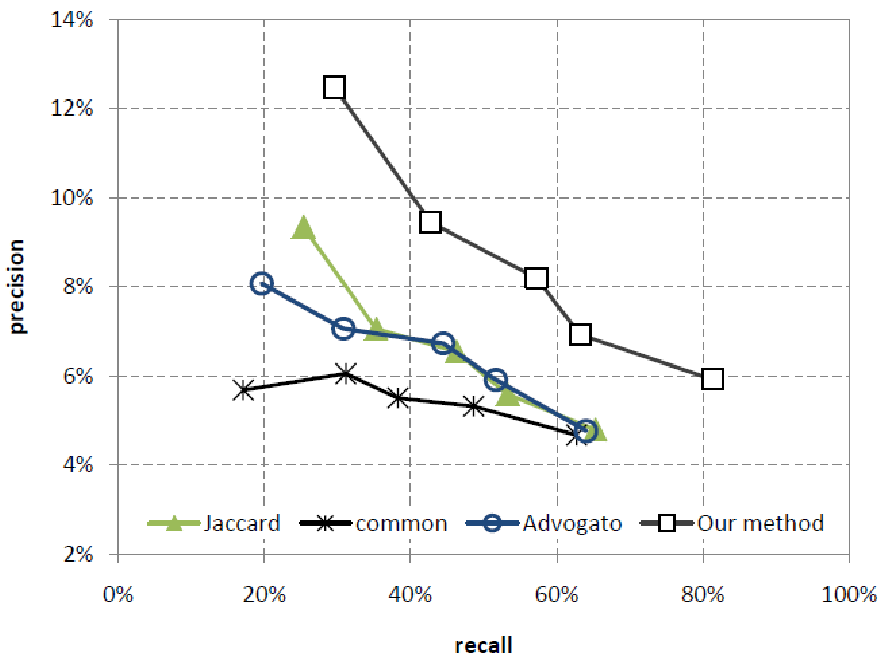
The authors tested their approach on the Epinions dataset, a social network where users explicitly mark others as "trust" or "distrust."
- Higher Accuracy: On the Precision-Recall curve, the Max-Capacity method consistently sits above the baselines. At the Top-5 recommendation level, it achieved nearly 10% higher recall than the standard Advogato implementation.
- Blocking Distrust: Perhaps more importantly for privacy, the "Error-Hit" rate (the frequency of recommending a user that was explicitly marked as "distrusted") was the lowest among all tested methods. In a Top-5 scenario, the Max-Capacity error rate was only 8.3%, compared to 17.2% for the Common Neighbors method.
Deep Insight: Why Capacity Works
The brilliance of the capacity-based approach lies in its attack resistance. In a standard graph search, a single malicious node can "infect" a neighborhood by connecting to many people. However, in a flow-based model, that malicious node is limited by its own incoming capacity. By weighting these capacities by the strength of the relationship (homophily), the authors created a self-correcting system where trust must be earned through shared social context, not just by spamming connection requests.
Conclusion
This work demonstrates that link prediction in social networks shouldn't just be about recommending more connections; it should be about curating trustworthy ones. By quantifying tie strength and applying network flow principles, we can build social platforms where "Sharing with Friends" actually means sharing with people you trust.
Future Outlook: As we move toward 2026 and beyond, integrating these trust metrics with decentralized social protocols (like Lens or Farcaster) could provide the technical foundation for truly "sovereign" privacy management.