
Mining the Partisan Divide: Automated Discovery of Political Conflict on Twitter
Controversial Topic Discovery on Members of Congress with Twitter
The paper proposes an unsupervised framework for discovering controversial topics between political communities by combining Latent Dirichlet Allocation (LDA) and sentiment analysis on Twitter data. The methodology was validated using tweets from the 112th U.S. House of Representatives, successfully identifying high-conflict issues like Obamacare and the 2013 government shutdown.
TL;DR
In an era of deep political polarization, understanding what drives conflict is as important as knowing who is involved. This paper introduces an unsupervised pipeline that leverages Latent Dirichlet Allocation (LDA) and lexicon-based sentiment analysis to automatically extract controversial topics from the tweets of U.S. Congress members. By aggregating tweets into community-specific documents, the researchers successfully bypassed the "short text problem" of Twitter, identifying real-world flashpoints like the 2013 government shutdown with striking accuracy.
Problem & Motivation: The Sparsity of Conflict
Traditional topic modeling often fails on Twitter because a 140-character (now 280) tweet doesn't provide enough context for algorithms to "understand" the latent theme. Previous research mostly looked at how many congressmen used Twitter, rather than the semantic content of their disagreements.
The authors' core insight was simple yet effective: Statistical Semantic Hypothesis. If you group tweets from the same community (Republicans vs. Democrats) that use the same hashtags, you create a "mega-document" large enough for statistical models like LDA to find meaningful patterns.
Methodology: From Tweets to Polarization Scores
The workflow follows a rigorous technical path:
- Data Collection: 500,000+ tweets were scraped from 377 influential Congress members (identified via Klout scores).
- Community Aggregation: Instead of treating each tweet as a document, they grouped tweets by party and shared features (hashtags like
#jobsor mentions like@politico). - LDA Topic Modeling: This unsupervised process surfaced weighted keywords representing the "themes" being discussed.
- Sentiment Calculation: Using SentiWordNet, the researchers calculated an average sentiment for each party on each topic.
- The Polarization Score: The ultimate metric was the absolute difference between the sentiments of the two parties. If Republicans were extremely negative and Democrats were extremely positive about a topic, it was flagged as "Controversial."
 Figure: The data collection and processing flow focused on Congressional influence.
Experiments & Results: Mapping the 2013 Crisis
The results were remarkably consistent with the 2013 news cycle. The model identified five primary zones of conflict:
- Obamacare (ACA): Represented by two opposing topics—Repubulicans focused on "insurance trainwrecks" while Democrats focused on "getting covered."
- The Government Shutdown: Successfully captured the
#GOPshutdownvs.#DemandAVoterhetoric. - The Keystone XL Pipeline: Highlighted a subtle divide where Republicans framed it as a "job" issue (
#4jobs), while Democrats pointedly avoided the employment narrative.
| Topic | Polarity Score | Key Terms |
|---|---|---|
| 1. Obamacare Rollout | 32760.57 | #obamacare, insurance, trainwreck |
| 2. ACA Enrollment | 14426.36 | #aca, #getcovered, care |
| 3. Shutdown | 3371.41 | #gopshutdown, #enoughalready |
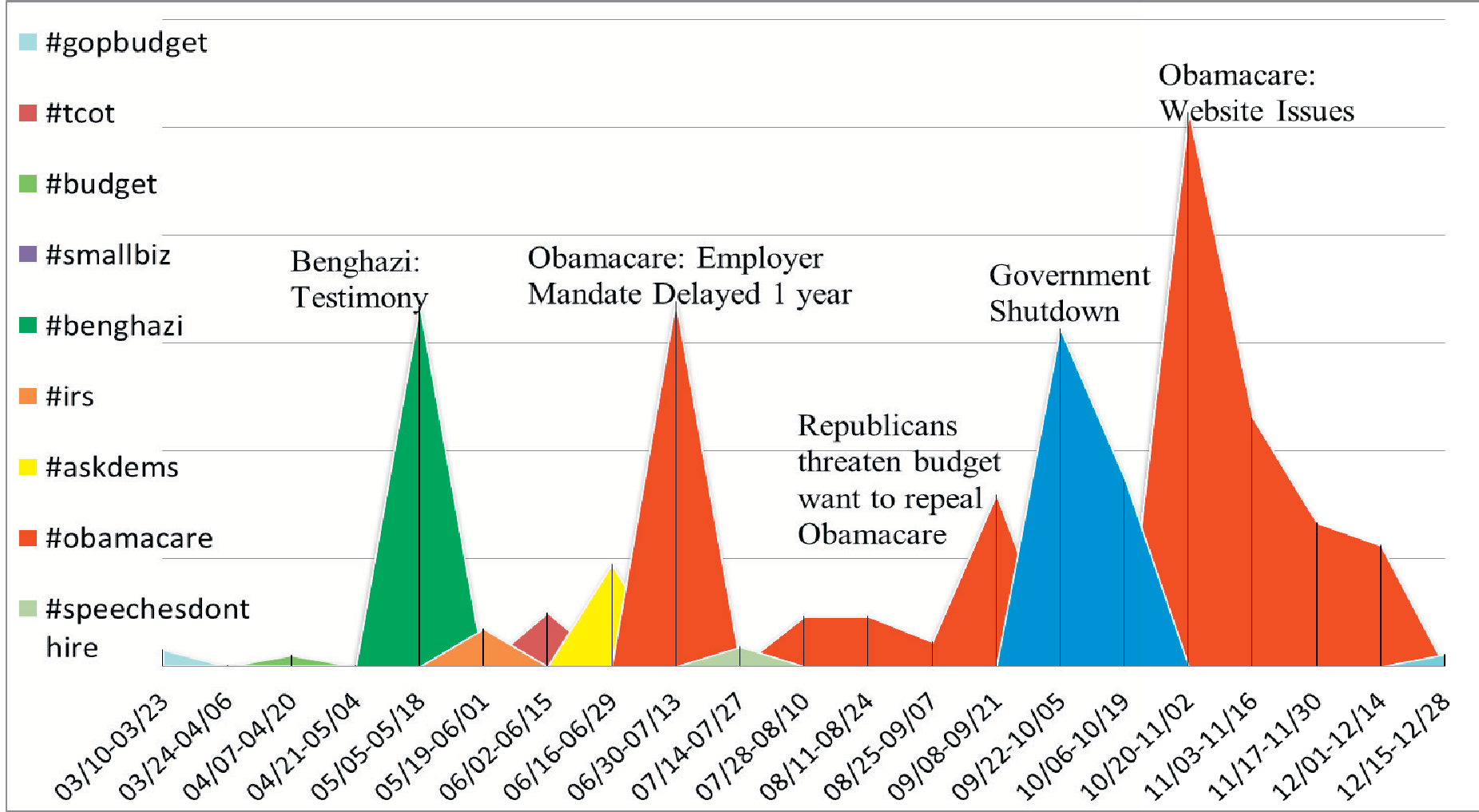 Visual Evidence: The "Conflict Timeline" shows sharp peaks corresponding precisely to the Benghazi testimony and the height of the budget crisis.
Critical Insight: Why Aggregation Matters
The most valuable contribution of this paper is the verification that Community-level Aggregation solves the sparsity problem of social media. By forcing the LDA model to see the "collective voice" of a party rather than individual rants, the noise is filtered out, leaving behind the core ideological pillars.
Future Outlook and Limitations
While the method is robust for known communities, its reliance on lexicon-based sentiment (SentiWordNet) is a weakness in the age of sarcasm and nuanced political dog-whistles. Modern LLMs (Large Language Models) like GPT-4 or Llama-3 could significantly improve the sentiment intensity detection. However, the author's long-term vision—using these "Disagreement Alerts" to predict potential real-world violence and unrest—remains a highly relevant (and increasingly urgent) research frontier.