
TrustZic: Solving the "He Said, She Said" Dilemma in Social Trust Networks
Controversy-Aware Hybrid Trust Inference in Online Social Networks
The paper introduces TrustZic, a hybrid trust inference algorithm designed for Online Social Networks (OSNs). It uniquely integrates local trust propagation with global reputation weights (PageRank-based) to resolve ambiguity in controversial scenarios where users receive conflicting trust evaluations.
TL;DR
Trust is the currency of Online Social Networks (OSNs), but what happens when your friends disagree? This paper presents TrustZic, a hybrid algorithm that resolves social "controversy" by weighting subjective local opinions with objective global reputation. In highly polarized scenarios, it improves trust decision accuracy (F-Score) by up to 92% over traditional baselines.
The Problem: The subjective Paradox
In a perfect world, trust is transitive: if Alice trusts Bob, and Bob trusts Charlie, Alice can likely trust Charlie. However, OSNs are messy. You might have two trusted friends, one who swears by a service provider and another who warns you to stay away. This is controversy.
Existing systems generally fall into two camps:
- Global Methods (Reputation): Like Google's PageRank, they provide a one-size-fits-all score. They lack personalization and "subjective bias."
- Local Methods (Inference): They follow specific paths from speaker to listener. While personalized, they become paralyzed when incoming paths provide contradictory signals of equal weight.
The authors argue that the missing link is Credibility. Not all opinions are equal; an opinion from a highly reputed "Global Master" should carry more weight than one from an unproven "Apprentice."
Methodology: Hybridizing Global Insight and Local Context
TrustZic operates through a sophisticated two-step pipeline that marries these two worlds.
Step 1: Global Reputation Ranking
The system first analyzes the entire graph structure to determine a base reputation for every user. This is done using a stochastic matrix and a PageRank-style power iteration.
Step 2: Reputation-Biased Propagation
This is where the magic happens. When inferring trust between two unconnected nodes, TrustZic doesn't just average the neighbors' opinions. It uses the global reputation calculated in Step 1 as a biasing factor.
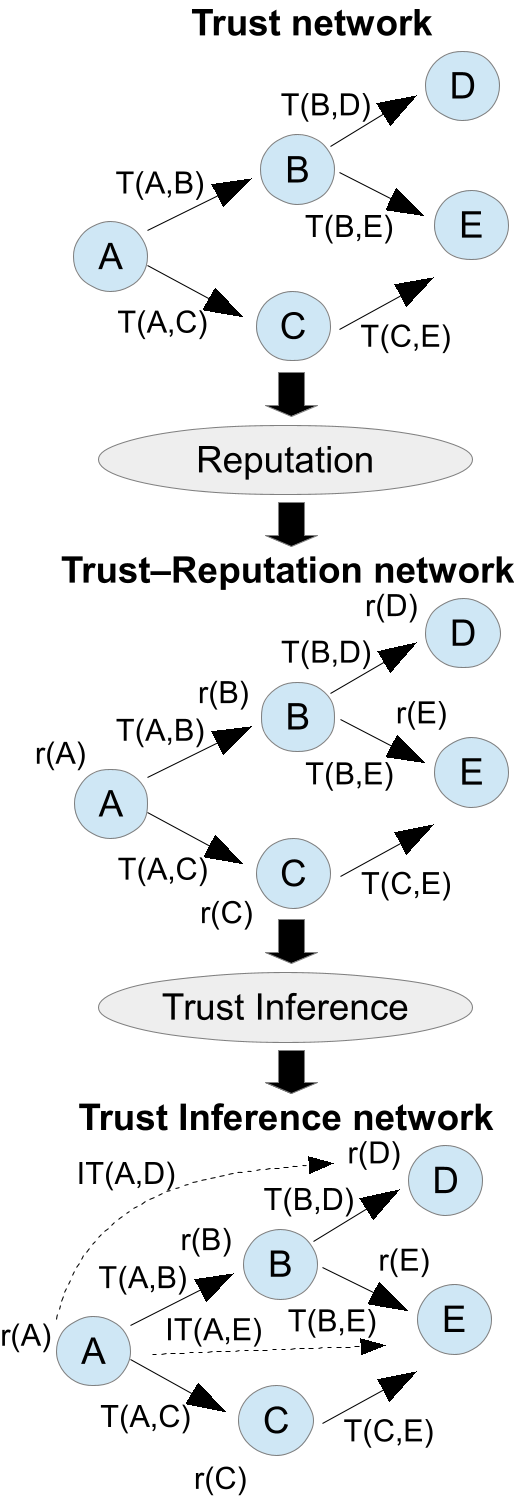 Fig. 1: The TrustZic workflow - transitioning from a flat trust network to a reputation-aware inference engine.
The recursive formula ensures that trust "decays" over distance but is amplified by the credibility of the intermediaries:
Here, is the global reputation of neighbor , acting as the "discernment criterion."
Proving the Point: Experimental Results
The authors tested TrustZic against TidalTrust (a popular local method) and NeighborTrust (a simple average baseline) using the Advogato dataset—a community of developers where users certify each other as "Master," "Journeyer," or "Apprentice."
Performance in the "Red Zone"
The paper categorizes results by the Normalized Trust Controversy (NTC). When NTC is low (everyone agrees), all methods perform similarly. However, as controversy increases (), TrustZic's superiority becomes undeniable.
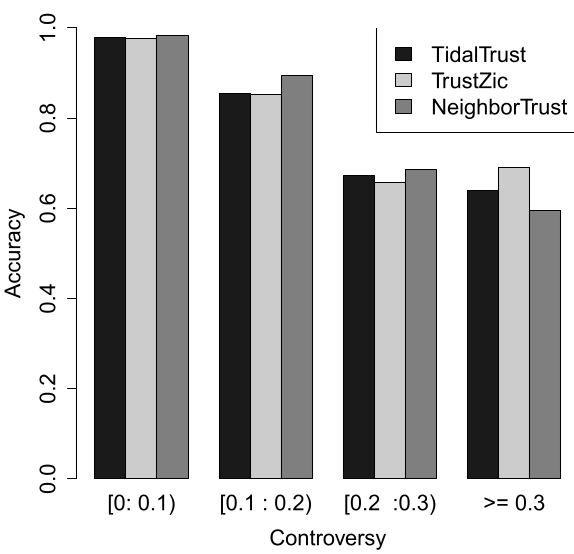 Fig. 2: Accuracy vs. Controversy at a high threshold (0.6). TrustZic maintains high performance where others collapse.
At higher decision thresholds (), the gap widens significantly. TrustZic achieved an F-Score nearly twice as high as NeighborTrust. This proves that global reputation is the most effective "tie-breaker" in controversial social debates.
Critical Insight & Conclusion
The brilliance of TrustZic lies in its Inductive Bias: it assumes that a person's standing in the entire community should validate their individual claims.
Takeaway for Practitioners: If you are building a recommendation or trust-based filter for a social platform, simple path-walking is not enough. To handle "toxic" or "polarized" targets, you must weight your users' edges by their global network importance.
Limitations: While effective, the recursive nature of Step 2 can be computationally expensive on massive graphs (like Twitter/X). Future work likely needs to explore approximation methods or GNN-based embeddings to maintain this "hybrid" advantage at scale.
Conclusion: TrustZic successfully bridges the gap between the "wisdom of the crowd" (Global) and "personal experience" (Local), providing a robust framework for navigation in the increasingly controversial landscape of modern OSNs.