
Beyond Convexity: Making SGD Resilient to Noisy Labels
On the Convergence of a Family of Robust Losses for Stochastic Gradient Descent
This paper introduces a family of robust loss functions designed specifically for Stochastic Gradient Descent (SGD) to mitigate the impact of noisy labels in large-scale classification. The core methods, Smooth Ramp Loss and Reversed Gompertz Loss, enable vanilla SGD to achieve state-of-the-art robustness while maintaining competitive convergence rates on massive datasets.
TL;DR
In real-world scenarios like crowdsourcing or automated user-behavior tagging, "ground truth" labels are often wrong. This paper introduces a family of Robust Losses (specifically Smooth Ramp and Reversed Gompertz losses) that allow Stochastic Gradient Descent (SGD) to ignore outliers. By replacing standard convex losses with these bounded alternatives, the authors achieve stable convergence even when 60% of the training labels are incorrect.
The Problem: The High Price of Convexity
Traditional machine learning favors convex losses (like Hinge loss for SVMs or Logistic loss) because they guarantee a global minimum. However, in the presence of noisy labels, convexity becomes a liability.
If a data point is mislabeled (an outlier), it sits far away from the decision boundary. Because convex losses grow as the error increases, these outliers generate massive gradients. In an SGD setting—where we update the model based on small batches—a single mislabeled point can "yank" the model's parameters in the wrong direction, slowing down convergence or causing the model to diverge entirely.
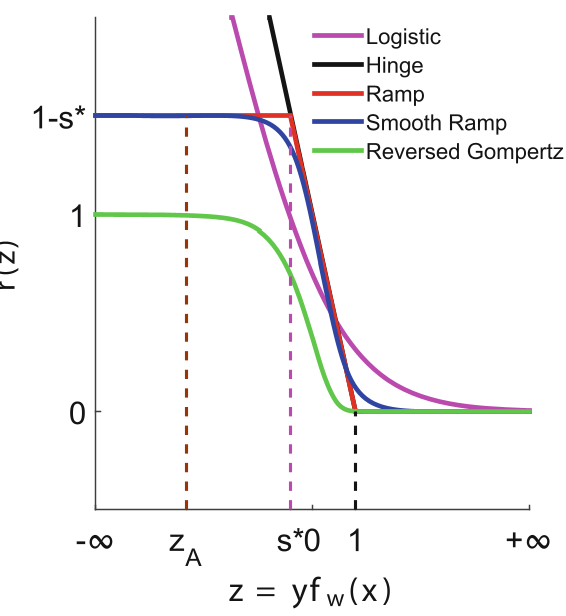 Fig 1. Left: An incorrectly labeled point 'A'. Right: Hinge loss (black) grows linearly with error, while robust losses (red/blue) plateau, effectively ignoring the outlier.
Methodology: Engineering the "Perfect" Robust Loss
The authors propose that for a loss function to be truly effective for SGD in noisy environments, it must satisfy three critical conditions:
- Upper Bound Condition: The gradient must go to zero as the error goes to infinity. This "truncates" the influence of outliers.
- Local Strong Convexity: To ensure the model converges quickly to a good local minimum.
- Smoothness: The function must be differentiable to allow standard gradient updates.
Two Primary Candidates:
- Smooth Ramp Loss: A "softened" version of the classic Ramp Loss. It uses a reversed sigmoid function to bridge the gap between robustness and optimizability.
- Reversed Gompertz Loss: Derived from the Gompertz function (often used in biology), this offers a different decay rate for the influence of noisy points.
Mathematical Insight: The Weighting Effect
The paper proves that these losses act as an automatic "re-weighter." When the model encounters a point that it is very confident is wrong (a likely noisy label), the effective weight () assigned to that point's gradient update automatically decreases.
The SGDRL algorithm (Algorithm 1) simplifies this into a unified update rule for both Smooth Ramp and Reversed Gompertz variants.
Experiments: Superior Progress Under Fire
The authors tested their methods against industry-standard baselines like LIBLINEAR and PEGASOS.
Key Findings:
- Fast Convergence: On the SUSY and IJCNN1 datasets, the robust SGD converged within 1–5 epochs, significantly faster than Hinge-based SGD.
- Resilience to High Noise: As label noise increased from 0% to 60%, the testing error of standard methods spiked or became highly volatile. In contrast, SGD(SRamp) and SGD(RGomp) remained relatively flat.
- Variable Stability: The variance of the testing error for robust losses was consistently lower, indicating that these models are less sensitive to which specific points are sampled in a mini-batch.
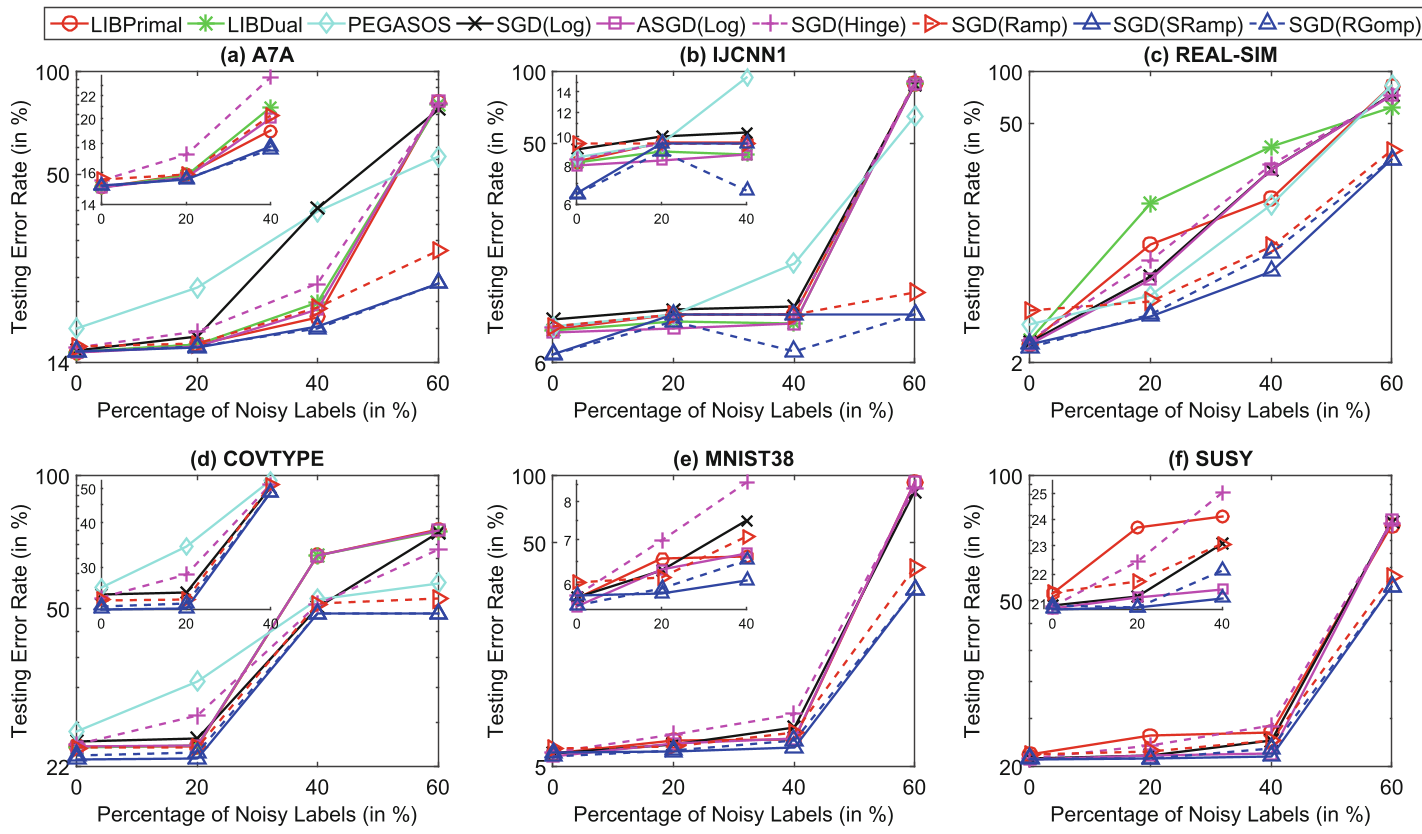 Fig 2. Testing error rates across different noise percentages. Note how the robust losses (bottom lines) stay lower and more stable as noise increases.
Critical Analysis & Conclusion
Takeaway
The beauty of this work lies in its theoretical rigor. It doesn't just provide a "trick" for noisy labels; it provides a convergence proof () under Augmented Restricted Strong Convexity (ARSC). This gives practitioners the confidence that switching to a non-convex robust loss won't lead to unpredictable optimization behavior.
Limitations
- Hyperparameter Tuning: While Reversed Gompertz is easier to tune, Smooth Ramp Loss requires careful selection of the parameter.
- Local Minima: Being non-convex, the starting initialization (though 0 worked well here) could theoretically impact results on more complex manifolds.
Future Outlook
This framework is ripe for extension into Deep Learning. As we move toward training on "found data" from the web (which is inherently noisy), embedding these robust loss characteristics directly into the backpropagation of Neural Networks could be a game-changer for large-scale foundation models.