
Harmonizing the Giants: A Converged Stack for Big Data and HPC in Precision Agriculture
Converging HPC, Big Data and Cloud Technologies for Precision Agriculture Data Analytics on Supercomputers
The paper presents a converged software architecture for the CYBELE EU project, integrating Kubernetes, Slurm/Torque, and Singularity to manage hybrid Big Data and HPC workflows. It specifically optimizes precision agriculture data analytics by bridging Cloud-native orchestration with supercomputing performance.
TL;DR
Modern data analytics, especially in Deep Learning, is outgrowing the capacity of standard Cloud VMs. This paper introduces a production-ready architecture from the CYBELE project that allows data scientists to trigger supercomputing (HPC) power using familiar Cloud-native tools (Kubernetes). By integrating Kubernetes, Slurm, and Singularity, the authors achieve a seamless workflow that scales precision agriculture models by orders of magnitude.
The "Cultural" Gap between Cloud and HPC
The research addresses a fundamental friction in modern computing:
- Big Data/Cloud emphasizes flexibility, ease of use through Docker, and elastic orchestration via Kubernetes.
- HPC (Supercomputing) focuses on raw performance, using batch schedulers like Slurm and bare-metal hardware.
The problem is that Big Data users find HPC environments "hostile" due to complex job scripts and lack of root access, while HPC admins find Cloud tools insecure. The CYBELE project bridges this gap by creating a translation layer that treats an HPC cluster as a "Virtual Node" within a Kubernetes cluster.
Methodology: The Convergence Architecture
The core innovation lies in the Meta-scheduling and Resource Abstraction layer.
1. The Orchestrator (Kubernetes)
Kubernetes acts as the brain. For Big Data tasks (web services, databases), it deploys Docker containers on VMs. For "heavy lifting" (AI training), it uses the wlm-operator to translate Kubernetes Pod requests into Slurm or Torque batch jobs.
2. The Bridge (Enhanced wlm-operator)
The authors extended the open-source wlm-operator to support:
- Multi-user Support: Crucially, it maps Kubernetes identities to HPC system users, ensuring that accounting and fair-share scheduling on the supercomputer remain intact.
- Virtual Kubelet: It presents Slurm partitions as virtual nodes to the Kubernetes API, allowing standard
kubectlcommands to control supercomputer resources.
3. The Payload (Singularity)
Because Docker poses security risks on HPC (root daemon), the system uses Singularity. Singularity containers run as the user, support MPI natively, and provide direct access to NVIDIA GPUs without performance overhead.
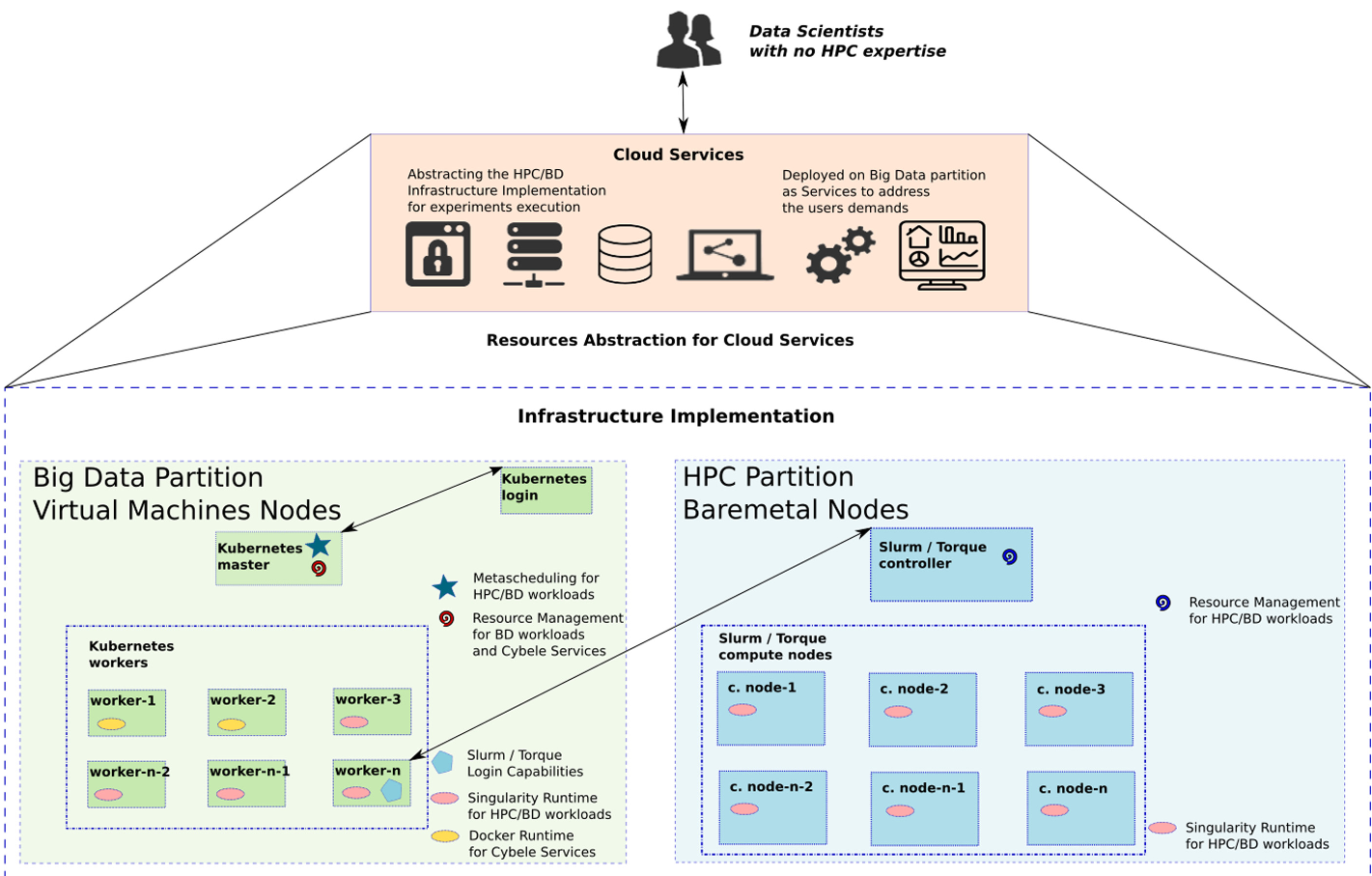 Figure 1: The CYBELE architecture showing the convergence of Cloud Services via Docker and HPC workloads via Singularity/Slurm.
Real-World Validation: Precision Agriculture
The authors tested the stack on a "Wheat Ear Counting" application—a Deep Learning model (Pytorch/Fastai) used to predict crop yields.
Key Results:
- HPC vs. Cloud VM: Moving the workload from a 4-CPU VM to a single HPC node resulted in a performance jump of 100x.
- GPU Scaling: On the HPC partition, simply enabling 1 GPU reduced time from 7020s (CPU) to 417s. Scaling to 4 GPUs further optimized the task to 247s.
 Table 1: Performance metrics across Virtual Machines and Bare Metal HPC nodes.
Critical Insight: Why This Matters
The breakthrough here isn't just the raw speed—it's the abstraction. A data scientist can keep their YAML-based workflow and "outsource" the heavy computation to a supercomputer without ever logging into a terminal or writing a Bash submission script.
Limitations and Future Work
- Identity Synchronization: While multi-user support is mentioned, the complexity of syncing LDAP/Active Directory with Kubernetes OIDC in a production supercomputing center remains a hurdle.
- Native API Evolution: The authors mention exploring the Slurm REST-API for future versions, which could potentially replace the custom operators for more standardized communication.
Conclusion
The CYBELE architecture proves that the democratization of HPC is possible through smart container orchestration. By using Kubernetes as a "meta-scheduler," we can provide the performance of a supercomputer with the agility of the cloud, paving the way for advanced Data Analytics in critical sectors like sustainable agriculture.