
TCOND: Beyond Keywords—Reconstructing the Full Fabric of Social Conversations
Conversation Analysis on Social Networking Sites
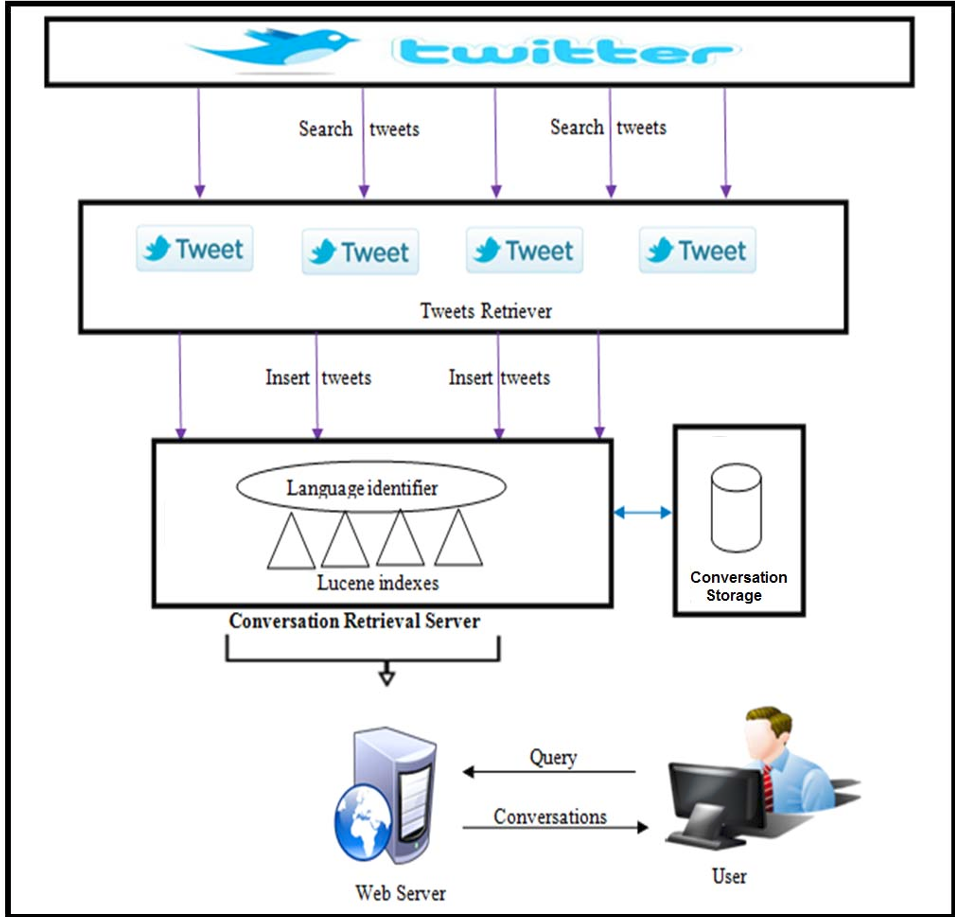
This paper introduces TCOND (Twitter Conversation Detector), a retrieval system designed to reconstruct full social discussions by combining explicit "reply-to" metadata with implicit content-based features. Unlike traditional search engines, TCOND identifies both direct interpersonal exchanges and indirect topic-related interactions to provide a comprehensive discussion context.
TL;DR
While traditional search engines treat tweets as isolated data points, the TCOND (Twitter Conversation Detector) system treats them as nodes in a complex, multi-threaded discussion. By merging explicit metadata (the "reply-to" field) with implicit signals (URL sharing, timing, and content similarity), this method outperforms Google and Twitter’s native search in delivering contextually rich results, achieving an average P@10 improvement of over 10%.
The "Isolated Tweet" Problem
The fundamental limitation of current Social Networking Site (SNS) search is the lack of context. If you search for a trending topic, you get a list of messages sorted by time or relevance, but you miss the argument, the interaction, and the evolution of the story.
Prior work typically focused on "reply-chains" using the @username tag. However, the authors argue that this is too narrow. A true discussion includes people who mention the same URL, use common hashtags, or post about the same specific sub-event within a tight time window without necessarily tagging a specific user.
Methodology: The TCOND Architecture
The TCOND system moves away from simple keyword matching toward a structured Discussion Reconstruction.
1. Direct Conversation Detection
The system utilizes two parallel algorithms to map the explicit backbone of a conversation:
- Recursive Root Finder: Given any tweet, it traverses backward through the
in_reply_to_status_idfield until it finds the "Root" (the original post). - Iterative Search: Once the root is found, it searches forward to find all descendants (replies to replies) that branched out from that origin.
2. Conversational Feature Enrichment
To capture the implicit conversation—those who are "talking about it" but not "replying to him"—the authors introduce a similarity function based on:
- Shared Infrastructure: Matching URLs and Hashtags.
- Spatio-Temporal Proximity: Using Euclidean distance for publication dates and absolute time differences to filter out unrelated noise.
- Semantic Alignment: TF-IDF cosine similarity to ensure the text remains on-topic.
Experimental Results & Insights
The authors tested TCOND against industry giants—Google and Twitter Search—on two major events: the 100th Tour de France and the death of Douglas Engelbart (inventor of the mouse).
| System | P@10 (Avg %) | NDCG@10 (Avg %) |
|---|---|---|
| 58.46 | 56.44 | |
| 64.25 | 59.08 | |
| TCOND | 70.27 | 63.62 |
Experimental results show TCOND consistently provides more relevant "conversational clusters" than traditional flat search results.
Key Discoveries in Conversation Dynamics:
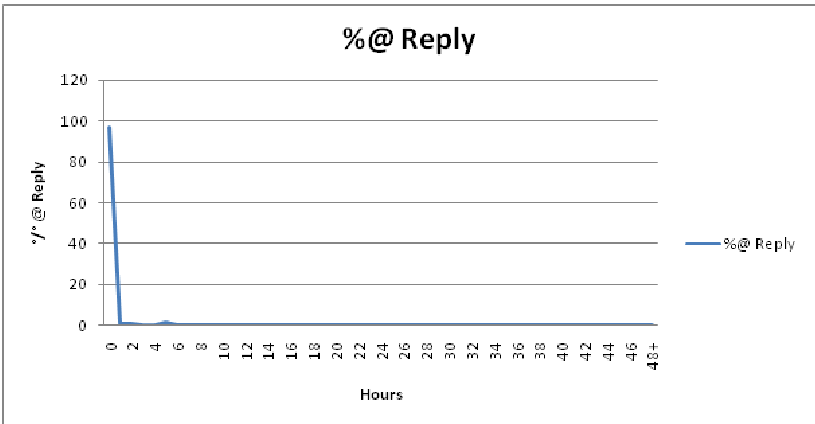
- The "One-Hour" Rule: 97.87% of all replies occur within the first hour of the original tweet. If a conversation doesn't gain traction within 5 hours, it is essentially "dead."
- Complexity: Most Twitter conversations are surprisingly shallow—84.8% have only one reply, and only 1.53% reach a depth of three levels or more.
Critical Analysis & Conclusion
TCOND represents a shift from Information Retrieval to Interaction Retrieval. By proving that implicit features (like URLs and timing) are just as critical as explicit links, the paper sets a blueprint for modern "Thread" detectors.
Limitations: The reliance on TF-IDF might struggle with the slang and brevity of microblogs compared to more modern Embedding-based (LLM) approaches. Additionally, the system currently treats "likes" and "retweets" as simple popularity metrics rather than structural nodes.
Future Outlook: Transitioning this framework to handle real-time, multi-platform data (e.g., cross-posting between Twitter and Reddit) would be the logical next step in mapping the unified "global conversation."