
Conversational Tagging: Deciphering the "Micro-Meme" Logic of Twitter
Conversational tagging in twitter
This paper introduces the concept of "Conversational Tagging" by analyzing over 42 million Twitter hashtags and comparing them with 378 million Delicious tags. It identifies a unique phenomenon called "micro-memes"—short-lived, social hashtags used for real-time participation rather than long-term information retrieval.
TL;DR
In 2010, researchers from the University of Washington identified a fundamental shift in how we categorize information online. Unlike the "organizational tagging" of the early web (bookmarks and libraries), Twitter birthed Conversational Tagging. This study reveals that hashtags like #igrewupon are not meant for filing—they are invitations to a global, real-time party known as a micro-meme.
The Problem: Why Tag Something You'll Never Search For?
In the mid-2000s, tagging was about recall. You tagged a link on Delicious so you could find it three months later. But Twitter introduced a paradox: users were spending precious characters (from their 140-character limit) to add hashtags to "ephemeral" status updates.
The researchers realized that prior work on social tagging couldn't explain this. In Twitter, tagging is often a priori—the tag exists first, and the tweet is written specifically to join the tag's stream. This is the opposite of the traditional "distill the content into a keyword" approach.
Methodology: Beyond the Surface of Trends
To understand this, the authors compared two massive datasets:
- Twitter: 42 million hashtags (2008-2009).
- Delicious: 378 million tags (2006-2007).
They didn't just look at what was "trending." They applied statistical "moments" to the timestamps of these tags to see how they "breathed" over time.
The Anatomy of a Micro-Meme
The authors coined the term micro-meme to describe a hashtag that:
- Explodes in popularity within hours.
- Serves as a "prompt" (e.g.,
#willgetyouslapped). - Disappears almost entirely within a few days.
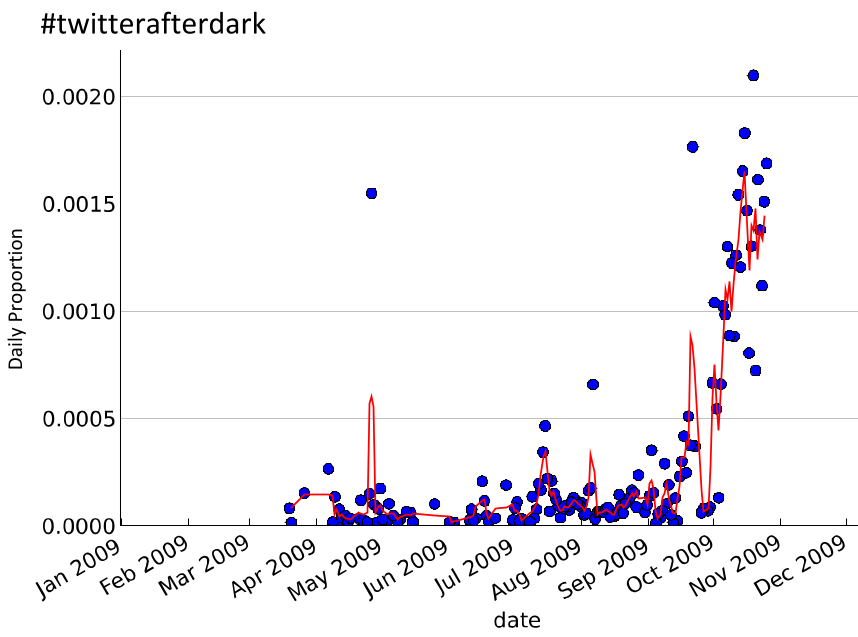 Figure: Comparison of Skewness (Adoption vs. Abandonment) in tag lifecycles.
Technical Deep Dive: Moments of Tagging
The study uses three key metrics to differentiate "Conversational" tags from "Organizational" ones:
- Standard Deviation (): Measures the spread. Micro-memes have ultra-low values (less than 1.0), meaning their entire lifecycle is compressed into a tiny window.
- Skew (): Measures the "viral" vs. "slow burn." A negative skew indicates a tag that was adopted instantly but abandoned slowly.
- Kurtosis (): Measures "staying power." High kurtosis represents a sharp, short peak—the hallmark of a participatory meme.
The Contrast Table
| Tag Type | Examples | Std Dev | Characteristic |
|---|---|---|---|
| Conversational | #ladiespleasestop, #clubrules | < 0.5 | High-intensity, short-lived "Prompts" |
| Organizational | #nsfw, #radio, #contest | > 70.0 | Steady, long-term categorization |
Key Experimental Results
The analysis showed that Twitter users were essentially using tags as a filtering mechanism to join "asynchronous massively multi-person conversations." While Delicious tags were stable over years, Twitter hashtags were "bursty."
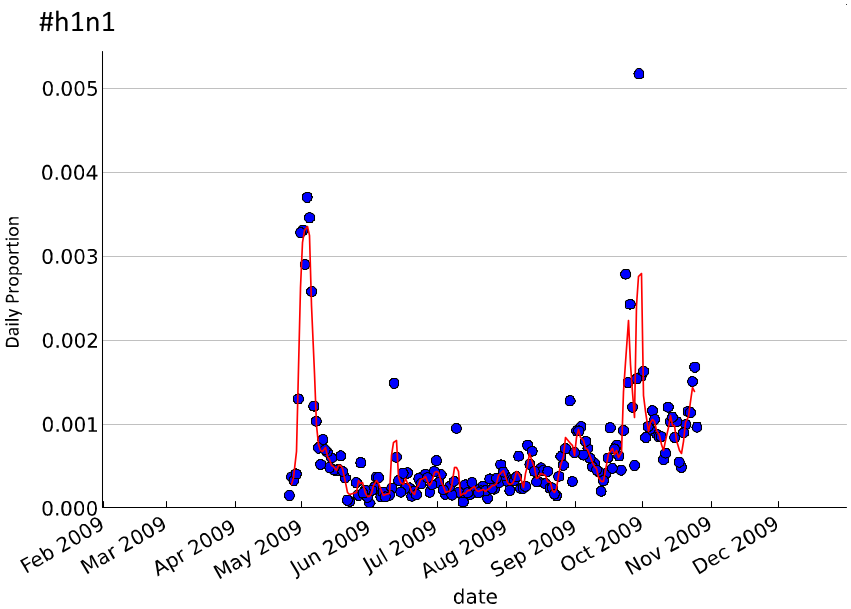 Figure: The "staying power" of the #h1n1 tag (broad interest) vs. the "spike" of #moonfruit (micro-meme).
Detailed statistical analysis revealed that tagging in Twitter is more about visibility in a stream than future retrieval. If you don't tag your tweet with the current micro-meme, it’s invisible to that specific ephemeral community.
Critical Analysis & Future Outlook
Takeaway
This paper was the first to formalize that metadata is not always for robots or archives—it's for social coordination. It transformed the hashtag from a technical indexing tool into a linguistic device (the "topic-comment" format).
Limitations
Published in 2010, the study couldn't foresee the rise of "Tag Hijacking" or the industrialization of "Trending Topics" by bots and marketers. It also focused on a 140-character environment; today's "long-form" social media might see a hybrid of conversational and organizational behavior.
Conclusion
For developers and researchers building real-time search engines or recommendation feeds, this work highlights a crucial design principle: Real-time systems need interfaces for "browsing the now" (the conversation), not just "retrieving the past" (the archive).