
Strategizing Awareness: A Convex Approach to Optimal Epidemic Control
A convex framework for optimal investment on disease awareness in social networks
The paper introduces a convex optimization framework to determine the cost-optimal distribution of disease awareness across social networks using the Heterogeneous SAIS (Susceptible-Alert-Infected-Susceptible) model. It identifies a spectral stability condition to ensure epidemic die-out and demonstrates that the resource allocation problem can be solved efficiently via Semidefinite Programming (SDP).
TL;DR
Epidemics aren't just biological; they are behavioral. This paper presents a mathematical framework to stop outbreaks not with vaccines, but with information. By extending the SIS model to include an "Alert" state (the SAIS model), the authors provide a Semidefinite Programming (SDP) solution to decide exactly how much to spend on educating each individual in a network to suppress a disease at the lowest possible cost.
Problem & Motivation: The Missing "Alert" State
Standard epidemic models like SIS (Susceptible-Infected-Susceptible) treat agents as passive entities. In reality, humans adapt. If your neighbor gets sick, you stay home or wear a mask—you become Aware.
The technical challenge lies in the heterogeneity of social networks. Every person has different contact levels (degrees) and different costs associated with bringing them to an "alert" state. Prior works often struggled with the trade-off between network complexity and computational tractability. How do we find a balance that guarantees the disease dies out without overspending?
Methodology: From Eigenvalues to Optimization
The core of the paper rests on a transition from differential equations to spectral graph theory.
1. The Heterogeneous SAIS Model
The authors define three states: Susceptible (), Alert (), and Infected (). The key insight is the reduction factor (where ): alert individuals are significantly less likely to be infected.
2. The Stability Threshold
The most critical contribution is Theorem 1, which provides the die-out condition: This formula connects the network's adjacency matrix () with diagonal matrices representing infection rates (), recovery rates (), and awareness parameters (). Essentially, if the largest eigenvalue of this "system matrix" is negative, the epidemic is guaranteed to vanish.
3. Turning Non-Convex into Convex
The problem of minimizing subject to the spectral constraint is natively difficult. However, the authors use a linear-fractional transformation (a clever change of variables) to map the problem into a Semidefinite Program (SDP).
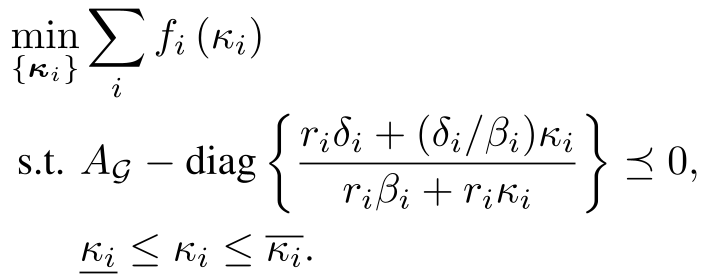 Figure: The reformulated optimization problem using Quasiconvex constraints.
Experiments & Results: The Degree Correlation
The authors tested their framework on a real-world online social network. The optimization wasn't just a theoretical exercise; it yielded concrete investment strategies.
Key Finding: There is a strong, non-linear correlation between a node's degree (number of contacts) and the optimal investment made into their awareness. Highly connected "super-spreaders" require more resources to keep the network safe, but the SDP finds the exact point of diminishing returns.
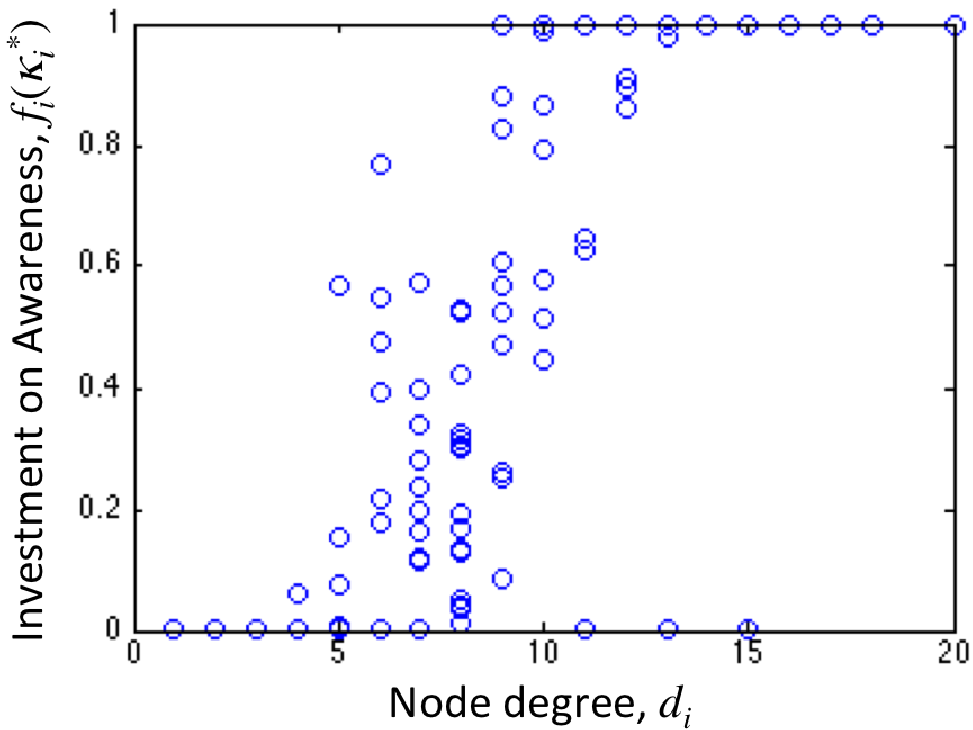 Figure: Scatter plot demonstrating that optimal investment levels (fi) are intrinsically linked to node degrees (di).
Critical Analysis & Conclusion
Takeaway
This work shifts the paradigm of epidemic control from "blanket policies" to targeted, cost-effective resource allocation. By proving the problem is convex, the authors ensure that global optima can be found efficiently even for large networks.
Limitations
- Mean-Field Assumption: The model relies on the first-order mean-field approximation, which may lose accuracy in networks with high clustering or small-world cycles.
- Static Topology: The contact network is assumed to be static, whereas real-world social contacts are dynamic and time-varying.
Future Outlook
The "Awareness" framework is highly versatile. It could be applied to cybersecurity (patching nodes), financial contagion (liquidity alerts), or even combating misinformation (fact-checking highly connected accounts). The math of the SAIS model provides a robust foundation for any network process where a "protective state" can be induced by external investment.