
Deciphering Demographics: Can 1D-CNNs Predict Who You Are From Your App Usage?
Convolutional Neural Networks on Multichannel Time Series of Smartphone Applications for Gender or Age Range Classification
The paper presents a 1D Convolutional Neural Network (CNN) framework for predicting user demographics (gender and age) using multichannel time-series data of smartphone application usage durations. By treating different app categories as distinct input channels, the model achieves a gender classification accuracy of 64.0% and an age range accuracy of 38.5% on Japanese market data.
TL;DR
This research explores the power of 1D Convolutional Neural Networks (CNNs) to predict a user's gender and age range solely based on how long they spend on various smartphone applications (SNS, Games, and Tools) throughout the day. By treating app categories as multiple "channels" in a time series, the authors demonstrate that temporal behavior is a viable proxy for demographic identity, achieving a 64% accuracy in gender prediction—a crucial capability for privacy-conscious digital marketing.
Background: The Marketing Information Gap
In the modern digital landscape, marketers often sit on mountains of log data (when and for how long an app was used) but lack the "ground truth" of who the user is. Traditional demographic inference relied on manual feature engineering or simple statistical models that ignored the rhythm of usage. Since human behavior is inherently cyclical and periodic, the authors turned to CNNs, which excel at detecting patterns in localized regions of data—in this case, segments of time.
Methodology: Multichannel Temporal Perception
The core of the approach is the transformation of raw logs into a Multichannel Time Series.
- Input Construction: Connection durations were aggregated hourly.
- Architecture: The model utilizes 5 convolutional layers and average pooling. Unlike image-based CNNs (2D), this uses 1D kernels specifically designed to slide across the time dimension.
- The "Channel" Insight: Instead of looking at a single app type, the model treats SNS, Games, and Tools as parallel channels (similar to RGB channels in an image). This allows the CNN to learn, for example, if a specific pattern of "Tool" use followed by "SNS" use at night is indicative of a specific demographic.
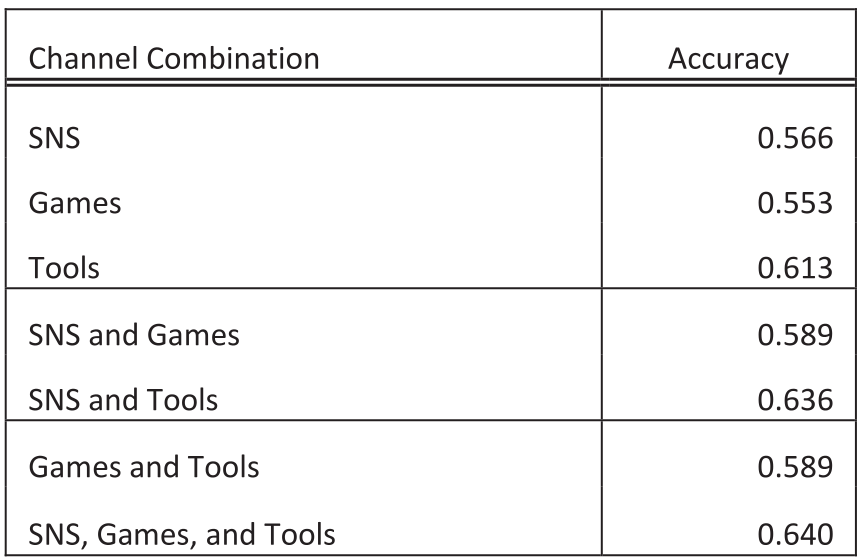 (Note: Table showing that combining channels consistently improves accuracy)
Experiments & Results
The study utilized the Intage Single Source Panel (i-SSP), a high-quality dataset of over 17,000 Japanese users.
1. Gender Classification: The Power of "Tools"
Surprisingly, the "Tools" category was a stronger predictor of gender (61.3% accuracy) than "Games" (55.3%). When the researchers combined all three channels (SNS+Games+Tools), accuracy peaked at 64.0%. This proves that demographic traits are not found in one specific action, but in the interplay between different types of digital behaviors.
2. Age Range: The "Mid-Life" Confusion
Age prediction proved significantly harder (38.5% accuracy). While the model was proficient at identifying the 20-29 and 50-69 age groups, it struggled with the "middle" ranges (30-49).
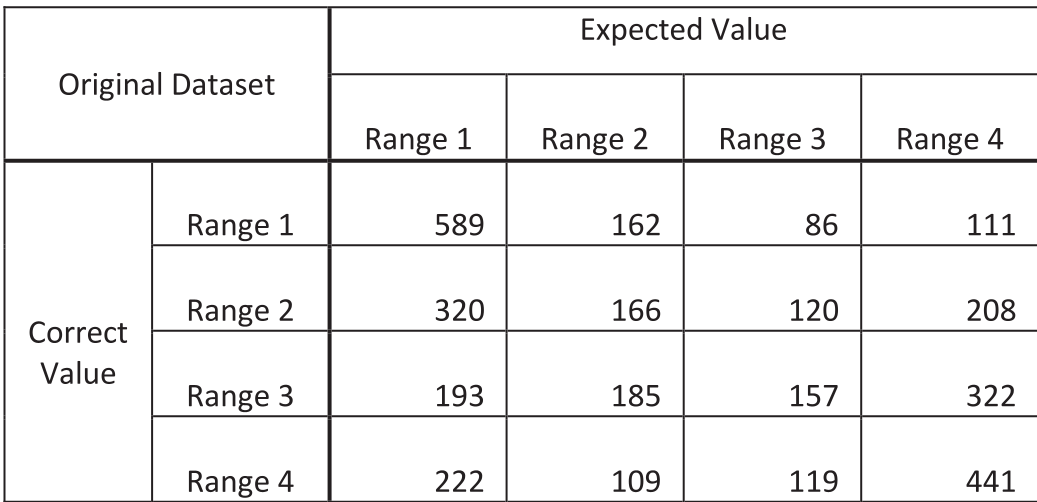
As seen in the Confusion Matrix (Table III), Range 2 and Range 3 users often exhibit overlapping app usage behaviors, suggesting that lifestyle patterns for people in their 30s and 40s are increasingly homogenized in the mobile era.
Critical Analysis & Conclusion
The Takeaway: 1D-CNNs effectively capture the "digital fingerprint" of gender through temporal usage logs. The success of the multichannel approach suggests that future models should incorporate even more diverse data streams (e.g., e-commerce logs or location data) to further refine predictions.
Limitations:
- Black Box Nature: While accurate, the CNN doesn't explicitly tell marketers why a certain pattern indicates a male user in his 20s.
- Age Overlap: The high variability in "Range 3" (40-49 years old) suggests that duration alone might not be enough; the content or context of the app usage may be required for higher precision.
Future Outlook: This research paves the way for "Privacy-Preserving Targeted Marketing," where demographics can be inferred locally on a device to provide personalized experiences without ever uploading sensitive personal identification to the cloud.
References:
- Kondo, H., & Kondo, F. N. (2020). Convolutional Neural Networks on Multichannel Time Series of Smartphone Applications.