
CA-SC: Building the Dream Team in Spatial Crowdsourcing via Game Theory
Cooperation-Aware Task Assignment in Spatial Crowdsourcing
The paper introduces the Cooperation-Aware Spatial Crowdsourcing (CA-SC) problem, which aims to assign multiple workers to location-based, time-constrained tasks while maximizing the total cooperation quality. It proposes a Task-Priority Greedy (TPG) approach and a Game Theoretic (GT) framework, achieving near-optimal performance (up to 97% of the upper bound) on real-world and synthetic datasets.
TL;DR
Spatial crowdsourcing is evolving from "one worker, one task" to collaborative efforts like event catering or logistics. This paper tackles the Cooperation-Aware Spatial Crowdsourcing (CA-SC) problem: how to assign worker groups to tasks to ensure they actually work well together. By proving the problem is an Exact Potential Game, the authors introduce a Game Theoretic approach that ensures a stable, high-quality assignment where no worker benefits from switching teams unilaterally.
The Problem: The "Synergy Gap" in Crowdsourcing
Most platforms like Uber or TaskRabbit treat workers as independent units. However, many real-world tasks require teamwork. If you assign two workers who have never met or have a history of poor collaboration to move heavy furniture, the "cooperation quality" drops, resulting in delays or "free-rider" behavior.
The challenge is that maximizing global cooperation quality is NP-hard (reducible from the k-set packing problem). We aren't just matching locations; we are searching for optimal cliques in a dynamic graph of human relationships.
Methodology: Synergy as a Potential Game
The researchers' key insight is that the task assignment can be framed as a strategic game where workers are "players."
1. Defining Cooperation Quality
The cooperation score between two workers and is a weighted balance of a base quality and their historical synergy (ratings from tasks they've completed together):
2. The Game Mechanics
The paper proves that CA-SC is a Potential Game. This is a massive theoretical win. In a potential game, any change in an individual's utility is reflected in a global "potential function." This guarantees that if workers keep choosing the task that is best for them (the Best-Response), the system will eventually settle into a Nash Equilibrium.
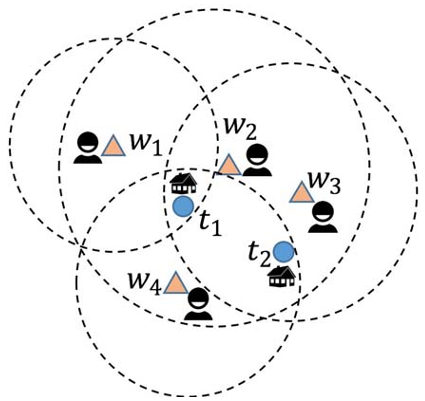 Figure 1: Illustration of how worker locations and relationship graphs influence assignment.
3. Optimization: LUB and TSI
To make this run in real-time, the authors introduced:
- Lazy-Updating (LUB): Only recalculate a worker's best-response if their current team changes in a way that actually impacts their utility (supported by Theorems V.3 and V.4).
- Threshold Stop (TSI): Stopping the iteration when the marginal gain in global synergy falls below a certain , dramatically speeding up convergence.
Experimental Performance
The authors tested their methods against MFLOW (Maximum Flow) and RAND (Random) baselines.
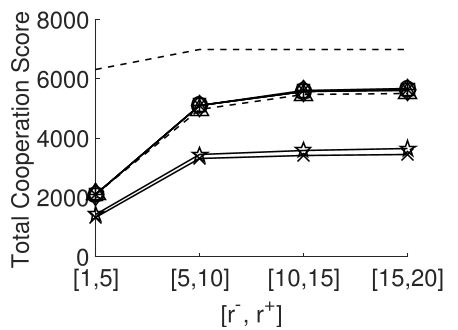 Figure 2: Performance on Meetup datasets showing the superiority of GT (Game Theoretic) models in total cooperation score.
Key Results:
- Revenue Quality: The GT approach reached approximately 97% of the theoretical upper bound in synthetic tests.
- Efficiency: Despite the NP-hard nature, the optimized GT+ALL variant processed thousands of workers within seconds, making it viable for production environments.
- Scalability: As the number of workers () increased, the gap between GT and the baselines widened, proving that synergy-aware models become more critical as crowds grow.
Critical Insight: Cooperation is the New Constraint
This paper shifts the focus of Spatial Crowdsourcing from "minimizing distance" to "maximizing synergy." By proving the existence of a Nash Equilibrium in this context, the authors provide a bridge between social network analysis and spatial optimization.
Limitations & Future Work
- Dynamics: The current model uses a batch-based approach. A fully online version (handling workers arriving in real-time) remains a challenge.
- Privacy: Calculating synergy requires historical collaboration data, which may raise privacy concerns regarding worker interaction logs.
In conclusion, the CA-SC framework demonstrates that when we treat crowdsourcing as a social system rather than just a logistical one, we can achieve significantly higher service quality without sacrificing computational efficiency.