
The Economics of Digital Piracy: Coalition Games in Multimedia Fingerprinting
9835_Cooperation and Coalition in Multimedia Fingerprinting Colluder Social Networks.
This paper presents a game-theoretic framework to analyze user dynamics in multimedia fingerprinting social networks, specifically focusing on how colluders form coalitions. It investigates the trade-off between the risk of detection and the rewards of illegal content usage using orthogonal fingerprinting and scalable video coding (SVC) as a case study.
TL;DR
Is more always better for attackers? Conventional wisdom in multimedia forensics suggests that as more individuals collude to average out their digital fingerprints, their risk of being caught drops toward zero. This paper by Zhao et al. flips the script by introducing the Utility of Piracy. By modeling attackers as rational actors who want to maximize profit while minimizing risk, the authors prove that colluder groups have an "equilibrium size." Beyond this size, adding more members actually hurts the individual attacker’s bottom line.
Problem & Motivation: The Missing Dimension of "Reward"
In the world of Fingerprinting Forensics, we label content with unique codes to trace traitors. Colluders fight back by "averaging" their copies to drown out these fingerprints.
Previous studies focused almost exclusively on the Risk (Probability of Detection, ). In those models, the optimal strategy for an attacker is simple: find as many accomplices as possible. However, Zhao et al. argue that attackers aren't just trying to survive; they are trying to profit. Whether it's the resale value of a pirated DVD or the social capital of sharing a leaked high-def video, there is a Reward (). If 1,000 people collude, the reward is split 1,000 ways.
The paper addresses two critical questions:
- When does the risk outweigh the reward (Feasability)?
- With whom should you collude to maximize your specific payoff (Coalition Formation)?
Methodology: Game Theory Meets Scalable Video Coding
The researchers utilize Scalable Video Coding (SVC), which splits video into a Base Layer (low quality) and Enhancement Layers (high quality). This creates a hierarchy of attackers: some have the "good stuff," while others have the "basic stuff."
The Utility Function
The core of the model is the expected payoff :
u^{(i)} = - P_d^{(i)} L^{(i)} + (1 - P_d^{(i)}) R^{(i)}$$ Where $L$ is the loss if caught and $R$ is the reward. ### Multi-Resolution Bargaining When attackers with different resolutions meet, a conflict arises. High-resolution users risk more because their fingerprints are embedded across more data. The paper models this as a **two-player game** between subgroups. They use a parameter $\beta$ to control how much "weight" the base layer carries in the final colluded copy.  *The table above summarizes the parameters used to balance resolutions and risk across the base and enhancement layers.* ## Key Insights: The Optimum Group Size The most striking result is the "Bell Curve" of utility. In a same-resolution scenario, an attacker's utility initially increases as they add more partners (because the risk $P_d$ drops rapidly). However, as $P_d$ approaches zero, the benefit of adding more people vanishes, but the **reward dilution** continue. 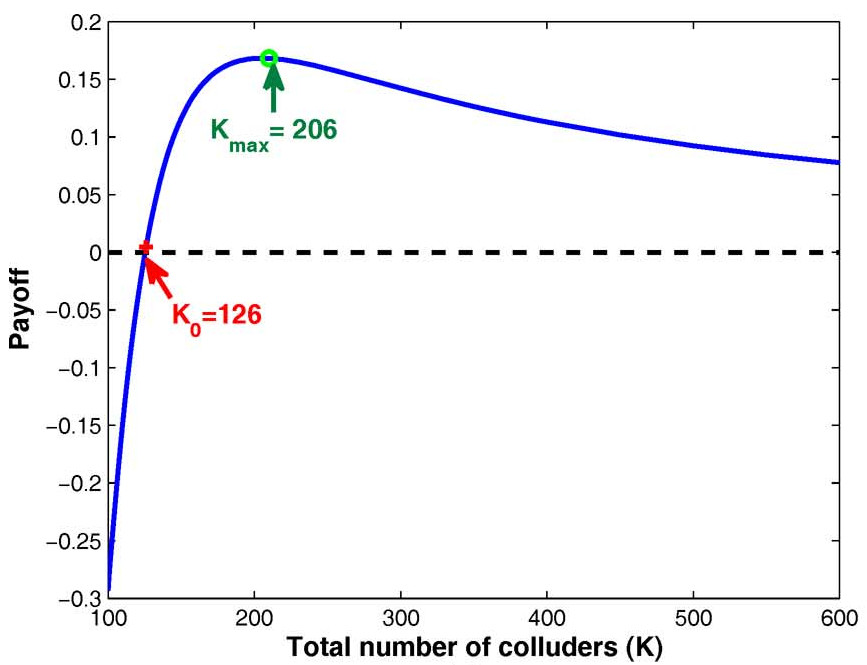 *As seen in Fig 1, the utility ($ u$) peaks and then declines. Attackers will only cooperate if the group size is within the "sweet spot" (e.g., between 125 and 206 members in this simulation).* ### Strategies for Coalition The paper analyzes different ways colluders might settle their "shares": * **Absolute Fairness**: Everyone gets the same utility. * **MaxSum Fairness**: Maximize the total group profit. * **Nash Bargaining Solution (NBS)**: A compromise based on "bargaining power." Interestingly, the authors find that high-resolution attackers can often "profit" by including a few low-resolution attackers to further blur the base layer, provided they don't give away too much of the reward. ## Critical Analysis & Conclusion ### Takeaway for System Designers This research changes how we approach **Traitor Tracing**. Instead of designing for a "worst-case" scenario of thousands of colluders, defenders should realize that attackers are limited by their own greed. By understanding the expected profit margins of pirated content, enforcers can predict the most likely coalition sizes and tune their detectors to be most sensitive in those ranges. ### Limitations * **Fixed Reward Models**: The model assumes reward is split linearly or by a fixed ratio. In real social networks, "first-movers" or "distributors" might take much larger shares. * **Orthogonal Assumption**: The study relies on orthogonal fingerprints. In massive networks, we often use BIBD or Tardos codes, which may introduce different noise characteristics. ### Future Outlook As we move toward decentralization (Web3) and AI-generated content, the logic of "risk vs. reward" in content protection becomes even more granular. This paper provides the foundational math to bridge the gap between signal processing and social economics.