
CL-MSNL: Decoding User Interests Across Multiple Social Networks Through Cooperation Learning
8418_Cooperation Learning From Multiple Social Networks Consistent and Complementary Perspectives.
The paper introduces CL-MSNL (Cooperation Learning from Multiple Social Networks), a novel framework for fusing data from diverse platforms like Twitter, Facebook, and Quora. It achieves SOTA performance in user interest inference by simultaneously modeling source consistency, complementarity, and confidence.
TL;DR
With the average user managing over five social media accounts, our digital footprints are scattered across heterogeneous platforms like LinkedIn, Twitter, and Quora. This paper presents CL-MSNL, a cooperation learning framework that fuses these signals by balancing Source Consistency (shared traits) and Source Complementarity (unique cues). It doesn't just aggregate data; it intelligently filters task-unrelated noise and weights source reliability to achieve superior user interest inference.
The "Blind Men and the Elephant" Problem in Social Data
Current multisource fusion strategies suffer from a fundamental misunderstanding of social behavior.
- Early Fusion (concatenation) leads to the "dimensionality curse" and mixes semantic domains.
- Late Fusion (averaging results) ignores the inherent relatedness between sources.
The authors argue that a user is like an elephant seen by different observers: Twitter captures their opinions, LinkedIn their career, and Quora their expertise. To understand the "whole" user, we must recognize that some observations are the same (Consistency) while others fill in specific gaps (Complementarity).
Methodology: The Consistency-Complementarity Split
The core innovation of CL-MSNL lies in its objective function. Unlike standard models that treat a weight matrix as a single unit, CL-MSNL decomposes it:
- (Consistent Mapping): Forces the model to find common ground. If I talk about "Python" on Twitter and Quora, the results from and should agree.
- (Complementary Mapping): Uses a Group Lasso (-norm). This acts as a "smart filter," identifying which unique platform-specific features are actually helpful for a task (like "Programming") and which are just noise (like "Weather updates").
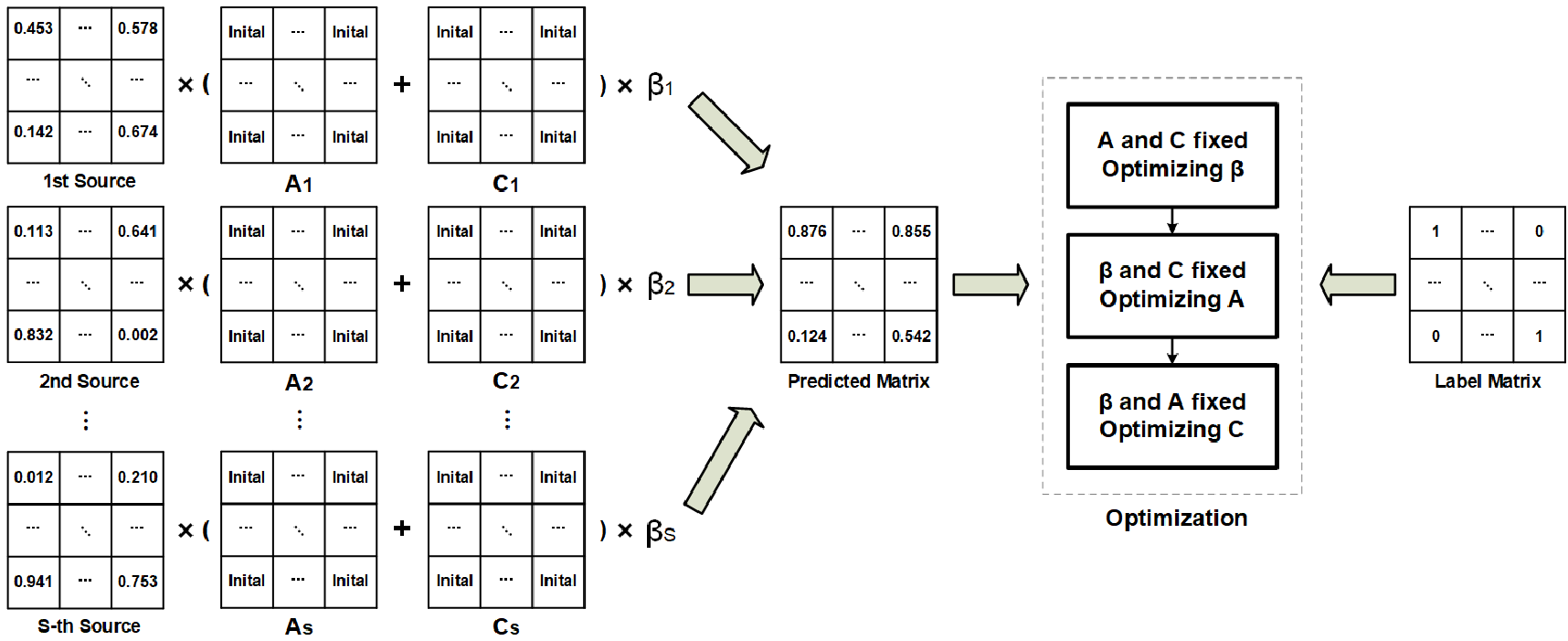 Fig 1: The overall workflow of the CL-MSNL method, showing the iterative optimization between source confidence (), consistent parts (), and complementary parts ().
Experimental Results: Precision Matters
The model was tested against 1,607 users with ground truth interests extracted from LinkedIn. It consistently beat state-of-the-art methods like MvDA-VC and CCMF.
| Metric | Ridge | MSNL | CL-MSNL (Ours) |
|---|---|---|---|
| P@2 | 0.160 | 0.186 | 0.205 |
| S@10 | 0.606 | 0.653 | 0.756 |
One of the most striking findings was the Source Discrimination analysis. The model automatically learned that Twitter was the most discriminative source for user interests, followed by Facebook and Quora.
 Fig 2: Comparison of the proposed model against variants, highlighting the necessity of combining consistency and complementarity.
Critical Insights: Why Consistency + Complementarity?
The ablation studies revealed a fascinating hierarchy:
- Consistency is the foundation: Modeling source agreement (noSC) provides a bigger boost than modeling complementarity alone (noSA).
- Complementarity is the enhancer: While consistency sets the baseline, adding the term (Group Lasso) allows the model to capture "long-tail" interests that only appear in specific contexts, leading to the overall SOTA performance.
Conclusion & Limitations
CL-MSNL moves beyond simple data merging into the realm of cooperative learning. It recognizes that social media sources are noisy, biased, but ultimately related.
Limitations: The current model assumes users are active across all networks. In the real world, "missing data" is a significant hurdle. Furthermore, while text features (LDA topics) were used here, the researchers acknowledge that moving toward Deep Representation Learning (e.g., BERT or CLIP features) could further unlock the potential of multi-network cooperation.
Final Takeaway: If you are building a recommendation engine or a user profiling tool, don't just dump all your data into one pot. Separate what is "universal" about your users from what is "context-specific."