
ICMOABC: Taming Uncertainty in Multiobjective Optimization via Cooperative Bee Colonies
Cooperative Artificial Bee Colony Algorithm With Multiple Populations for Interval Multiobjective Optimization Problems
This paper introduces the Interval Cooperative Multiobjective Artificial Bee Colony (ICMOABC) algorithm, a novel swarm intelligence approach designed for Interval Multiobjective Optimization Problems (IMOPs). It leverages a multiple-population framework (MPMO) and an enhanced interval credibility metric to handle objective uncertainty without increasing problem dimensionality.
TL;DR
In real-world engineering, parameters are rarely "exact"—they are intervals. The Interval Cooperative Multiobjective Artificial Bee Colony (ICMOABC) algorithm introduces a robust way to optimize multiple conflicting objectives under such uncertainty. By combining a cooperative multi-population structure with a specialized interval credibility metric, it achieves SOTA performance on benchmarks like ZDT and DTLZ with significantly higher stability than previous models.
The "Precision" Trap: Why Traditional MOO Fails
Most Multiobjective Optimization (MOO) research assumes a world of deterministic values. However, in risk assessment or structural design, noise and measurement errors turn "points" into "intervals."
Previous attempts to solve Interval Multiobjective Problems (IMOPs) suffered from two major flaws:
- Metric Failure: Methods like IP-dominance cannot distinguish between intervals if one is contained within another.
- Dimensionality Curse: Mean-Variance models solve uncertainty by doubling the number of objectives (adding variance to mean), which makes the Pareto front exponentially harder to find.
Methodology: The Architecture of ICMOABC
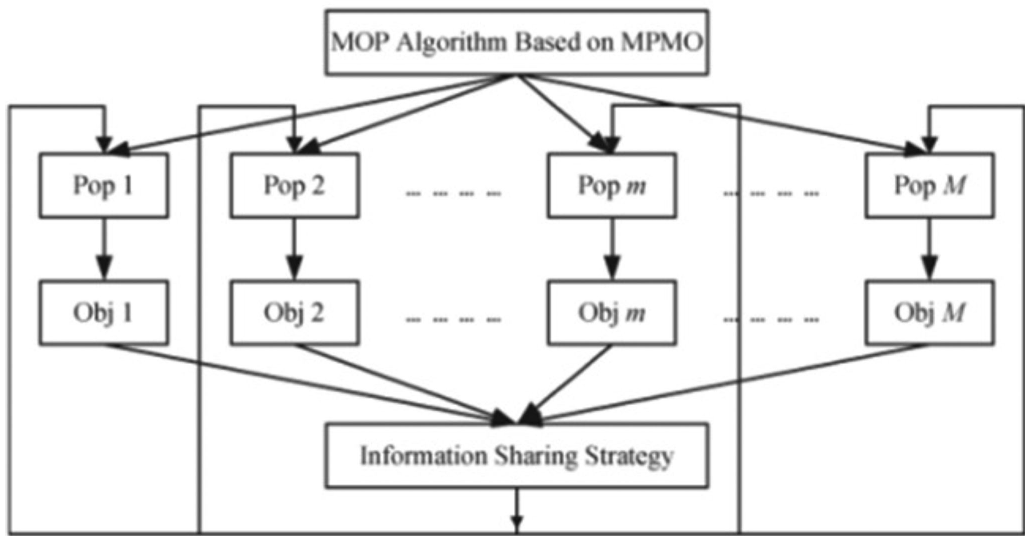
The core philosophy of ICMOABC is Cooperation. Instead of one population struggling with all objectives, the algorithm breaks the problem down.
1. Multiple Populations for Multiple Objectives (MPMO)
The system maintains subpopulations, where each subpopulation focuses on a single objective using the Artificial Bee Colony (ABC) logic. They don't work in isolation; they share a global archive to approximate the entire Pareto Front.
2. The Credibility-Based Dominance
Unlike traditional Pareto dominance, ICMOABC uses Interval Credibility. It calculates the "distance" between intervals to determine dominance probabilities. This allows the algorithm to handle overlapping intervals that would paralyze standard methods.
3. Enhanced Search Operators
The authors modified the standard ABC mutation operator to include a "social" component: This equation balances local exploitation with global exploration via the archive () and the subpopulation's best solution ().
Performance Benchmarks
The algorithm was tested against KI-IMOEA/D and IMOEA-IC on modified ZDT and DTLZ functions (the "I" variants denoting interval imprecision).
- Convergence (IH-Metric): ICMOABC consistently found solutions closer to the true Interval Pareto Front.
- Diversity (ISP-Metric): Thanks to the Elitist Learning Strategy (ELS) and crowding-distance-based selection, the solutions were more uniformly distributed across the front.
- Stability: On ZDT4_I (a notoriously difficult multimodal problem), ICMOABC showed significantly lower variance in results compared to its peers, indicating high reliability.
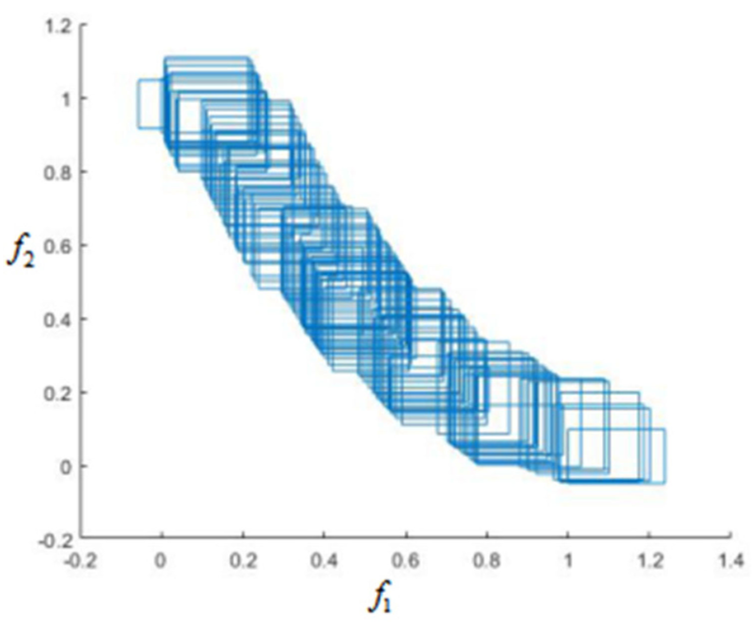 Figure: Final results on ZDT1_I. (a) ICMOABC shows a much denser and more accurate approximation of the front compared to (b) IMOEA-IC.
Deep Insights: The Power of Onlooker Bees
One of the paper's most salient points is the refinement of the Onlooker Bee probability calculation. In ICMOABC, the fitness is tied not just to the rank but also to the Crowding Operator. This ensures that "lonely" or "crowded" solutions are prioritized for re-optimization, preventing the algorithm from getting stuck in local optima—a common pitfall for ABC-based models.
Critical Analysis & Future Outlook
While ICMOABC is powerful, it is computationally intensive. The complexity is , which might be a bottleneck for extremely large-scale objectives. However, the authors correctly point out that the MPMO mechanism is inherently parallelizable. Moving this to a GPU-based parallel architecture could provide the speed needed for real-time engineering applications.
Takeaway: If your optimization problem involves "fuzzy" or uncertain data, stop using simple Pareto dominance. The transition to interval credibility and cooperative subpopulations is no longer just an academic exercise—it is a requirement for robust engineering.