
SPF: Navigating Social Selfishness in Mobile Networks via Cooperative Forwarding
A cooperative forwarding scheme for social preference-based selfishness in mobile social networks
This paper introduces the Social Preference-aware Forwarding (SPF) scheme, a cooperative routing protocol designed for Mobile Social Networks (MSNs) that accounts for "social preference-based selfishness." By integrating message content affinity and node community relationships into forwarding and buffer management, SPF achieves higher delivery ratios and lower network traffic than traditional Epidemic and PRoPHET protocols.
TL;DR
In the world of Mobile Social Networks (MSNs), nodes are just like people—selfish. They don't want to waste their precious buffer space on messages they don't "like." This paper introduces SPF (Social Preference-aware Forwarding), a protocol that turns this selfishness into a cooperative advantage by modeling message preferences and community ties, resulting in smarter forwarding decisions and optimized resource usage.
Background: The Myth of the Altruistic Node
Standard routing protocols for opportunistic networks, like Epidemic or PRoPHET, operate on a shaky assumption: that every node is a "good citizen" willing to store and carry any message for anyone. In reality, nodes (often mobile devices owned by individuals) have limited energy and storage.
The authors identify a critical gap: Social Preference. Just as you might be more willing to share a news article about your favorite hobby than a random advertisement, nodes in an MSN should have varying degrees of willingness to participate based on the message's subject and the community status of the sender.
The Core Innovation: Social Preference-based Selfishness
The paper categorizes node behavior into six degrees of preference, combining community relationship (Same/Different) and interest level (Like/Partially Like/Dislike).
- Same Community/Like: Keep and prioritize the message.
- Different Community/Dislike: Drop the message immediately to save space.
- The Buffer Strategy: If the buffer is full, the node replaces the oldest "Partially Like" message before touching "Like" messages.
1. Methodology: The Smart Forwarding Value
SPF doesn't just look at whether two nodes met; it calculates a Forwarding Value that balances two pillars:
- Contact Probability (): Calculated using refined degree centrality (how many people you meet) and inter-contact time (how recently you met them).
- Buffer Weight (): Represents the ratio of empty space. SPF avoids sending "Partially Like" messages to nodes with nearly full buffers to prevent immediate drops.
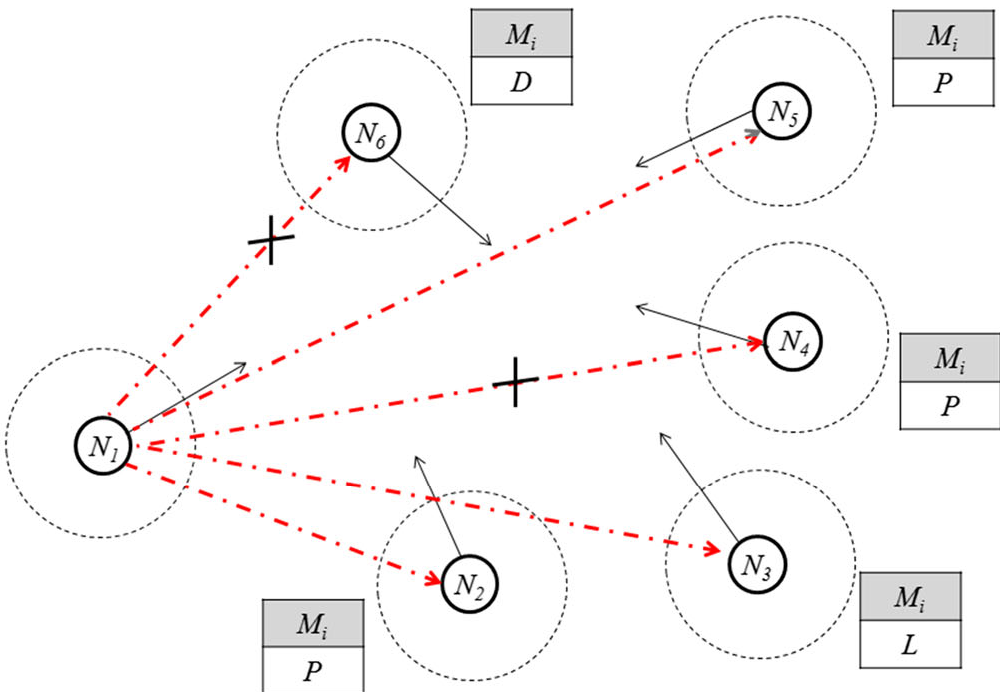 Figure 1: Example of the SPF forwarding process showing decisions based on community and buffer values.
2. Selfishness Detection through Snooping
Since nodes don't always broadcast their preferences, SPF implements a snooping mechanism. By observing the messages a relay node carries (the PrevID list), a neighbor can estimate that relay's preferences. If you see a node carrying "Physics" messages, you can infer it either "Likes" or "Partially Likes" Physics, making it a viable candidate for similar future traffic.
Experimental Showdown
The authors tested SPF against three heavyweight baselines: Epidemic, PRoPHET, and SimBet using the NS-2 simulator and the HCMM mobility model.
- Delivery Ratio: SPF maintains a superior delivery ratio even when nodes are selfish, as it avoids "black holes" (nodes that would drop the message).
- Network Traffic Efficiency: Unlike Epidemic, which floods the network, SPF is surgical. It only moves messages to nodes with a high probability of success and available buffer.
- Buffer Replacement: The preference-based replacement policy significantly reduces "Replacement Frequency," meaning messages that enter the network are much more likely to stay alive until they hit the destination.
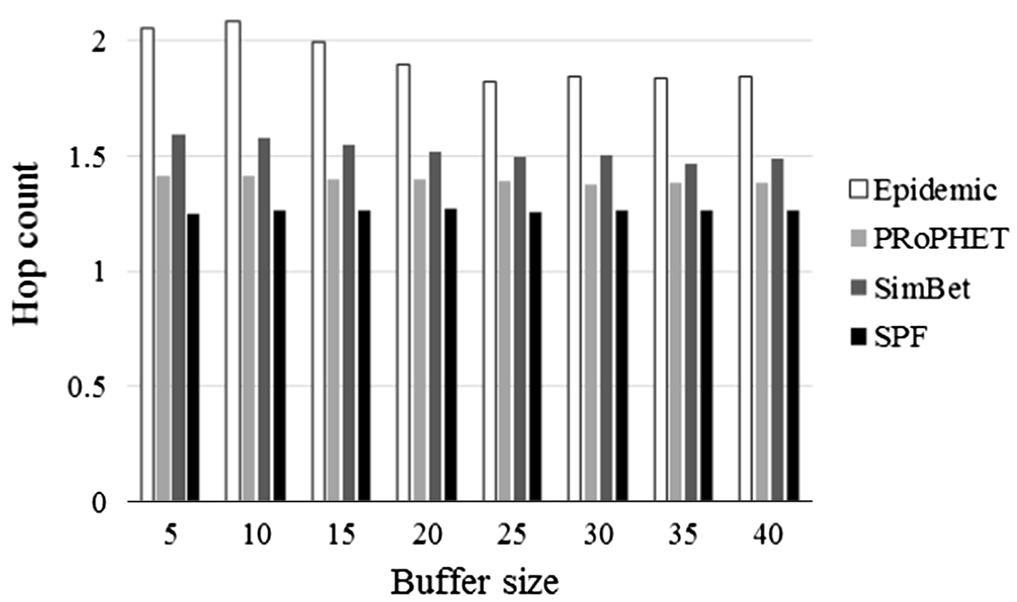 Figure 2: Impact of buffer size on delivery ratio and network traffic across different protocols.
Critical Insight: Why it Works
The "magic" of SPF lies in its Inductive Bias toward social structures. By recognizing that human movement is not random but clustered into "home communities" and driven by interests, the protocol mimics human cooperation. It effectively filters out "noise" (traffic that would be dropped anyway) before it even enters the wireless medium.
Conclusion & Future Outlook
SPF proves that acknowledging selfishness is more effective than ignoring it. By building a protocol that "understands" preference, the authors have created a blueprint for more resilient IoT and mobile social architectures.
Future Directions: The next frontier for this work is Trust Management. While snooping helps detect preferences, it doesn't necessarily detect malicious nodes that might lie about their community or drop messages "Like" messages out of spite. Integrating a reputation system with SPF would make it nearly bulletproof for real-world deployment.