
RFID Crowdsourcing: Solving the Asynchrony Trap in IoT Localization
A cooperative localization scheme using RFID crowdsourcing and time-shifted multilateration
The paper introduces a cooperative RFID-based localization scheme using crowdsourced mobile readers to locate passive tags in dynamic IoT environments. The core contribution is the Time-Shifted Multilateration (TSM) technique, which compensates for asynchronous detections to achieve high-accuracy tracking.
TL;DR
Researchers from Queen's University have proposed a scheme that turns pervasive, uncoordinated mobile RFID readers (like smartphones) into a distributed tracking network. By using the RFID tag's own memory as a "bulletin board" for detection records and applying a novel Time-Shifted Multilateration (TSM) algorithm, they enable accurate tracking of moving objects even when detections are staggered in time.
Positioning: This work moves beyond centralized "Infrastructure-to-Tag" models toward a "Crowd-to-Tag" paradigm, making it highly relevant for Smart City and massive IoT deployments.
The Problem: The "Synchronicity" Myth
Localization usually relies on Multilateration: if three readers know their distance to a tag at the same time, they can pinpoint its exact location.
However, in a real-world IoT setting (like a busy fairground or warehouse):
- Readers are mobile: Handheld readers move unpredictably.
- Tags are mobile: The objects we want to track are rarely still.
- Detections are sporadic: Reader A might see the tag at 10:00:01, but Reader B might not see it until 10:00:05.
Existing methods fail here because by 10:00:05, the data from 10:00:01 is "stale"—the tag has moved. Standard geometry breaks down, leading to massive errors or an inability to calculate a position at all.
Methodology: The Tag as a Focal Point
1. Decentralized Storage
Instead of sending data to a central server, this scheme uses the Tag's on-chip memory.
- Action A: When a mobile reader passes a tag, it writes its own ID, timestamp, and coordinates onto the tag.
- Action B: A subsequent reader can fetch these historical detections, "consult" the tag's history, and perform a local calculation to find out where the tag actually is.
2. Time-Shifted Multilateration (TSM)
The "secret sauce" is TSM. If a tag is caught by Reader J at time and Reader K at , TSM estimates the tag's speed (). It then "expands" the detection radius of the older record () to account for the maximum distance the tag could have traveled in the time gap .
Mathematically, the radius becomes:
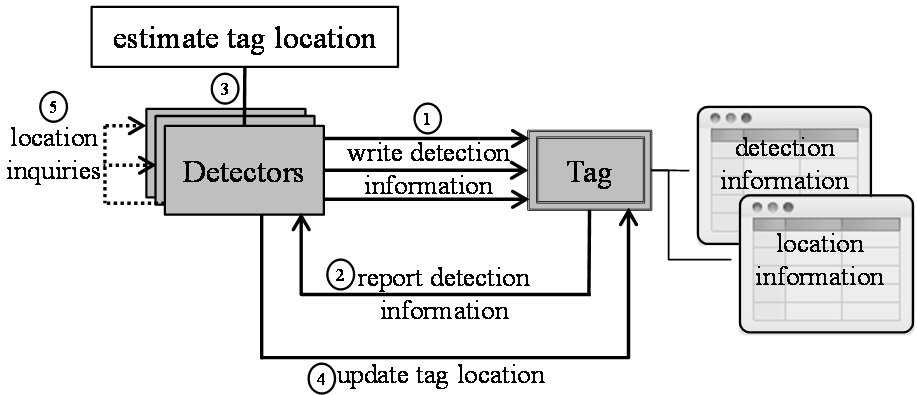 Fig 1: The Reader Crowdsourcing Framework highlighting the interaction between heterogeneous Detectors and Tags.
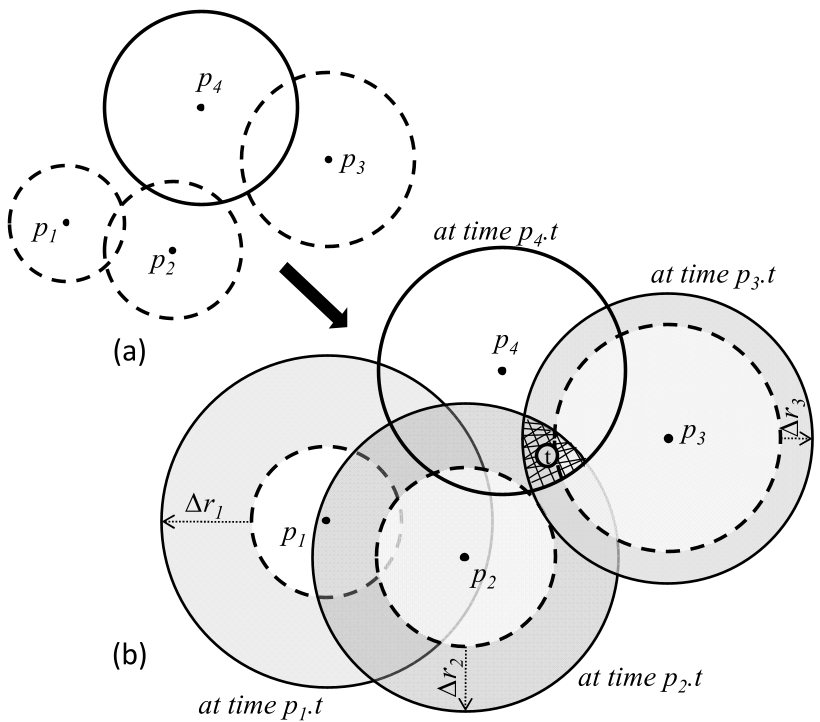 Fig 2: Intuition of TSM—older "circles" are expanded to intersect with the most recent detection, narrowing down the search area.
Performance: Robustness Under Mobility
The system was validated using ns-3 in a simulated 200m x 200m attraction area. The results showcase two major wins:
- Speed Resilience: While standard multilateration accuracy plummets as tags move faster (due to spatial mismatch), TSM's error remains stable because it accounts for velocity. At a pedestrian speed of 1.5m/s, TSM's accuracy is roughly double that of the baseline.
- Tracking Continuity: TSM requires fewer simultaneous readers. By "recycling" old detections through time-shifting, it can track tags in sparse areas where a standard system would go "blind."
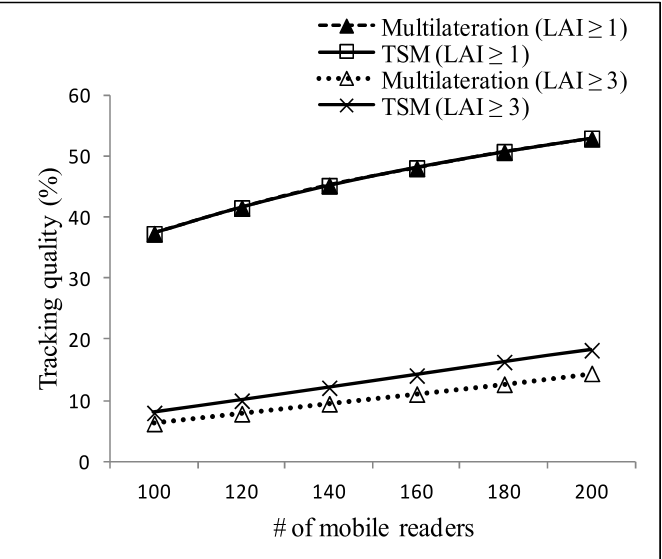 Fig 3: Localization delay comparison—TSM significantly reduces the time required to lock onto a tag's position by utilizing asynchronous data efficiently.
Deep Insight: Why This Matters
This paper addresses a fundamental Inductive Bias in localization: the assumption of a "Global Snapshot." By shifting the computation to the edge (the readers) and the storage to the physical object (the tag), the authors create a system that is naturally Self-Organizing.
Limitations:
- The accuracy depends heavily on the velocity estimation. If the tag changes direction abruptly between detections, the time-shifted "expanded circle" may become too large, leading to higher uncertainty (LAI).
- Privacy: Having a tag store a history of who "saw" it raises privacy concerns, though the authors suggest lightweight authentication as a fix.
Conclusion
The TSM approach provides a elegant geometric solution to a temporal problem. In a future where every smartphone acts as an IoT gateway, leveraging crowdsourced, asynchronous data will be the only way to achieve truly ubiquitous tracking without blanketing the world in expensive fixed sensors.