
Breaking the NP-Hard Barrier: Local Altruistic Games for 5G Edge Caching
8774_Cooperative RAN Caching Based on Local Altruistic Game for Single and Joint Transmissions.
This paper proposes a cooperative Radio Access Network (RAN) caching framework that integrates Coordinated Multi-Point Joint Transmission (CAJT) and Single-Cell Transmission (CAST). To solve the resulting NP-hard combinatorial optimization problem, the authors transform it into a Local Altruistic Game (LAG) and introduce two evolved Spatial Adaptive Play (SAP) algorithms—FP-SAP and RP-SAP—to minimize content transmission time.
TL;DR
In the race toward lower latency in 5G/6G, caching content at the edge is vital. However, deciding what to cache across a cluster of base stations is an NP-hard nightmare. This paper introduces a Local Altruistic Game (LAG) framework and a high-efficiency algorithm called RP-SAP that speeds up optimization by 500%, effectively reducing user transmission times by half.
Background: The Complexity of Cooperation
Edge caching is shifting from simple storage to complex "coordinated" systems. We now have:
- CAJT (Joint Transmission): Multiple BSs stream the same file to a user simultaneously to boost signal quality.
- CAST (Single Transmission): A single BS serves a user, potentially fetching from a neighbor if it's not local.
Combining these means the "action space" (the number of possible caching combinations) becomes astronomical. A simple network with 20 contents can result in billions of possible configurations per base station, making standard optimization impossible.
The Insight: Local Altruism
The authors' core intuition is that a global optimization problem can be solved if base stations act "locally altruistic." Instead of every BS acting purely in its own interest (which leads to poor social outcomes) or trying to optimize the entire global network (which is too complex), each BS optimizes for the welfare of its immediate neighbors.
Mathematically, this is framed as an Exact Potential Game. This structure guarantees that if individual BSs reach a Nash Equilibrium, it aligns with a global improvement in the network's potential function (transmission time reduction).
Methodology: Escaping "Fake" Equilibria
The paper introduces two critical evolutions of the Spatial Adaptive Play (SAP) algorithm:
1. From Exhaustive to Partitioned Search
Traditional SAP requires checking every possible caching action. The authors propose Fixed-Partitioning (FP-SAP), breaking the content library into smaller "son players." This reduces the per-iteration computational burden from billions of checks to a manageable handful.
2. The Power of Randomization (RP-SAP)
The real "aha!" moment is Random-Partitioning (RP-SAP). The authors identified a phenomenon called Fake Nash Equilibria (FNE)—a trap where a BS can't improve its utility by changing one specific set of cached files, even though a global improvement is possible.
By randomly reshuffling which contents are updated in each iteration, RP-SAP allows the system to "jump" out of these traps.
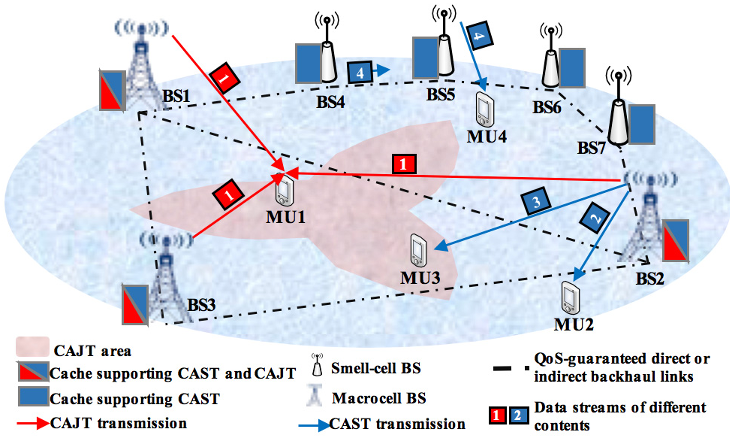 Figure 1: The architecture of CAJT and CAST transmissions across macro and small-cell BSs.
Results: 5x Speedup in Convergence
Using a realistic LTE traffic dataset, the results were striking:
- Transmission Efficiency: The CAJT + CAST joint strategy reduced the Average Transmission Time (ATT) by 50%.
- Algorithmic Speed: RP-SAP converged in 7,500 iterations, whereas the fixed version (FP-SAP) needed over 33,000.
- Robustness: Unlike Best Response Dynamics (BRD), which got stuck in inefficient states immediately, RP-SAP consistently found high-efficiency equilibria.
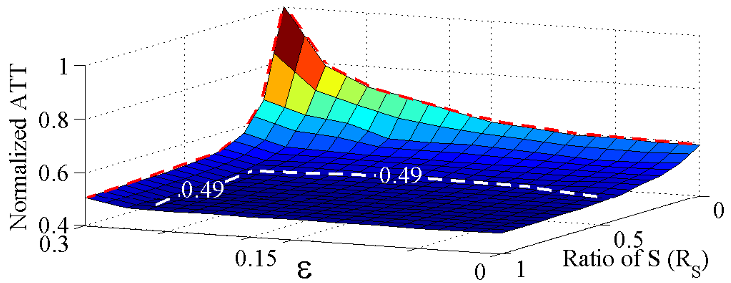 Figure 3: CDF of convergence rates showing RP-SAP's significant lead over FP-SAP.
Critical Insights
The primary value of this work lies in its Game-Theoretic decomposition. While many papers focus on the "what" (caching policies), this focuses on the "how" (the mechanics of search).
Limitations: The study assumes content popularity is relatively stable over 4-hour windows. In highly dynamic environments (e.g., viral social media events), the overhead of re-calculating the LAG might become a bottleneck.
Conclusion: The Local Altruistic Game framework proves that "neighborly help" is not just a social virtue but a mathematically sound strategy for optimizing high-dimensional 5G networks.