
SHoPS: Revolutionizing Cloud Integrity with Set-Homomorphic Proofs
Cooperative Set Homomorphic Proofs for Data Possession Checking in Clouds
The paper introduces SHoPS, a Set-Homomorphic Proof of Data Possession (PDP) scheme designed for distributed cloud storage. It leverages pairing-based cryptography to enable the aggregation and verification of data blocks using set operations like union, intersection, and inclusion while achieving constant communication overhead.
TL;DR
SHoPS (Set-Homomorphic Proof of Data Possession) is a deterministic cryptographic protocol that allows verifiers to check the integrity of outsourced data across multiple cloud nodes using a single aggregated proof. By introducing set-homomorphism, it supports operations like Union, Intersection, and Inclusion, reducing communication overhead to a constant and enabling efficient auditing in distributed "Cloud-of-Clouds" architectures.
Background: The Cost of Cloud Transparency
As organizations move massive datasets to the cloud, verifying that data remains uncorrupted is vital—especially for "cold" data that is rarely accessed but legally required. Prior work in Provable Data Possession (PDP) often required a linear relationship between the number of blocks and the verification cost. In a distributed environment, this means the more nodes you use for redundancy (like HDFS or GFS), the more expensive it becomes to check if your file is still there.
The Problem: The Coordination Bottleneck
Existing PDP schemes face three major hurdles in the distributed era:
- Communication Explosion: Challenging multiple storage nodes separately scales poorly.
- Lack of Flexibility: They cannot easily verify a specific subset of files or handle overlapping data versions without recomputing everything.
- Compute Inefficiency: The burden of proof aggregation often falls on a central gateway, creating a bottleneck.
Methodology: The Secret of Set-Homomorphism
The core innovation of SHoPS is its ability to treat cryptographic proofs as sets.
1. Architectural Design
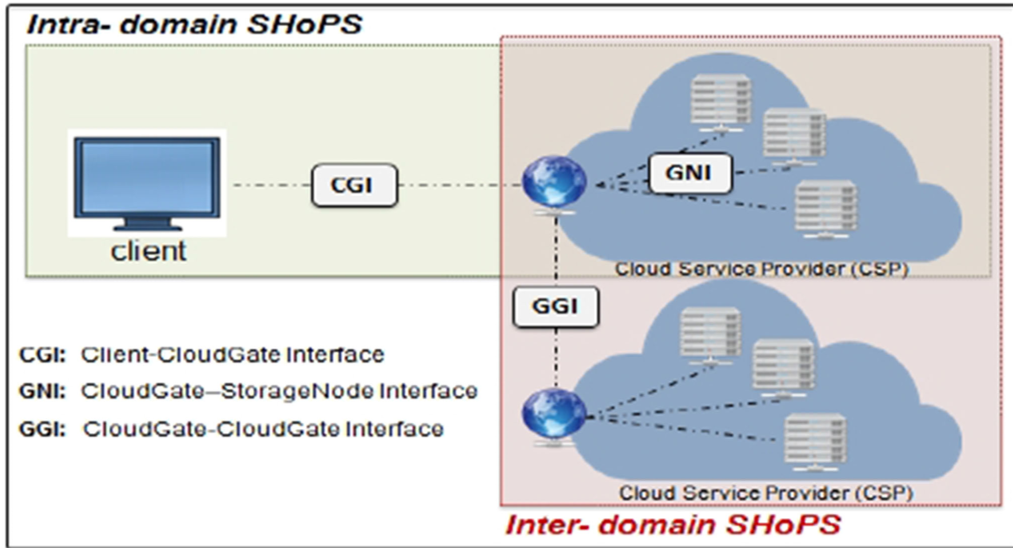
SHoPS operates across three critical interfaces:
- Client-CSP: Enabling lightweight periodic checks.
- Intra-CSP: Allowing the cloud gateway to monitor its own internal storage nodes.
- Inter-CSP: Facilitating integrity checks in "Cloud-of-Clouds" scenarios.
2. Set-Homomorphic Proofs
Unlike standard homomorphic encryption (which usually supports addition or multiplication), SHoPS supports set operations:
- Union (): Verify a whole file stored in fragments across nodes.
- Intersection (): Verify commonalities between different versions of the same file.
- Inclusion (): Verify that a specific directory or subset is intact.
The mathematical foundation relies on an asymmetric pairing function . By using a variant of the Pedersen commitment as an accumulator, multiple proofs can be combined using the Least Common Multiple (LCM) and Greatest Common Divisor (GCD) relations in the exponent, as shown in the paper's proof of Lemma 5.8.
Experiments & Results
The authors validated SHoPS using an OpenStack Swift (S3-compatible) testbed.
Key Metrics:
- Computation: Private verification is extremely fast, requiring only 2 pairing operations. Public verification (delegated to a third party) requires 3 pairings.
- Scalability: The processing time for proof generation () scales linearly with the block index size , but remains manageable for standard cloud servers.
- Communication: Only two group elements are sent as a response, regardless of how many blocks were challenged.
 Table 1: SHoPS stands out by supporting Cloud-of-Clouds and public verifiability with communication cost.
Efficiency Gains
As seen in the experimental data, using Type D or Type A pairings at an 80-bit security level allows the client to perform setup operations in roughly 5.6 seconds for 100-bit data blocks, making it practical for real-world deployment.
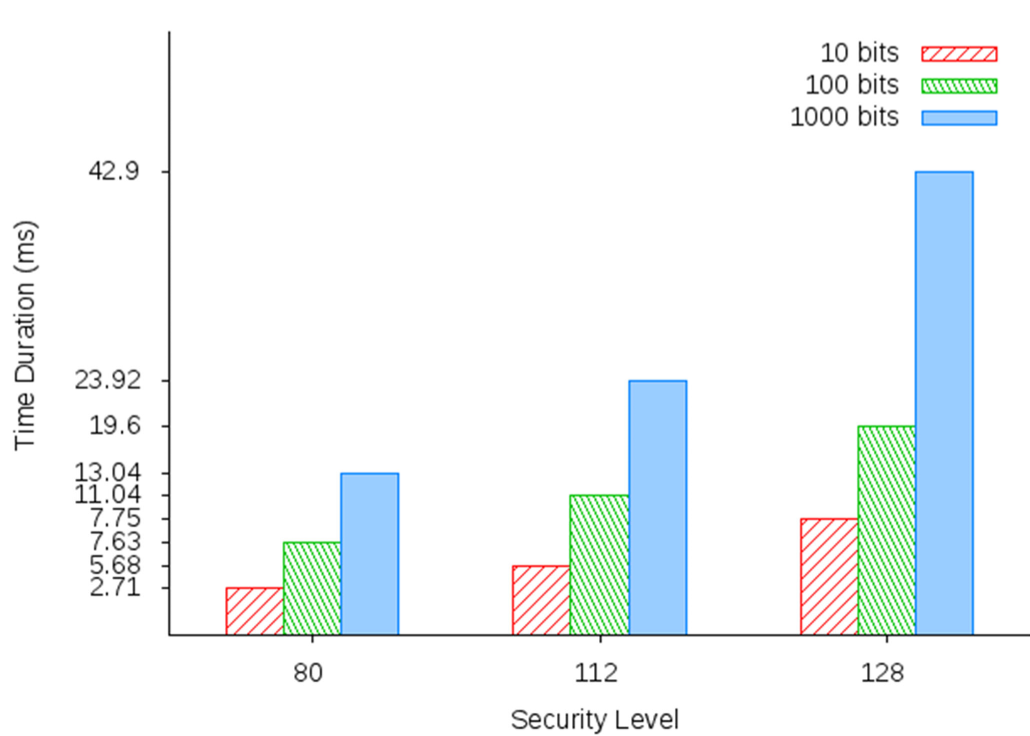 Fig 3: The setup cost () increases with block size but remains a one-time overhead per file.
Critical Insight & Conclusion
SHoPS is a significant step forward because it acknowledges that modern cloud storage is never a single monolithic disk. By embedding set theory into the cryptographic proof itself, the authors have turned "distributedness" from a liability into an advantage.
Limitations: The reliance on pairing-based cryptography—while elegant—is computationally more intensive than symmetric-key approaches. However, the shift toward public verifiability and communication makes this a worthy trade-off for large-scale enterprise storage systems.
Future Outlook: We expect this "Set-Homomorphism" paradigm to migrate into decentralized storage networks (DePIN) and blockchain-based auditing, where efficient subset verification is a core requirement.