
DBO: Harnessing Social Intelligence to Solve Urban VANET Congestion
Cooperative Socio-aware Dynamic Backoff Optimization for Urban VANETs
This paper introduces the Dynamic Backoff Optimization (DBO) algorithm for Urban VANETs, leveraging Social Network Analysis (SNA) to identify specific vehicle roles. By integrating localized social metrics like lobby index and closeness centrality into the IEEE 802.11p MAC layer, it optimizes channel access and achieves a 30% reduction in packet loss rate.
TL;DR
Urban Vehicular Ad-Hoc Networks (VANETs) suffer from intermittent disconnections and channel congestion due to the erratic nature of human driving. This paper presents Dynamic Backoff Optimization (DBO), a protocol that treats vehicles not just as nodes, but as "social entities" within a graph. By identifying Unlucky Players and High-Connectivity Players using localized centrality metrics, DBO boosts beacon throughput by 40% and slashes packet loss by 30%.
Problem & Motivation: The Chaos of Urban Mobility
Standard IEEE 802.11p protocols use a static Contention Window (CW). In a quiet suburb, this works; in a dense urban intersection, it’s a disaster. High vehicle density leads to "broadcast storms" where safety-critical beacons collide, leading to what the author calls fairness degradation.
Prior works attempted to adjust the CW based on simple density estimation, but density alone doesn't capture the structural role of a vehicle. A bus at the center of a cluster has a different communication burden than a car at the edge. The challenge is: how do we identify these roles without "flooding" the network (which would further choke the bandwidth)?
Methodology: The Social Genome of a VANET
The author's core insight is using Social Network Analysis (SNA) at a 2-hop local level. Instead of global knowledge, each vehicle calculates:
- Lobby Index (LI): Identifies vehicles with high-degree neighbors (potential hubs).
- 2-hop Closeness Centrality (CC): Estimates how "central" a vehicle is within its immediate vicinity.
- Localized Clustering Coefficient (LCC): Measures how close a neighborhood is to being a clique.
Identifying the "Players"
The DBO algorithm classifies nodes into two critical categories based on these metrics:
- Unlucky Players: High degree, high Lobby Index, but high collision probability—these nodes are being "bullied" by the channel.
- High-Connectivity Players: High Lobby Index and central positioning—these are the "backbones" of the local cluster.
 (Equation for 2-hop Closeness Centrality used to determine node roles)
The Optimization Loop
When the DBO algorithm runs, it modifies the standard backoff procedure. If a node is an Unlucky Player, it multiplies its CW by 2 to step back and let the channel clear. If it is a High-Connectivity Player with a heavy queue, it divides its CW by 2 to proactively clear traffic.
Experiments: Real-World Urban Simulation
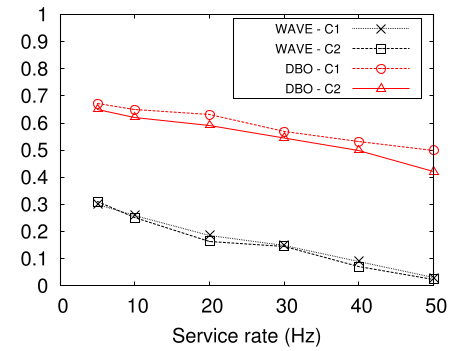
Using VanetMobiSim to generate realistic Voronoi-style urban graphs, the author tested DBO against the standard 802.11p (WAVE) protocol.
Key Performance Gains
- Packet Loss Reduction: DBO maintains significantly lower loss rates than WAVE, especially when the initial CW is small.
- Throughput: In high-density scenarios (100 vehicles), DBO provides a 40% gain in beacon delivery ratio.
- Latency: As the giant cluster forms (around 60s in the simulation), DBO's ability to identify High-Connectivity nodes allows it to drop access delay from 12.5ms to 4.7ms.
Critical Analysis & Conclusion
The brilliance of this work lies in localized intelligence. By making the MAC layer "socially aware," the author solves a global congestion problem using only local 2-hop data.
Takeaway: Future V2X protocols should stop treating all nodes as equal. Architecture that distinguishes between "hubs" and "unlucky edges" can achieve massive efficiency gains without the overhead of centralized management.
Limitations: The study primarily focuses on 802.11p. With the industry shifting toward C-V2X (LTE/5G-based), the application of these social metrics to Sidelink Resource Allocation (Mode 4) remains an open and exciting research avenue.