
The Coordination Paradox: Why "More Eyeballs" Can Sometimes Blur the Vision in Collective Intelligence
Coordination in Collective Intelligence: The Role of Team Structure and Task Interdependence
This paper investigates how team structure and task interdependence influence the quality of collective intelligence in Wikipedia. It demonstrates that while increasing the number of editors improves "independent" tasks like content coverage, it potentially harms "interdependent" tasks like readability and flow unless work is concentrated among a core group of editors.
TL;DR
In the world of Web 2.0, we often worship the "Wisdom of the Crowd." We assume that adding more people to a project—like a Wikipedia article—will naturally lead to a better product. However, this research by Aniket Kittur, Bryant Lee, and Robert Kraut proves that task interdependence changes everything. While a crowd is great for adding facts (coverage), it can be a disaster for flow and cohesion (readability) unless a small "core" group takes charge of the organization.
The "Brooks’s Law" of Wikis
The core insight of this paper is that not all tasks are created equal. In software engineering, Brooks’s Law famously states that "adding manpower to a late software project makes it later." Why? Because of coordination costs.
The authors suggest Wikipedia suffers from the same friction.
- Independent Tasks: Adding a citation or fixing a typo. These have low "interdependence." More people = more efficiency.
- Interdependent Tasks: Restructuring sections or maintaining a "neutral point of view." These require everyone to be on the same page. More people = massive coordination overhead and "process loss."
Methodology: Facts vs. Flow
The researchers conducted two distinct studies to prove their hypothesis:
- Direct Article Analysis: They analyzed 20 articles in the "American Rock Singers" category, measuring Coverage (independent) and Readability (interdependent).
- Peer Review Mining: They analyzed over 10,000 comments from Wikipedia’s own internal review processes (Featured Article reviews, etc.) to see what kinds of complaints arose as the number of editors grew.
Key Quantitative Findings
The results provided a nuanced view of how "crowds" actually work. As seen in the table below, the number of editors had vastly different impacts depending on the metric.

- The Positive: More editors lead to significantly better Computer-coded Coverage (p < 0.01).
- The Negative: More editors actually showed a marginal negative effect on readability.
- The Solution: The interaction between the number of editors and work concentration (Gini coefficient) was significant. This means that if you have many editors, you must have a concentrated core of "power editors" to maintain quality.
How Concentration Saves the Crowd
Study 2 looked at the proportion of interdependent problems (like flow and bias) compared to independent problems.
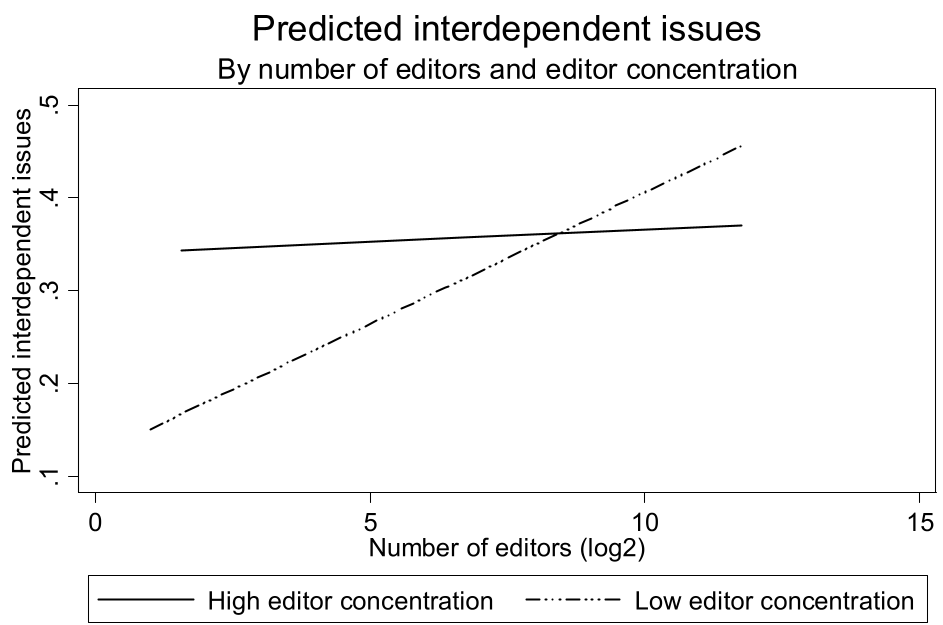
As shown in the figure above, when editor concentration is low (meaning everyone contributes roughly the same amount), the number of coordination problems skyrockets as more people join. But when concentration is high (a few leaders directing the flow), the article quality remains stable even as the crowd grows.
Critical Insight: The "Scaffolding" Effect
The authors argue that the core editors aren't just doing "better work" themselves. Instead, they are providing a scaffold. By creating a strong outline and a consistent style, they enable the "peripheral" editors to contribute their small pieces of knowledge without breaking the whole article.
Future Implications & Design
This paper isn't just an academic exercise; it has real-world design implications for any collaborative platform:
- Intelligent Task Routing: Systems should steer "newbies" toward independent tasks (fact-checking) and reserve interdependent tasks (restructuring) for veterans.
- Role Designation: Systems like Wikipedia might benefit from temporary "Article Guides" or "Maintainers" who have the social authority to coordinate high-impact changes.
- Harnessing Inequality: While "equality" sounds good in theory, successful collective intelligence thrives on a specific type of inequality: a powerful core supported by a massive, distributed periphery.
Conclusion
The "Wisdom of the Crowd" is not a magic wand. To build complex, high-quality knowledge bases, we must respect the physical limits of human coordination. The crowd provides the bricks; the core editors provide the blueprint.