
Beyond the Crowd: How Social Networks and "Joneses" Logic Solve the El Farol Bar Problem
Coordination in the El Farol Bar problem: The role of social preferences and social networks
This paper introduces a socially-oriented extension of the El Farol Bar problem (EFBP) by replacing global information with local social networks and introducing social preferences. Using agent-based modeling, the authors demonstrate that local interaction (Circular and von Neumann neighborhoods) consistently leads to perfect coordination, achieving the Bar's maximum capacity without over-congestion.
TL;DR
Researchers have finally "solved" the El Farol Bar coordination paradox. By shifting agents from watching the "global crowd" to watching their "local neighbors" and adding a dash of social envy (minimum attendance thresholds), they transformed a chaotic, fluctuating system into one of perfect coordination and social equality.
Context: The Inductive Reasoning Trap
In the classic El Farol Bar problem, if everyone thinks the bar will be empty, everyone goes, and it becomes crowded (and miserable). If everyone thinks it will be crowded, nobody goes, and the opportunity is wasted. This leads to permanent volatility. Previous "solutions" led to a harsh "2-Class" society where some agents are permanent winners and others are permanent losers.
The current study asks: Can we reach full capacity and maintain social equity?
Methodology: Local Vision and Social Pressure
The authors modified the standard setup in two radical ways:
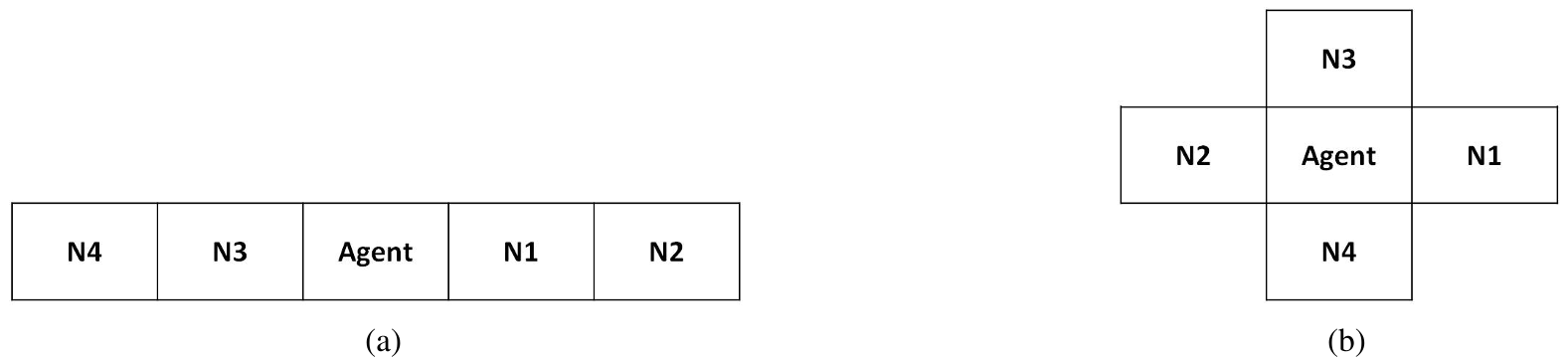
- Local Neighborhoods: Instead of seeing the total bar attendance, agents only see what their immediate neighbors (Circular or von Neumann) did in the previous step.
- Social Preferences (KUWJ): Agents feel "dissatisfied" if they attend less than their neighbors. This "Keep-up-with-the-Joneses" behavior forces agents to adapt their strategies until they reach a parity with their local cluster.
The learning mechanism is a mix of imitation (copying a more successful neighbor) and mutation (randomly changing a rule if the current strategy fails).
The Power of the Grid: Key Results
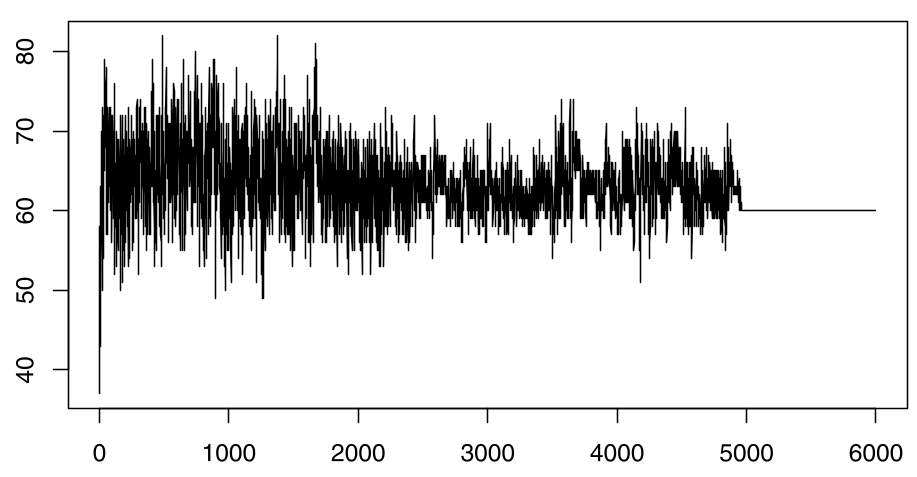
The simulation results are striking. Unlike the original model which fluctuates forever, this network-based system always reaches a steady state of perfect coordination ().
Neighborhood Matters
- Circular Neighborhood: Tends to lock into "classes" where some attend more than others.
- von Neumann Neighborhood: Proved much more conducive to "One-Class" (1C) equilibria—where everyone attends exactly 60% of the time.
The "Minority" Effect
One of the most profound findings is the influence of a small minority. You don't need the whole population to care about equality. The study shows that if just 25% of the population adopts the "Keep-up-with-the-Joneses" preference, the entire system is pulled into a 1C equilibrium of perfect equity. The social pressure "infects" the network, forcing a stable, equitable rotation of attendance.
Deep Insight: Emergent Simplicity
Despite the strategies potentially being complex (2^16 combinations), at the 1C equilibrium, the system collapses into beautiful, simple cycles.
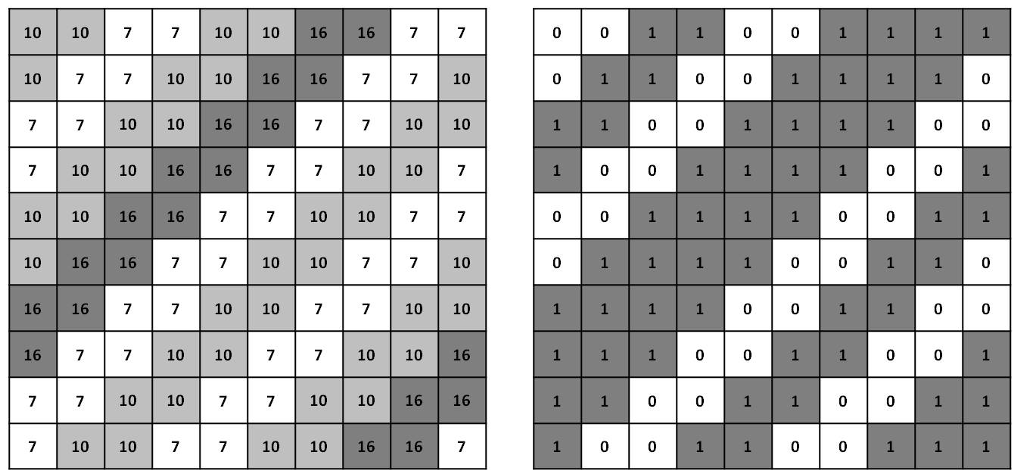
As seen in the snapshot above, the population organizes into spatial-temporal patterns (diagonals moving through time). This represents a self-organized schedule where agents essentially "take turns," a feat they could never achieve when trying to process the complex global signal of the whole crowd.
Critical Analysis & Takeaways
The brilliance of this work lies in showing that less information can lead to better outcomes. When agents ignore the global chaos and focus on their four immediate neighbors, they can synchronize.
Limitations: The model assumes a fixed, static network. In reality, social networks are dynamic—we choose our "Joneses." Future research should explore "homophily," where agents might move away from neighbors who attend the bar too often.
Conclusion: This paper provides a blueprint for resource management in public economics. It suggests that by fostering local peer-to-peer communication and subtle social incentives, we can resolve congestion in traffic, computer networks, and common-pool resources without needing a centralized dictator.