
Social Capital vs. Technochanges: The Hidden Networks Behind ICT Adaptation
Investigating the Coping Mechanism Towards Technochanges: A Perspective of Social Network Theory
This study investigates individual coping mechanisms during "technochanges" by integrating Social Network Theory with Coping Theory. It identifies how supportive and informational social networks influence self-efficacy and absorptive capacity, respectively, to drive adaptation and task performance.
TL;DR
Why do sophisticated IT systems often fail at the implementation stage? This paper argues that the secret to successful "technochanges" lies not in the software's UI, but in the user's social network. By analyzing 85 participants through the lens of Social Network Theory, the study proves that supportive networks boost the confidence needed to handle emotional stress, while informational networks provide the knowledge required to master new tools.
The "Technochange" Paradox
Organizations frequently introduce new Information and Communication Technologies (ICT) to gain competitive edges, yet many projects stall. The authors identify two primary barriers:
- Technical Perspective: Complexity creates "Knowledge Barriers."
- Sociopsychological Perspective: Displacement and change create "Emotion Barriers" (anxiety and uncertainty).
Traditional IT management focuses on manuals and training (addressing the knowledge barrier), but ignores the social tissue that helps an employee regain psychological balance.
Methodology: The Dual-Coping Mechanism
The study bridges the gap between Social Network Theory and Coping Theory. Coping is categorized into two efforts:
- Problem-focused: Changing the situation by learning new skills (mediated by Absorptive Capacity).
- Emotion-focused: Managing internal distress by changing perceptions (mediated by Self-Efficacy).
The Research Model
The authors posit that your position in a social network determines your access to these coping resources.
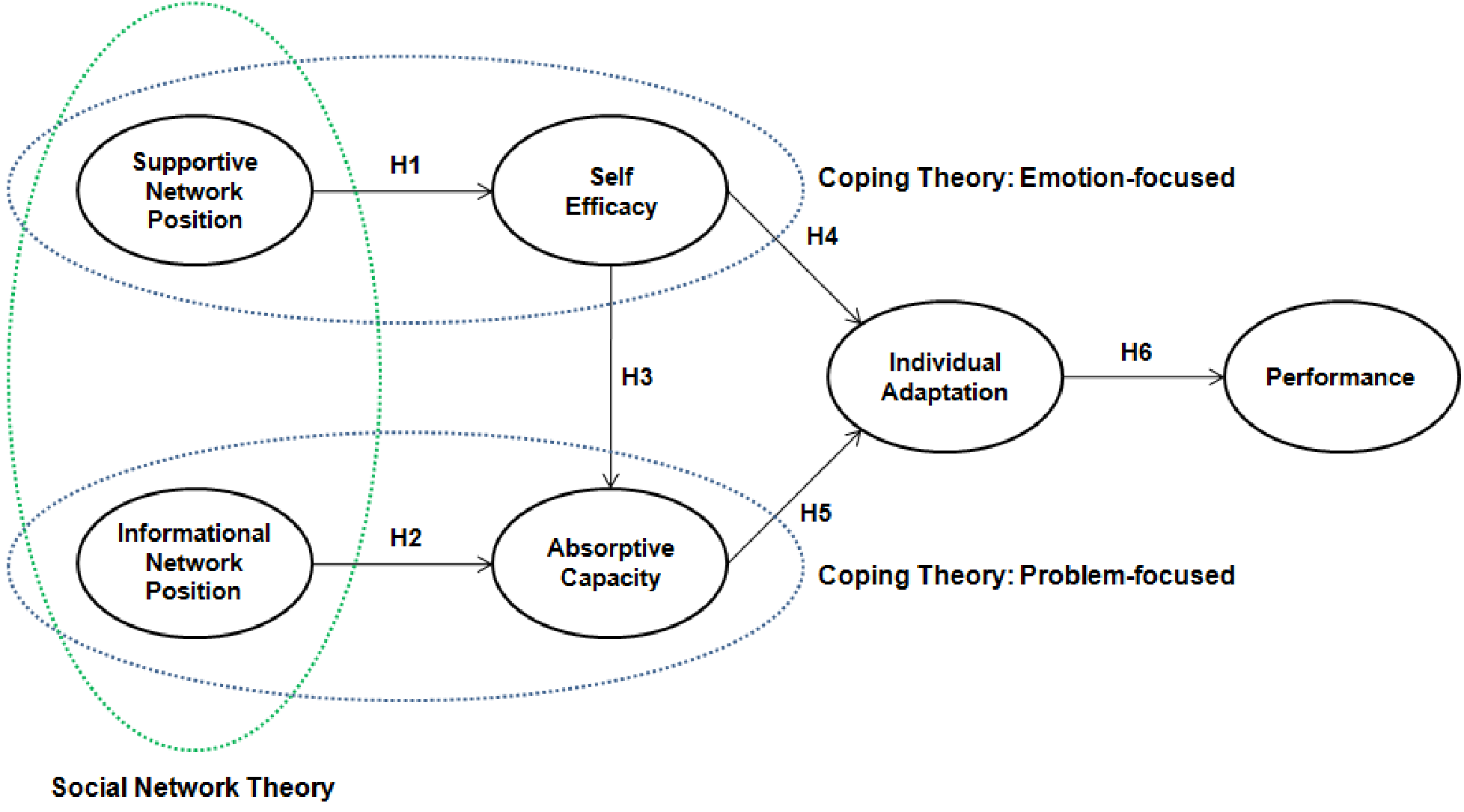
- Informational Networks: Ties used for task-related advice.
- Supportive Networks: Affective ties for emotional security.
Key Findings & Experimental Results
Using Partial Least Squares (PLS) and social network metrics (Size, Closeness, Frequency, Density), the research provides several deep insights:
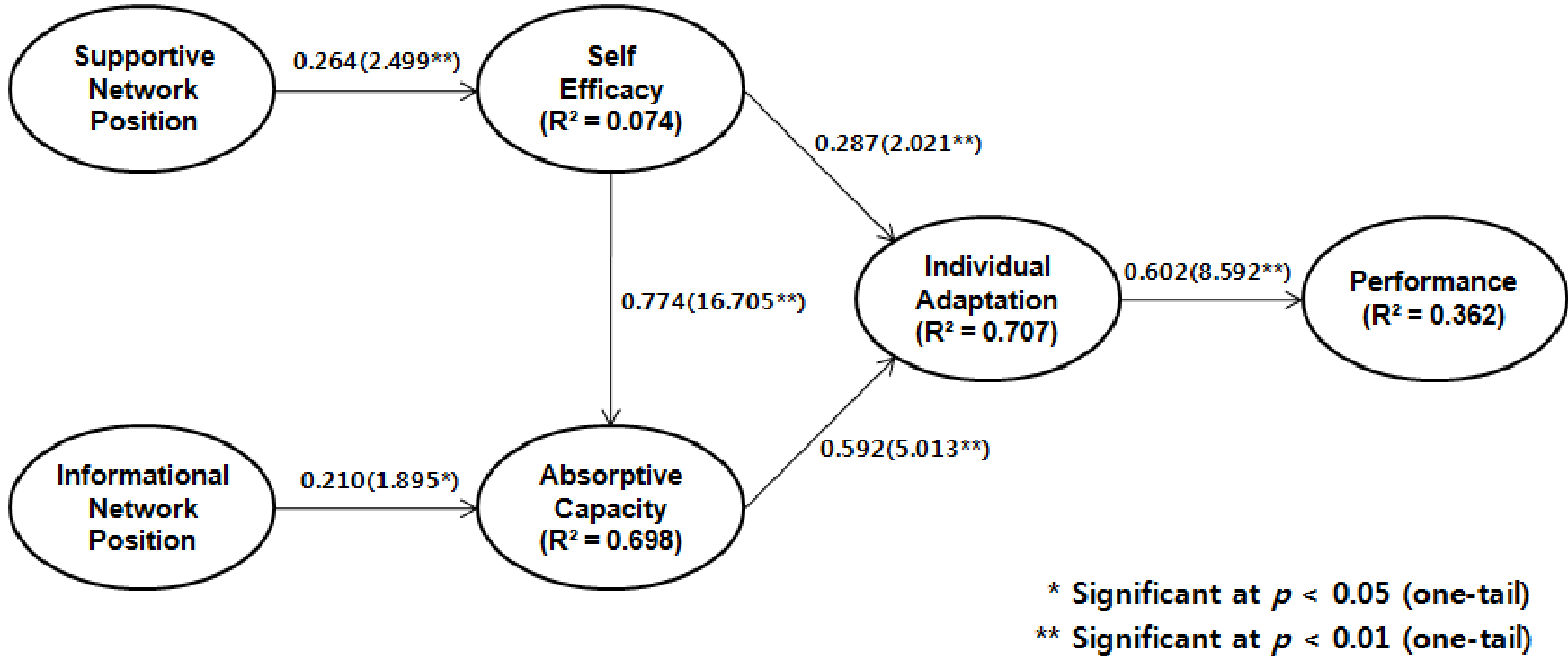
- Supportive Ties Self-Efficacy: Having "people you can count on" directly increases your belief in your ability to handle the new system ().
- Informational Ties Absorptive Capacity: Access to experts and advice-givers allows individuals to assimilate and exploit new knowledge effectively.
- The Performance Chain: Both coping paths lead to Individual Adaptation, which accounts for 36.2% of the variance in final Performance.
Quantitative Evidence
The measurement model showed high reliability, with most factor loadings exceeding the 0.7 threshold.
Deep Insight: Why This Matters for Change Management
This paper shifts the focus from the individual to the individual-within-a-network.
- For Researchers: It introduces a methodology to model social network indices (like Density and Closeness) as latent variables in SEM, a significant step away from treating network metrics as simple single-item indicators.
- For Practitioners: It suggests that if an employee is struggling with a new ERP or AI tool, the solution isn't necessarily more training. If the barrier is emotional, they need a stronger Supportive Network. Managers should identify "isolated actors" who lack these informal ties and pair them with mentors or encourage non-work socialization.
Conclusion & Future Work
The study proves that social capital is a primary driver of ICT adaptation. While limited by its cross-sectional nature and student-based sample, it provides a robust framework for future longitudinal studies. The takeaway is clear: Digital transformation is a social process as much as a technical one. To change the technology, you must first understand the network.