
The Ghost in the Machine: Identifying the Significant Core of Evolving Social Networks
A significant core structure inside the social network evolutionary process
The paper introduces a dynamic approach to identify a "significant core" in social networks by analyzing temporal group evolution. It proposes a meta-model called the Temporal Weighted Directed Acyclic Graph (TW-DAG) to detect persistent, dominant, and cohesive elite structures over time, validated on the Enron email dataset.
TL;DR
Researchers have moved beyond static "snapshots" of social networks to uncover the true elite—the Significant Core. By modeling the Enron email dataset as a dynamic graph of overlapping groups (TW-DAG), the authors identified a persistent 6-person core that dictates the network's stability. Unlike temporary "influencers," this core represents the durable backbone of the organization.
Problem: The Static Trap
Most Social Network Analysis (SNA) treats a network like a frozen photograph. We look for dense clusters or individuals with many connections. But real organizations are fluid; people leave, new projects start, and communication pulses change.
The authors argue that existing "core-periphery" models focus too much on what is dense now, rather than who keeps the network centralized over time. Why does this matter? Because in homeland security, corporate innovation, or criminal investigations, identifying a transient leader is less useful than finding the "elite class" that steers the ship through months of turbulence.
Methodology: The TW-DAG Approach
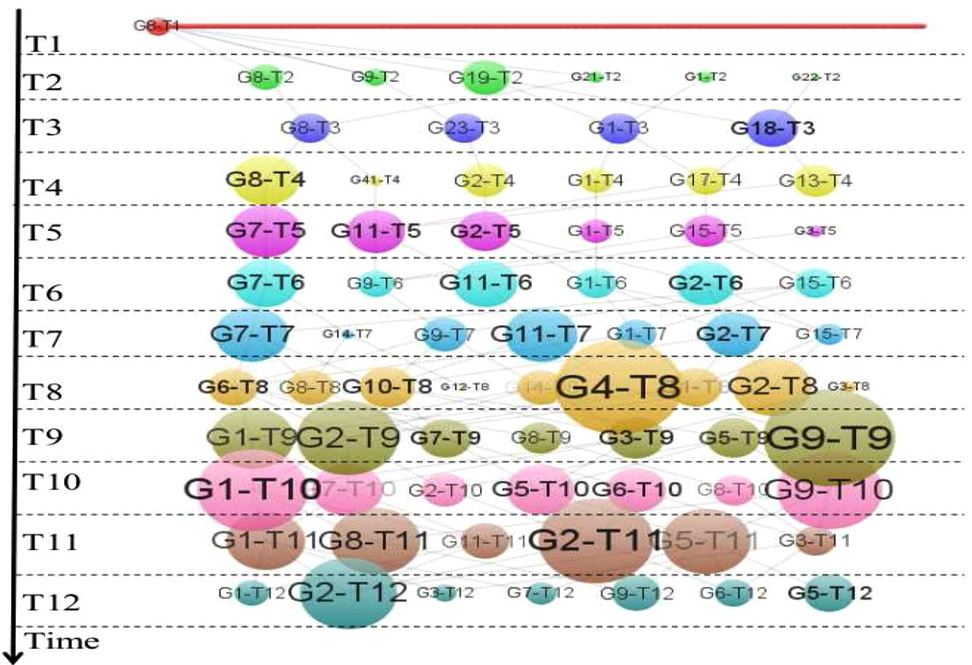
The heart of this research is the Temporal Weighted Directed Acyclic Graph (TW-DAG). Instead of nodes representing people, the vertices represent groups at specific time steps.
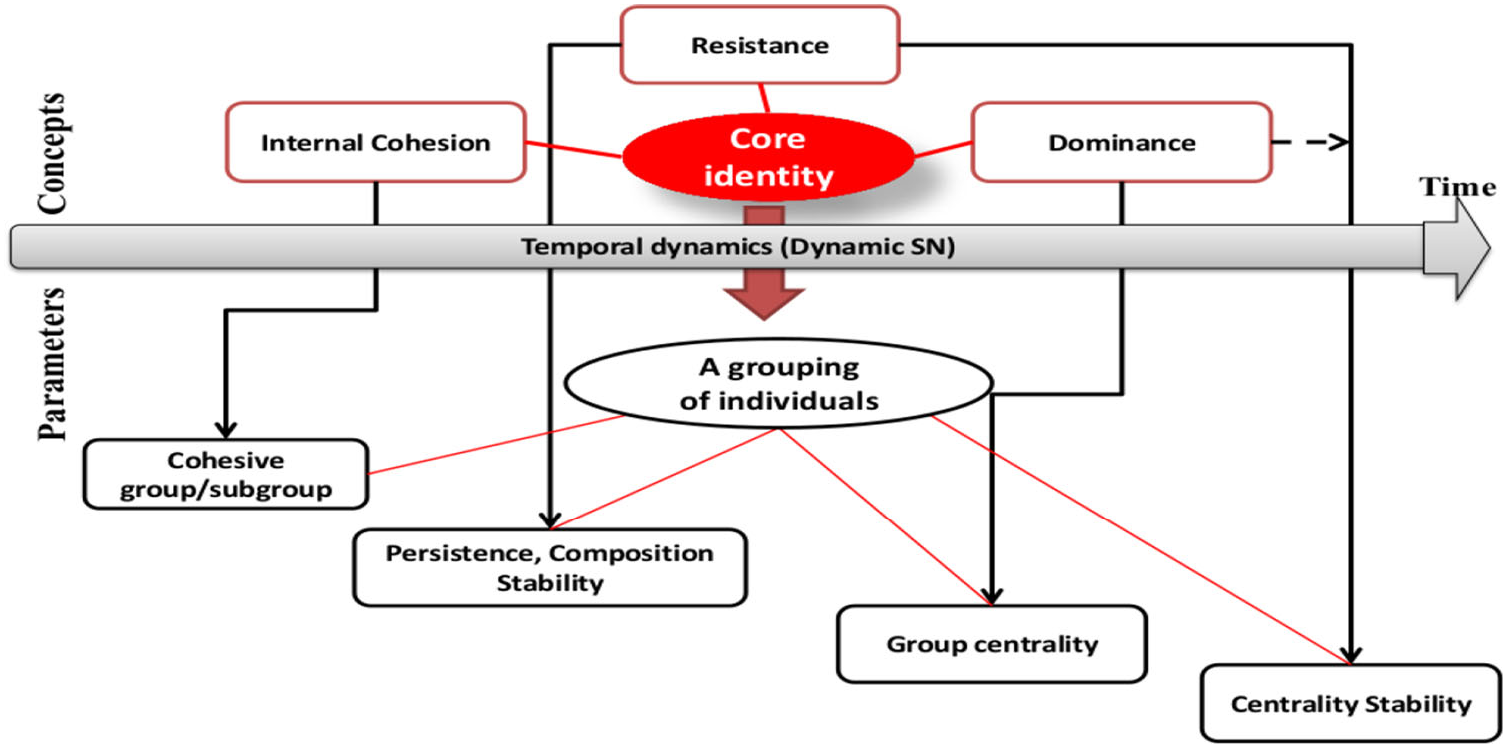
1. The Three Pillars of a Core
- Cohesion: Not just a dense group, but a group that remains "tight" over time.
- Dominance: Measured by Group Centrality. It's not about how many emails one person sends, but how much the group as a whole controls the flow of information.
- Resistance (Durability): The ability to keep the same members and the same level of influence even as the rest of the network changes.
2. The Weighting Secret
The arcs between groups are weighted by a sophisticated function. It doesn't just look at how many people stay in a group; it uses Centrality Amplitude () to penalize groups that lose their influence. A high weight means a group is large, central, and stable.
Identifying the "Critical Pattern"
By applying the Critical Path Method (CPM)—a tool usually used in project management—the authors found the "heaviest path" through the TW-DAG. This path isn't just a sequence of groups; it's the evolution of the network’s soul.
Experimental Proof: The Fall of Enron
Using the Enron email dataset (112 employees), the researchers found that:
- Size ≠ Influence: The largest overlapping group had 19 people, but it wasn't the most central.
- The 6-Person Core: A specific pattern of 6 individuals persisted throughout the 12-month observation period.
- Sensitivity Analysis: When this 6-person core was "removed" from the model, the entire network's centralized structure collapsed. Other persistent groups (even those with 5 people) didn't have nearly the same impact.
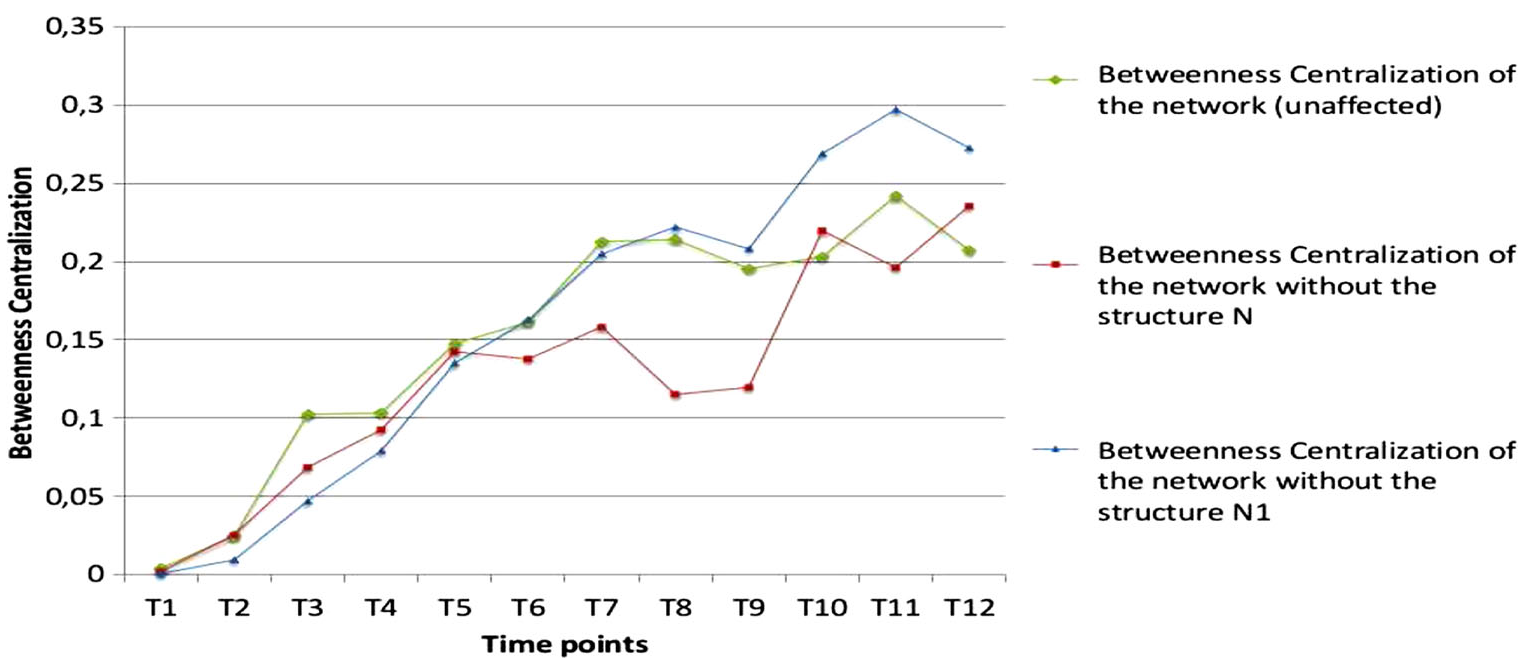 In the graph above, the red curve shows the collapse of network centralization once the identified 'Core N' is removed, compared to the stable green (unaffected) and blue (non-core removal) lines.
Critical Insight & Conclusion
This paper shifts the focus from individual importance to collective durability. The "Significant Core" isn't just a group of high-degree nodes; it's a structural invariant.
Limitations: The study relies on "time windows" (months). If you change the window to weeks or days, the "core" might look different. Furthermore, it treats email metadata as a proxy for social importance, excluding the actual content of the messages.
Future Impact: This framework is a potent blueprint for identifying the "inner circle" in any evolving system—from terrorist cells to P2P networks and corporate innovation hubs. To understand a network, don't just look at its size; look at what stays the same when everything else changes.