
Deciphering the Enron Collapse: Can Email Metadata Predict Stock Volatility?
Corporate Communication Network and Stock Price Movements: Insights From Data Mining
The paper introduces a specialized data-mining algorithm designed to detect association relationships between corporate e-mail communication patterns and stock price movements. Using the Enron corpus as a case study, the authors demonstrate that internal communication frequency, particularly between key executives and employees, can predict stock market performance with an average accuracy of approximately 80% when using a weekly time window.
TL;DR
Researchers have developed a data-mining framework that proves internal corporate email patterns are a leading indicator of stock performance. By analyzing the frequency of exchanges—not the content—within the infamous Enron corpus, the proposed algorithm achieved an 80%+ accuracy in predicting weekly price movements, significantly outperforming traditional machine learning classifiers.
Background: The Hidden Value of Corporate "Noise"
Communication theory suggests that employee interactions are the lifeblood of a firm's success or failure. While previous research focused on public sentiment (e.g., Twitter/X) to predict stocks, this paper dives into the internal network. The intuition is simple: major corporate changes like mergers, R&D breakthroughs, or impending bankruptcies trigger identifiable shifts in how key employees communicate long before they are reflected in financial statements.
Methodology: From Matrices to Stock Trends
The researchers treat the corporate network as a dynamic graph stream. Their approach follows four rigorous steps:
- Discretization: Raw email counts and stock price percentage changes are transformed into discrete states (e.g., "Strong Relationship" or "Large Decrease").
- Adjusted Residual Analysis: Instead of simple correlation, they use a probabilistic measure to find "Graph-Stock Patterns"—statistically significant links between a specific communication state at time and a stock state at time .
- Weight of Evidence (W): They calculate how much a specific pattern (e.g., "Weak CEO communication") supports a specific outcome (e.g., "Stock Increase") using mutual information.
- Prediction: By summing the total weight of evidence across all node interactions, the model selects the most likely stock movement.
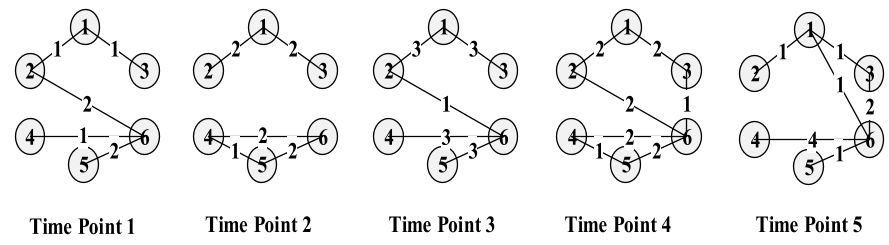 Fig 1: The process of transforming communication streams into weighted matrices for pattern discovery.
The "CEO Interaction" Insight
A fascinating discovery from the Enron data was the correlation between the CEO and staff. The data revealed a counter-intuitive pattern:
- Weak Communication Frequency Stock Price Increased.
- Strong Communication Frequency Stock Price Decreased.
The academic interpretation: When a company is stable, the CEO doesn't need to micro-manage or hold frequent emergency meetings. Intense spikes in CEO communication often signal a crisis mode, which inevitably leads to market decline.
Experimental Performance: SOTA vs. Baseline
The study compared the proposed algorithm against C5.0 Decision Trees. While the Decision Tree hovered near the 50% "random guessing" mark, the proposed method saw its accuracy scale as the observation window increased.
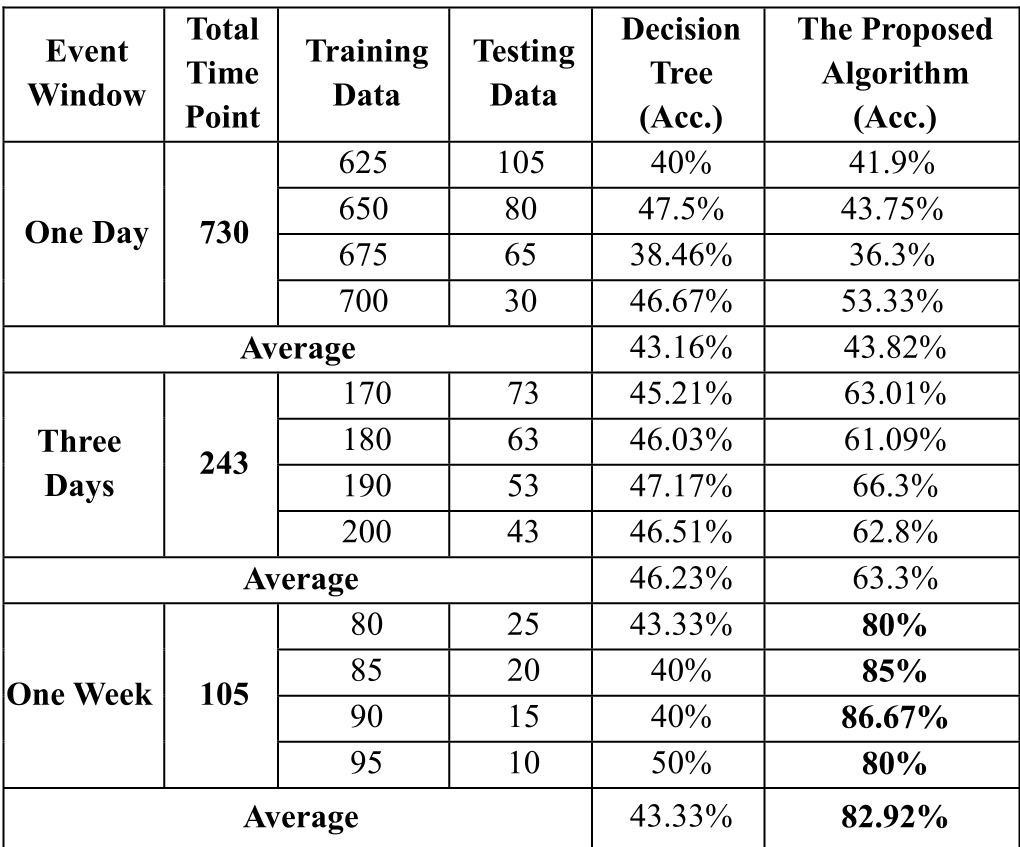 Table 1: Performance comparison showing the proposed algorithm's superiority in weekly event windows.
| Time Interval | Proposed Algorithm Accuracy | Decision Tree Accuracy |
|---|---|---|
| One Day | 43.82% | 43.16% |
| Three Days | 63.30% | 46.23% |
| One Week | 82.92% | 43.33% |
Critical Insight & Future Outlook
This work demonstrates that metadata is often more valuable than data. By ignoring the content of the emails, the model avoids the complexities of Natural Language Processing (NLP) while bypassing privacy concerns related to reading private messages.
However, the study has limitations:
- Data Specificity: The Enron case is an extreme outlier (a total corporate collapse). Whether these patterns hold for 100 consecutive years of a stable firm like Coca-Cola remains to be seen.
- Modern Shift: Today's communication has moved from Email to Slack, Teams, and Zoom. Future adaptations must account for these multi-channel "instant" interactions.
Conclusion
This paper bridges the gap between organizational psychology and high-frequency finance. It proves that internal organizational stability—or the lack thereof—is encoded in the frequency of our digital handshakes. For auditors and investors, this provides a powerful new lens through which to assess corporate health.