
The Resilient Core: Testing the "Fracturing" of Corporate Elite via Bayesian Network Analysis
Is the corporate elite disintegrating? Interlock boards and the Mizruchi hypothesis
This paper investigates the "Mizruchi hypothesis" regarding the fragmentation of the American corporate elite by analyzing interlocked board networks of the Dow Jones 30 from 2001 to 2010. It introduces a Bayesian p1 model extension and the "hull of a sequence of networks" concept to address longitudinal node volatility in social network analysis.
TL;DR
Is the American corporate elite losing its collective voice? While the Mizruchi hypothesis argues that elite power has been disintegrating since WWII, this study applies advanced Bayesian Social Network Analysis (SNA) to the Dow Jones 30 (2001-2010). The verdict: The "elite of the elite" remains a remarkably robust and cohesive core, with no statistically significant disintegration over the decade, despite the 2008 financial shock.
Problem & Motivation: The Challenge of Shifting Nodes
Sociologist Mark Mizruchi famously posited that the corporate elite has become fragmented and ineffectual. To verify this, researchers look at interlocked boards—the practice of directors sitting on multiple corporate boards. High density in these networks implies cohesive power.
However, analyzing this over time is technically difficult. The Dow Jones 30 is not a static list; companies are added and removed (e.g., Citigroup and GM were replaced in 2009). Traditional network models struggle when the "players" change every year. Most prior work either ignored these changes or limited comparisons to two static points in time, missing the continuous evolution of power.
Methodology: Bayesian Models and the "Network Hull"
The authors introduce a two-fold methodological innovation to solve the longitudinal problem:
- The "Hull" Concept: Instead of just looking at 30 companies each year, the authors create a "hull" of 43 companies (everyone who was ever in the DOW 30 during the decade). This creates a stable theater for the analysis.
- Extended Bayesian p1 Model: They model the propensity of corporations to form links () while accounting for individual corporate tendencies (). By using Bayesian credible intervals, they can determine if a change in network density is a "real" shift or just statistical noise.
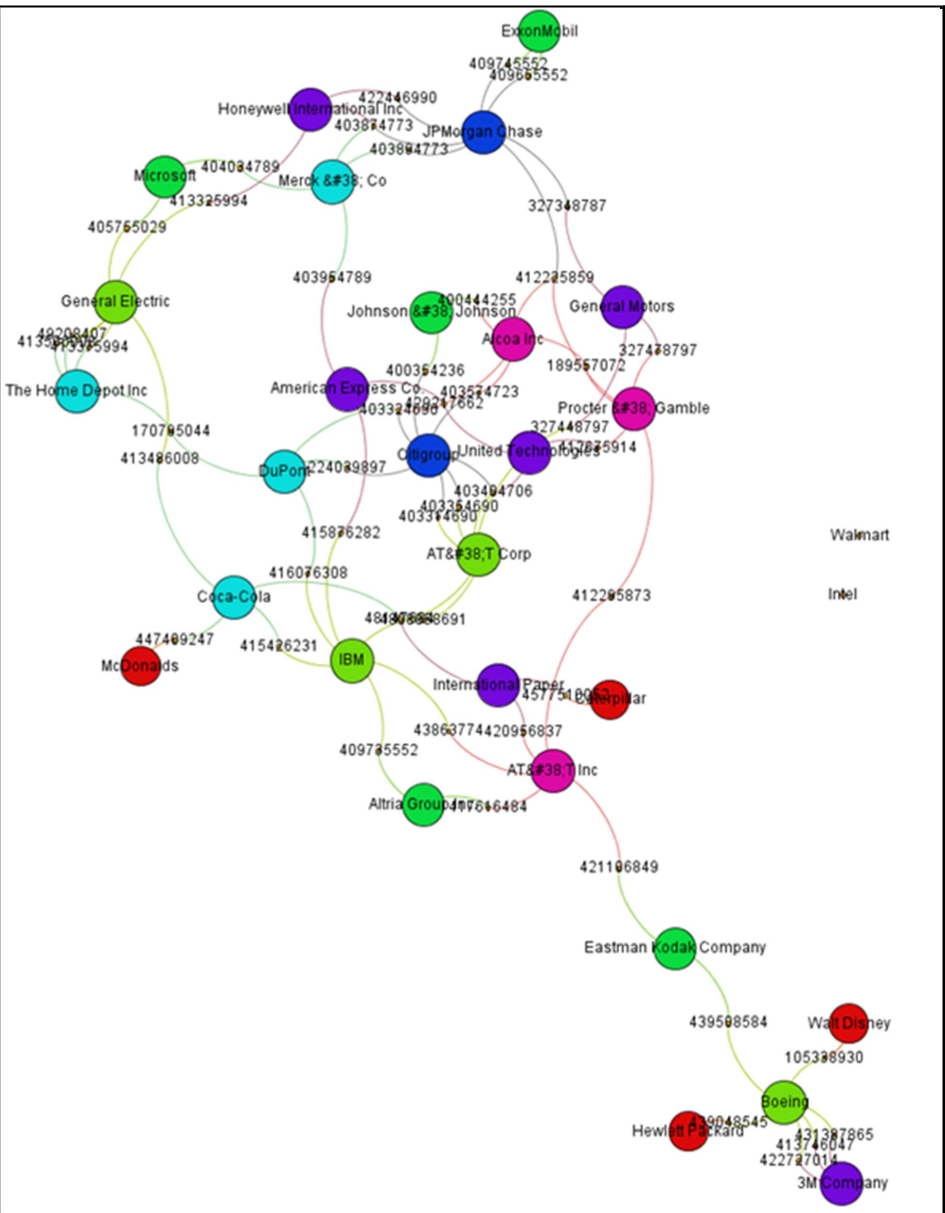 Figure 1: The bipartite network showing the "inner circle" of directors connecting major corporations in 2001.
Experiments & Results: Stability Amidst Crisis
The study analyzed the density, modularity, and clustering of the network from 2001 to 2010.
- Stable Density: The graph density remained steady near 10-11%.
- Statistical Significance: When comparing 2001 directly to 2010, the Bayesian posterior distribution for the "difference in cohesiveness" centered near zero. In academic terms: No significant change.
- The 2008 Shock: The only notable fluctuation occurred during the 2008-2009 financial crisis, where a slight decrease in cohesiveness was observed, but the network quickly rebounded.
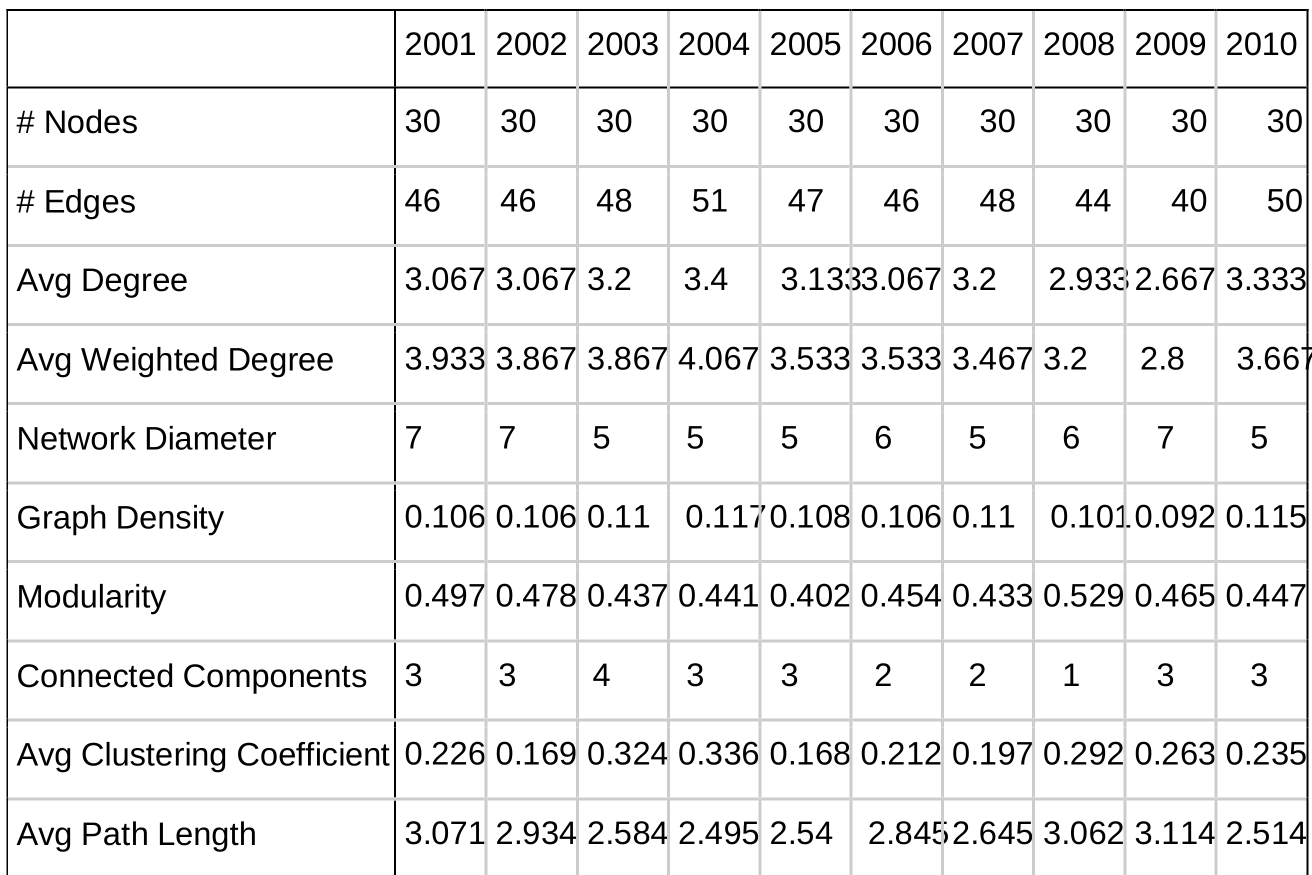 Figure 2: Key network measures showing the stability of the DOW 30 "Elite" core across a decade of economic volatility.
Critical Insight: Why Mizruchi Might Still Be Right (or Not)
The paper doesn't outright debunk Mizruchi; rather, it suggests that the "fracturing" isn't happening in the short term. The Dow Jones 30 represents a "rich club"—a core so central to the global economy that it is impervious to the forces of disintegration affecting smaller firms.
Takeaway for Researchers: When modeling social change, the choice of "window" matters. A decade might show stability, while a century shows collapse. The "hull" method proposed here provides the mathematical framework to finally begin that century-long investigation.
Conclusion & Future Work
The authors conclude that the corporate elite's core is more resilient than hypothesized. Moving forward, the team aims to extend this Bayesian analysis back to 1945. Only by examining the post-WWII era in its entirety can we confirm if the "voice" of the elite has truly been silenced or if it has simply moved to different, less visible channels.