
Google's Machine Learning MOOC: Bridging the Gap Between Learning and Production
Corporate Learning at Scale: Lessons from a Large Online Course at Google
This paper presents a case study of Google's internal Machine Learning (ML) MOOC, designed to scale engineering expertise across 80+ global offices. It introduces a unique evaluation framework that moves beyond traditional completion rates by tracking longitudinal behavioral changes through central code repository logs.
Executive Summary
TL;DR: Google Research conducted a massive internal Machine Learning (ML) course for 6,500+ engineers, blending theory with proprietary tool tutorials. Unlike typical MOOCs that focus on completion rates, this study proposes a revolutionary metric for success: tracking whether students actually write more ML-related code in the company’s central repository after finishing the course.
Context: Published at the inaugural ACM Conference on Learning @ Scale (2014), this work marks a shift from "education as content delivery" to "education as measurable behavioral change" within the world's most sophisticated engineering culture.
The Motivation: Moving Beyond "Single-Digit" Success
Modern MOOCs are often criticized for their high attrition rates. In a corporate setting, the stakes are higher; time spent training is time away from building products. Google's researchers realized that standard metrics—like watching a video or passing a multiple-choice quiz—don't prove that an engineer can actually implement a Neural Network or a Decision Tree in a production environment.
The core insight here is Access to Data. Because Google tracks code execution and maintains a unified repository, they have the "Ground Truth" of learning: actual implementation.
Methodology: The Hybrid Learning Model
The course was structured to remove the "abstraction barrier" between academic theory and practical utility.
1. Three-Tiered Content Architecture
- Theory: Lectures by ML experts on foundational concepts.
- Case Studies: Internal experts explained how these theories were applied to specific Google products (e.g., Search, Ads).
- Application: Optional programming assignments using Google’s internal libraries (e.g., early versions of TensorFlow-like frameworks or MapReduce-based ML).
2. Flexible Delivery
Students chose their "Learning Manifold":
- Synchronous: Live streams to office viewing rooms for social learning.
- Asynchronous: Watching recordings individually at their own pace.

Analyzing the Impact: Early Results
The study highlights a significant shift in perceived expertise. Before the class, a vast majority of participants identified as "Novices." Post-course surveys indicated not just a growth in knowledge, but a surge in "ML Advocacy" within the company.
- 62% of respondents started ML-related conversations with managers or teammates.
- 46% intended to use ML in their next project.
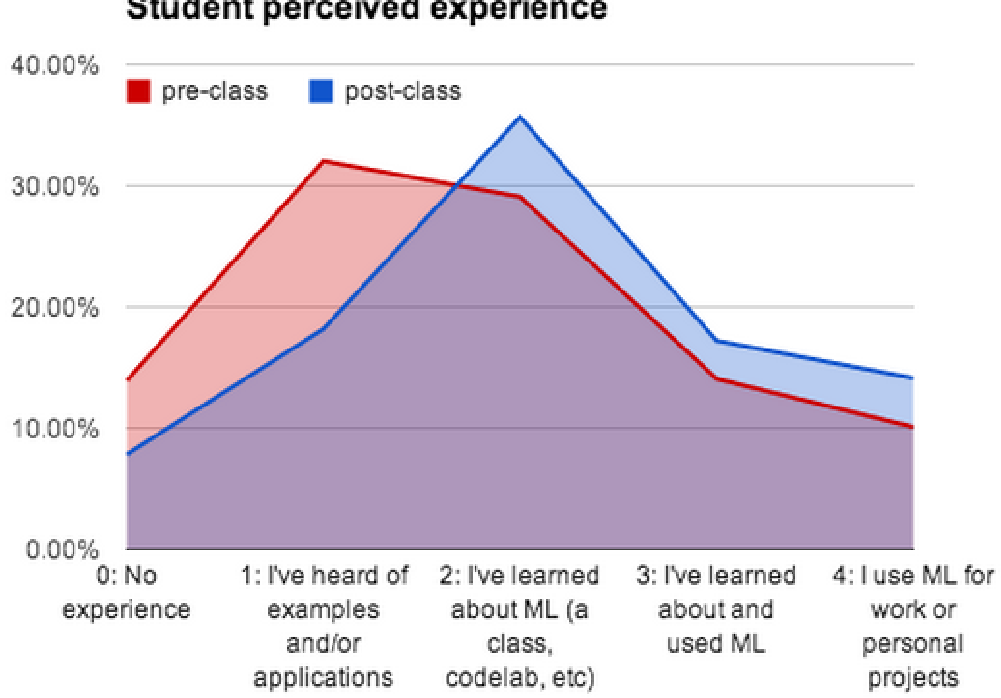 Figure 1: Comparison of pre- and post-class surveys showing the distribution of ML experience.
Critical Insights & Future Outlook
The "Google Way" of learning suggests that Social Density matters. By allowing students to watch in groups, the course functioned as a social network, increasing the "Reachability" of expert knowledge across the organization.
The Limitations: The paper is a "Poster" entry, meaning the deep longitudinal analysis of the code repository was still in progress at the time of publication. However, the framework it sets—matching student IDs to code commits—is the Gold Standard for Technical Training Evaluation.
Final Takeaway: For any tech organization, the lesson is clear: Stop measuring "modules completed" and start measuring "pull requests using the new stack." That is the only metric that truly scales.