
Unmasking the Corporate Shadow: A Graph-Based Approach to Residence Fraud
Corporate residence fraud detection
This paper presents the first data mining application specifically designed for Corporate Residence Fraud Detection, a task aimed at identifying companies that deceitfully claim residency in low-tax countries. The authors propose a hybrid approach combining structured tax data with fine-grained transactional invoicing data using techniques like Big Bayes, relational learners on bipartite graphs, and stacked models.
Executive Summary
TL;DR: Researchers have developed a groundbreaking system for the Belgian government to detect companies illegally claiming foreign residency to dodge taxes. By shifting from traditional "summary stats" to a massive graph-based analysis of every single invoice, the system identifies fraud patterns with an AUC of 96% and provides "Lifts" hundreds of times more efficient than manual audits.
Positioning: This is a seminal "Big Data for Social Good" paper (presented at KDD '14) that bridges the gap between theoretical relational learning and real-world government enforcement. It moves the needle from simple feature engineering to sophisticated relational inference on bipartite networks.
The "Golf Club" Insight: Why Traditional Audits Fail
Standard fraud detection looks at "What": Is the company's revenue consistent with its sector? But residence fraud is about "Where": Is this company actually managed from Belgium while claiming to be in a tax haven?
The authors' core insight is that fine-grained transactions reveal the truth. If multiple "foreign" companies are all paying invoices to the same exclusive golf club in Brussels, it’s a smoking gun that their directors are physically present in Belgium. Traditional models aggregate this into "Total Expenses," losing the specific identity of the golf club and thus the "guilt-by-association" signal.
Methodology: The Power of the Stack
The researchers faced a "Big Data" cocktail: high volume, extreme sparsity, and high class imbalance (only 62 fraudulent cases out of nearly 900,000).
1. Data Representation: Structured vs. Transactional
They split the world into two views:
- Structured (S): Location, industry code, and legal type.
- Transactional (T): A massive bipartite graph where Belgian companies are connected to foreign entities via invoices.
2. Dual-Engine Learning
To process this, they used a "Stacked" approach:
- Relational Learners: They projected the bipartite graph into a unigraph of foreign companies. Weights were assigned using a tanh-weighted inverse degree (penalizing connections to common entities like utility companies while boosting connections to "niche" entities like the aforementioned golf clubs).
- Big Bayes: An optimized Naive Bayes variant designed to handle millions of sparse binary features by only processing non-zero elements.
 Figure: The data flow from raw invoices to the ensemble stacked model.
Experimental Battleground: Precision at the Top
The results confirm that context is king. While the Stacked Model (SVM_S+T) wins on overall ranking (AUC), the Transactional models are the "snipers" of the system.
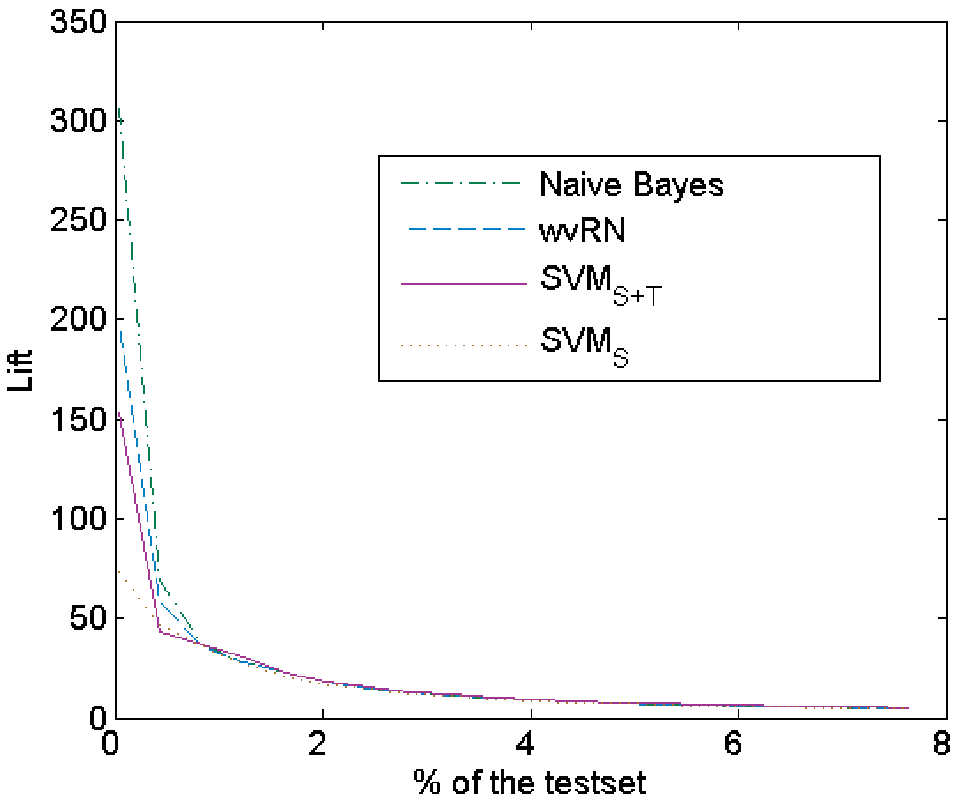 Figure: Lift curves showing that at the highest risk levels, transactional data (wvRN_T) outperforms everything else.
In practical terms, an auditor focusing on the top 0.1% of the list generated by this model is hundreds of times more likely to find a fraudster than if they picked companies at random or used traditional methods.
Beyond the Numbers: The "Explainability" Requirement
A recurring theme in high-stakes AI (e.g., government, healthcare) is that a "Black Box" is a "No-Go." Government auditors will ignore a system they don't trust.
The paper addresses this through Instance-Level Explanations: Instead of showing a coefficient, the system says: "If this company hadn't invoiced Golf Club XYZ, its risk score would drop below the fraud threshold." This allows the human expert to validate the "Relational Logic" and discard false positives (like a foreign company simply sponsoring an event).
Conclusion & Future Outlook
This work highlights a critical shift in Academic Tech: Data Asymmetry. While governments have the most valuable data (invoices), it is rarely shared or researched. By using scalable relational inference, the Belgian government isn't just "finding" fraud; they are creating a deterrence effect—making the "cost" of fraud higher than the benefit.
Takeaway for Tech Leaders: Don't aggregate your identifiers too early. The specific "Who" in your transaction logs likely holds 10x more predictive power than the "How Much."