
Corporate Valuation Through "Fuzzy Lenses": Why the Dark Side of the Moon Matters
13563_Corporate Valuation Looking Beyond the Forecast Period Through New Fuzzy Lenses.
The paper introduces a fuzzy logic-based framework for corporate valuation, specifically targeting the estimation of "Terminal Value" or "Horizon Value" in Discounted Cash Flow (DCF) analysis. It replaces traditional single-valued (crisp) estimates with multivalent fuzzy numbers (trapezoidal and triangular) to better represent financial uncertainty in long-term forecasts.
TL;DR
Standard financial models (DCF) suffer from "Aristotelian blindness"—the need to pick one single number for a future that is inherently blurry. This paper proposes a Fuzzy Logic approach to corporate valuation, specifically for the Terminal Value (the value of a company beyond the 10-year forecast). By using trapezoidal fuzzy numbers instead of rigid constants, appraisers can map out a "geometric polygon of value," providing a more transparent, credible, and holistic view of financial uncertainty.
Background: The Crisis of "Crisp" Logic
In the 21st century, the importance of intangible factors and dynamic environments has made traditional valuation problematic. Most appraisers use the Discounted Cash Flow (DCF) method, which culminates in a "Terminal Value" calculation. This single number often represents over 60-70% of a company's total value, yet it is usually treated as a static, "crisp" point.
The author argues that absolute conclusions on business values are a "celestial existence" (quoting Bertrand Russell) that doesn't apply to our terrestrial, messy reality. To fix this, we need Fuzzy Logic—a system that admits "half-true" solutions and treats "vagueness" not as an error, but as a feature of high-level knowledge.
Methodology: Deconstructing the "Horizon Value"
The core innovation lies in "fuzzifying" the perpetuity formula: Where is the future cash flow and is the cost of capital. Instead of single inputs, the author introduces Trapezoidal Membership Functions.
1. The Geometry of Uncertainty
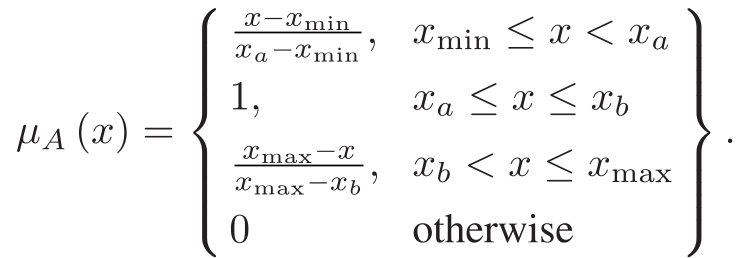
A fuzzy number is defined as a quadruple: .
- The Core (Kernel): The range represents the most plausible values (Membership Degree = 1).
- The Support: The range includes all values that are "possible to some extent."
2. The Multiplier Effect
By treating both the cash flow () and the discount rate () as fuzzy numbers, the resulting Value () becomes a complex polygon. The author demonstrates that the reactivity of value is much higher toward changes in (cost of capital) than in (cash flows), a nuance often simplified away in standard sensitivity tables.
Experimental Insight: Fuzzy vs. Probability
The paper provides a compelling comparison between the Possibilistic (Fuzzy) approach and the Probabilistic (Monte Carlo) approach.
- Probabilistic Model: Asks "How likely is this event based on past frequency?" It often collapses into a single "Expected Value," losing the "nuance" of extreme but plausible scenarios.
- Fuzzy Model: Asks "How well does this value fit our expert judgment of 'adequacy'?" It preserves the "halo" of information around the core estimate.
Key Result: The "OverValue"
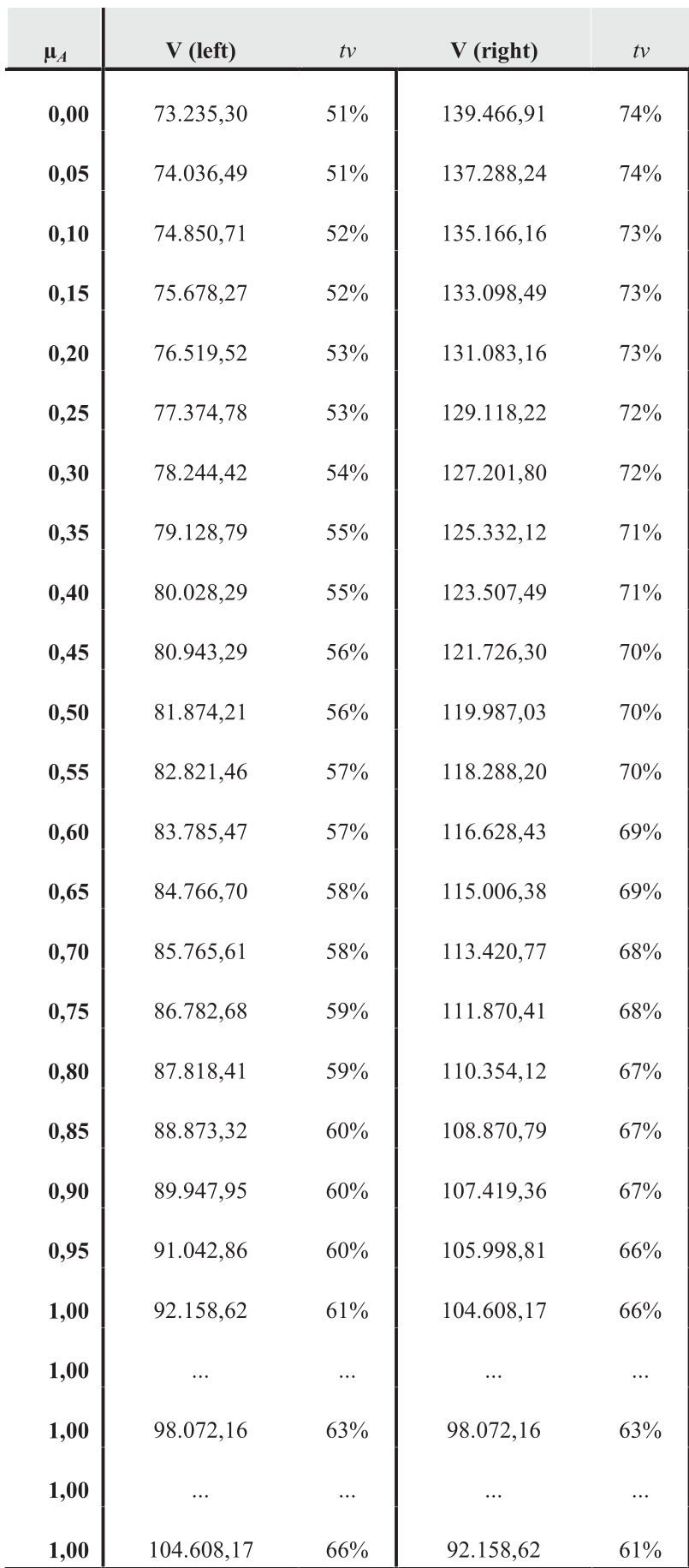
In a numerical example, a classic valuation might result in a median value of 98,072 kcu. The fuzzy model, however, reveals that the "Adequate Value" range is actually 92,159 to 104,608 kcu, while extreme but possible tail-risk values stretch from 73,235 to 139,467 kcu.
Deep Insight: "Impressionistic" Valuation
The author uses a beautiful analogy: traditional DCF acts like a high-shutter-speed camera trying to capture a moving object, resulting in a frozen, albeit unrealistic, image. Fuzzy valuation acts like an Impressionist painter (Monet), capturing the motion, the light, and the "blurs" that actually define the object's existence in a dynamic space.
By "zooming" into the terminal period through a deconstructionist lens, managers gain:
- Transparency: No more hidden assumptions behind a single "lucky" number.
- Strategic Flexibility: Identifying the impact of a new strategy on the "shape" of the fuzzy value.
- Risk Management: Quantifying the "Fuzzy Risk Premium"—the gap between a crisp estimate and the defuzzified center of gravity.
Critical Analysis & Conclusion
Takeaway
The paper successfully bridges the gap between philosophical "vagueness" and rigorous financial metrology. It transforms corporate valuation from a "fact-finding" mission into an "opinion-mapping" exercise.
Limitations
- Subjectivity: The model relies heavily on "expert judgment" to define the boundaries of the fuzzy numbers. If the experts are biased, the "fuzzy lenses" simply magnify that bias.
- Axiological Resistance: The financial industry is deeply rooted in the "single-number" paradigm for the sake of simplicity in contracts and stock prices.
Future Outlook
As Artificial Intelligence and Neural Networks become more integrated into Business Intelligence, Expert Systems will likely use these fuzzy logic frameworks to provide real-time, "spectral" valuations of companies, moving away from static PDF reports toward dynamic, geometric value maps.
Final Thought: If you only look at the "near side of the moon" (the visible, predictable cash flows), you miss the "halo" of the terminal value that ultimately determines the company's gravity.