
Decoding Radicalization: Quantitative Linguistic Insights into the KavkazChat Extremist Forum
Using Corpus Linguistics Tools to Analyze a Russian-Language Islamic Extremist Forum
This study utilizes corpus linguistics tools (WordSmith Tools 4.0) to analyze Russian-language Islamic extremist discourse on the "KavkazChat" forum following the 2010 Moscow Metro bombings. By comparing extremist posts with general internet commentary, the authors identify distinct linguistic patterns, such as the "us-versus-them" dichotomy and the systematic avoidance of the term "terrorism."
TL;DR
This research provides a rare quantitative glimpse into the Russian-language extremist digital underground. By analyzing the "KavkazChat" forum through corpus linguistics, authors Tatiana Litvinova et al. demonstrate how extremists systematically reframed the 2010 Moscow Metro bombings not as a tragedy, but as a "righteous war." Their findings reveal a linguistic infrastructure built on polarized "Us vs. Them" narratives and the strategic avoidance of criminalizing terminology.
Background & Motivation
Most counter-terrorism research is stuck in a qualitative bottleneck—manual discourse analysis that is hard to scale and often Eurocentric. The authors identify a critical gap: the lack of quantitative data on Russian-speaking extremist networks. Leveraging data from the University of Arizona's Dark Web Project, they gained access to the restricted KavkazChat forum to understand how ideology is encoded in the very fabric of language during the immediate aftermath of a high-profile attack.
Methodology: The Corpus Approach
The study compared two distinct datasets (corpora):
- Extremist Corpus (EC): 50,447 words from KovkazChat members.
- Reference Corpus (RC): 42,878 words from mainstream news commenters (The Village, Radio Svoboda).
The team utilized WordSmith Tools 4.0 to perform three core analyses:
- Frequency Comparison: Identifying which words appear significantly more often in one group versus the other.
- Cluster Analysis: Finding common 3-word strings (trigrams) to capture recurring phrases.
- Collate Identification: Using Mutual Information (MI) scores to see which words "stick together" (e.g., how the word "You" is paired with "Kill" or "Blow up").
 Figure 1: The study focuses on Russian-language extremist discourse often hidden behind Dark Web layers.
Key Findings: The Language of a "Warrior Mentality"
1. Reframing the Narrative
The most striking difference lay in the labels used for the event. Mainstream users frequently used terms like terror, tragedy, and victim. Conversely, extremists replaced these with a war discourse. They used lemmas like war, enemy, revenge, and weapon.
Interestingly, the word "terrorist" (террорист) was used by extremists only to quote and mock "Russian kafirs" (infidels), rather than to describe themselves. This reflects a "moral superiority" mindset where the act of violence is sanitized through religious framing.
2. The Us-Versus-Them Dichotomy
Through Collate analysis, the researchers found that the pronouns "You" and "Your" in the extremist forum were strongly associated with violent verbs (blow up, kill) and nouns like territory and ideology.
| Feature | Extremist Corpus (EC) | Reference Corpus (RC) |
|---|---|---|
| Primary Focus | Religious Path, War, Revenge | Tragedy, Casualties, State Power |
| Key Entities | Mujahids, Allah, Muslims | Authorities, Putin, FSB, Victims |
| Attitude | Justification & Approval | Shock, Fear, Blame |
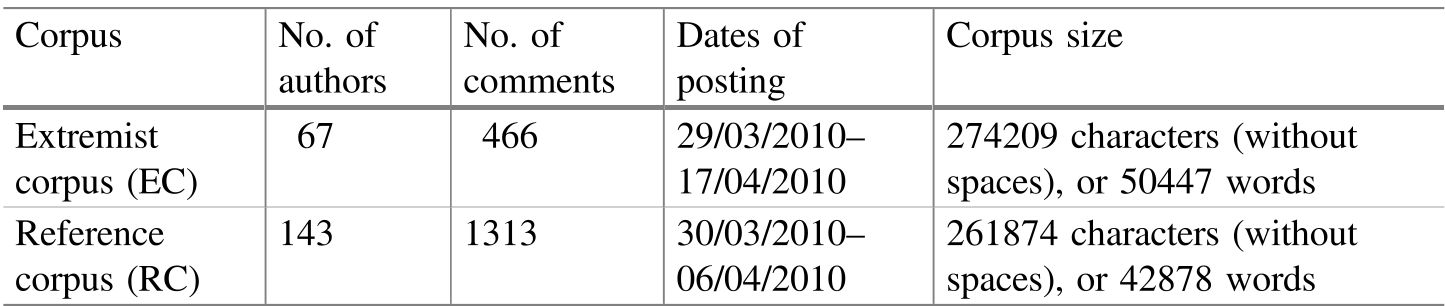 Table 1: General statistics showing that extremist posts were significantly longer (avg. 108 words) than mainstream comments (avg. 32 words), suggesting active propagation and indoctrination efforts.
Critical Insight: Fixation-Warning Behavior
The authors align their findings with the psychological concept of "Fixation-Warning Behavior." The extremist's preoccupation with a perceived enemy, combined with increasingly negative characterizations (e.g., calling Russia a "blood empire"), serves as a quantifiable marker for radicalization. The forum acted not just as a space for discussion, but as a platform for "warrior mentality" training, where any dissenting peaceful interpretation of Sharia law was immediately purged.
Conclusion & Future Looking
This paper proves that corpus linguistics is more than an academic exercise; it's a diagnostic tool for national security. While the study is limited by its specific timeframe (2010), it provides the blueprint for future AI-driven classifiers that can monitor extremist sentiment in real-time.
The transition from manual reading to automated thematic modeling (TopicMiner) and Linguistic Inquiry and Word Count (LIWC) represents the next frontier in understanding the hidden motives of those dwelling in the web's darkest corners.