
CorpWiki: Elevating Corporate Intelligence via Neural Expert Matching
CorpWiki: A self-regulating wiki to promote corporate collective intelligence through expert peer matching
This paper introduces CorpWiki, a self-regulating corporate wiki system designed to enhance collective intelligence through an automated quality assurance framework. The core mechanism is the Expert Peer Matching (EPM) algorithm, powered by feed-forward neural networks (FFNN), which identifies and assigns the most suitable in-house experts to improve low-quality articles.
TL;DR
CorpWiki is a self-regulating wiki system that solves the "quality-latency tradeoff" in corporate knowledge management. By utilizing a Feed-Forward Neural Network (FFNN) based algorithm called Expert Peer Matching (EPM), the system automatically identifies the best employee to fix an inadequate article, ensuring high-quality content with minimal organizational overhead.
Problem & Motivation: The "Gardener" Bottleneck
In the modern enterprise, knowledge is a fluid asset. However, organizations often struggle with two extremes:
- Hierarchical Expertise: High quality, but extreme latency (knowledge moves up the chain).
- Flat Wikis (Web 2.0): Low latency, but questionable quality and a lack of authorship recognition.
The authors' insight is grounded in the "Wisdom of the Crowds" theory. They realized that for a crowd to be "wise," it needs Aggregation and Independence. CorpWiki acts as the aggregator, using machine learning to filter the noise of the crowd and pinpoint the exact expertise needed at the right moment.
Methodology: The Core EPM Algorithm
The "secret sauce" of CorpWiki is the Expert Peer Matching (EPM) algorithm. Instead of waiting for a volunteer, the system proactively manages content quality.
1. The Mapping Function
The FFNN approximates a complex, non-linear function:
- CAQ (Current Article Quality): Derived from peer review grades.
- PEX (Peer Expertise): The historical quality of a user's contributions in a specific domain.
- ACR (Acceptance Ratio): The likelihood of a user saying "yes" to a system request.
2. System Architecture
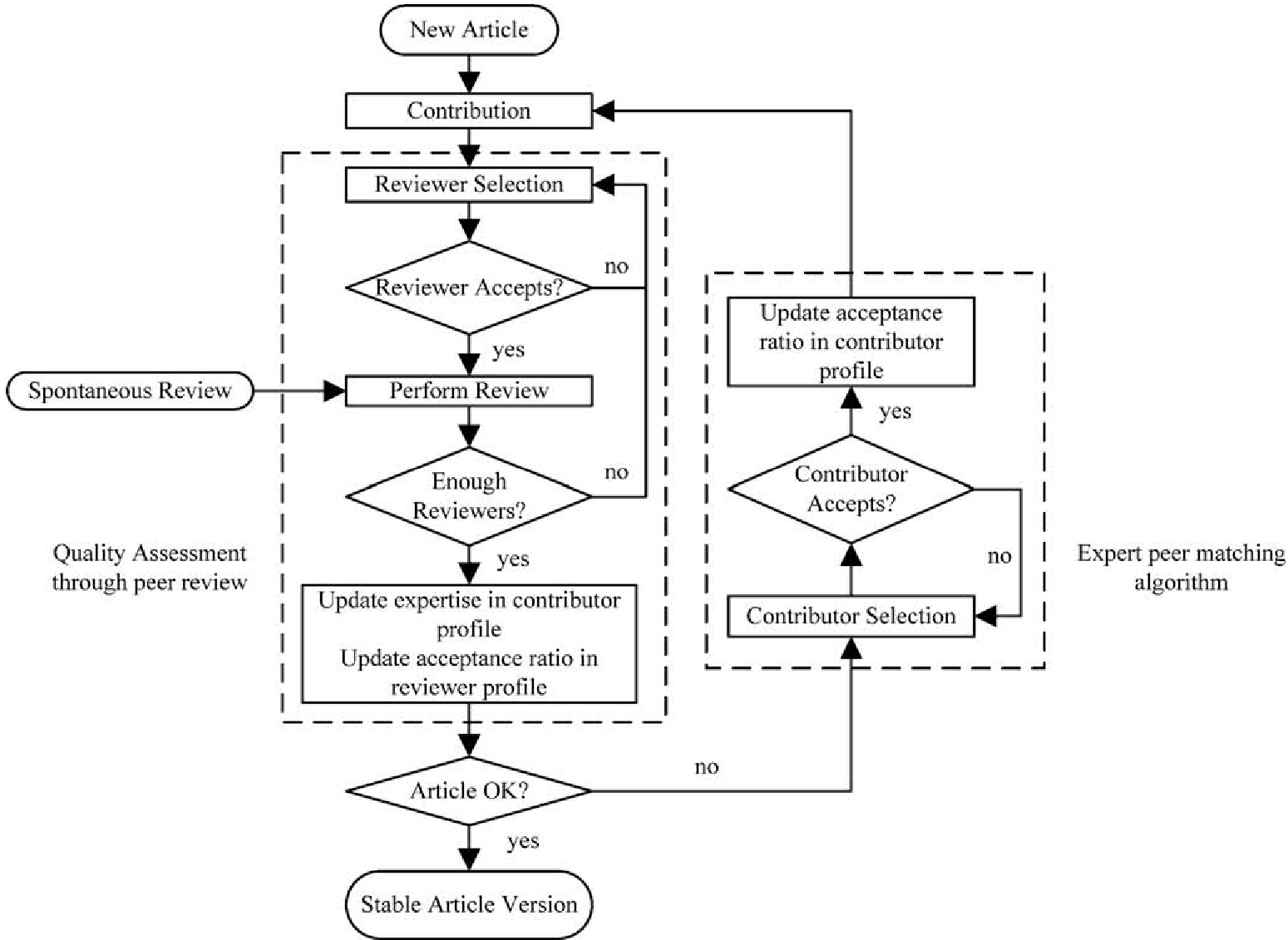
The architecture facilitates a continuous loop of contribution, assessment, and improvement.
3. Balancing Choice: Fairness vs. Expertise
A common pitfall in expert systems is "expert burnout." To combat this, the authors implemented a Fairness-based policy using Jain’s Fairness Index. By adjusting a parameter , management can choose between selecting the absolute best expert or the least-busy qualified expert.
Experiments & Results: Efficiency Gains
The authors validated CorpWiki through extensive simulation across several scenarios:
Reaching SOTA Quality Faster
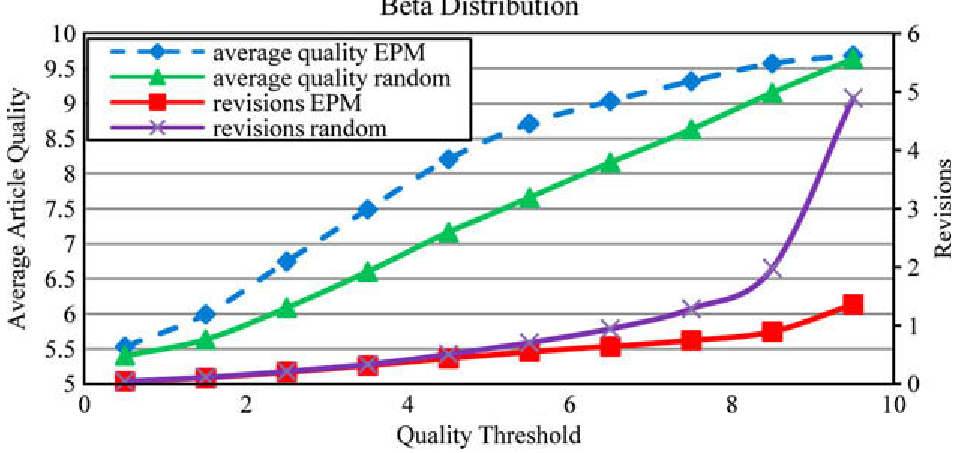
The EPM algorithm consistently outperformed random selection. Specifically, at high-quality thresholds (9.5/10), CorpWiki required significantly fewer revisions.
The "RevRank" Innovation
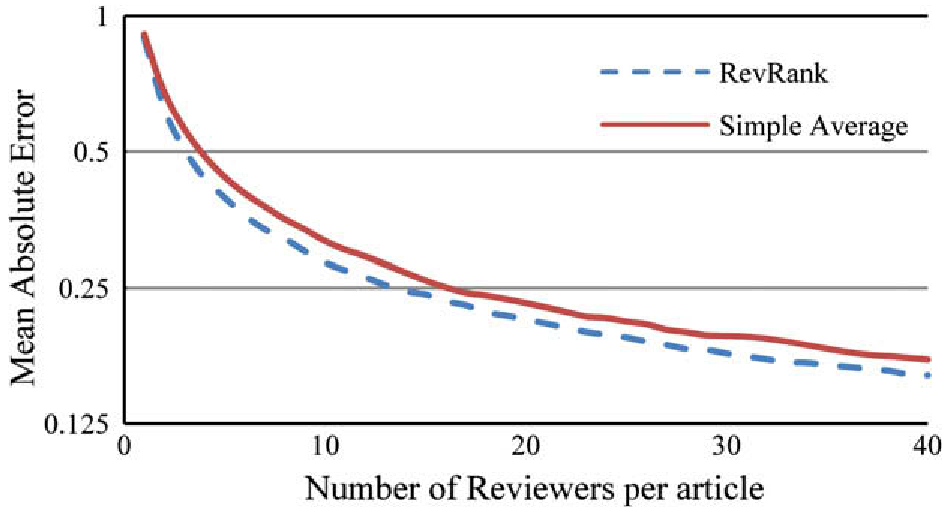
Inspired by Google's PageRank, the authors introduced RevRank. It weights the grade of a reviewer by their expertise. The results show that RevRank allows the system to reach an accurate article quality estimation with far fewer reviewers than a simple average calculation.
Deep Insights & Conclusion
Summary of Impact
CorpWiki successfully shifts the paradigm of corporate wikis from static storage to active intelligence. By automating the "matching" of problems to experts, it reduces the friction usually found in decentralized knowledge sharing.
Limitations & Future Outlook
While the neural network approach is robust, it relies on a "warm start" (initial data density) to be effective. The paper notes that during the system's infancy, random selection is actually better for "discovering" hidden experts across the organization.
Future Work: The integration of Semantic Web capabilities and the advent of LLMs (not available at the time of original publication) could potentially replace the FFNN for even more nuanced expert matching based on the actual text content of the articles, rather than just historical meta-data.