
COSI: Scaling Subgraph Matching to Billion-Edge Social Networks via Cloud Intelligence
COSI: Cloud Oriented Subgraph Identification in Massive Social Networks
This paper introduces COSI (Cloud Oriented Subgraph Identification), a distributed system for efficient subgraph matching in massive social networks. By combining a "master-slave" cloud architecture with a novel probabilistic graph partitioning strategy, COSI achieves SOTA performance on graphs with up to 778 million edges.
TL;DR
Subgraph matching is the "holy grail" of social network analysis—and its greatest computational nightmare. COSI (Cloud Oriented Subgraph Identification) breaks the scale barrier by moving from single-machine constraints to a distributed cloud architecture. By treating graph partitioning as a probabilistic optimization problem, COSI handles graphs with 778 million edges, delivering query results in less than a second where traditional databases would hang for minutes.
The Bottleneck: Why Your RDBMS Fails at Social Graphs
In a massive social network, a query like "Find all faculty in Italy who are friends with Prof. Dooley and have commented on his papers" translates to a complex subgraph matching task.
Traditional Relational Database Management Systems (RDBMS) like PostgreSQL treat these as a series of massive joins. As the graph grows, the join overhead explodes. While specialized graph indexes like DOGMA work well on single machines for ~25M edges, they cannot handle the nearly 1 billion edges found in modern datasets from Facebook or Flickr. The challenge isn't just storage; it's the communication cost between servers when a query "hops" from a vertex on Node A to a neighbor on Node B.
The Methodology: Probabilistic Partitioning
The core insight of COSI is that not all edges are created equal. If two vertices are likely to be accessed together in a query, they must live on the same physical machine to avoid "network noise."
1. Weighted Graph Transformation
COSI learns from historical query logs to calculate:
- P(v): The probability a vertex is retrieved.
- P(v1, v2): The probability that v2 is retrieved immediately after v1.
The system builds a weighted graph where edge weights reflect these co-retrieval probabilities. According to the authors' theoretical framework, producing a minimal edge cut on this weighted graph is mathematically equivalent to minimizing the total expected communication cost of query execution.
2. The COSI Partition Algorithm
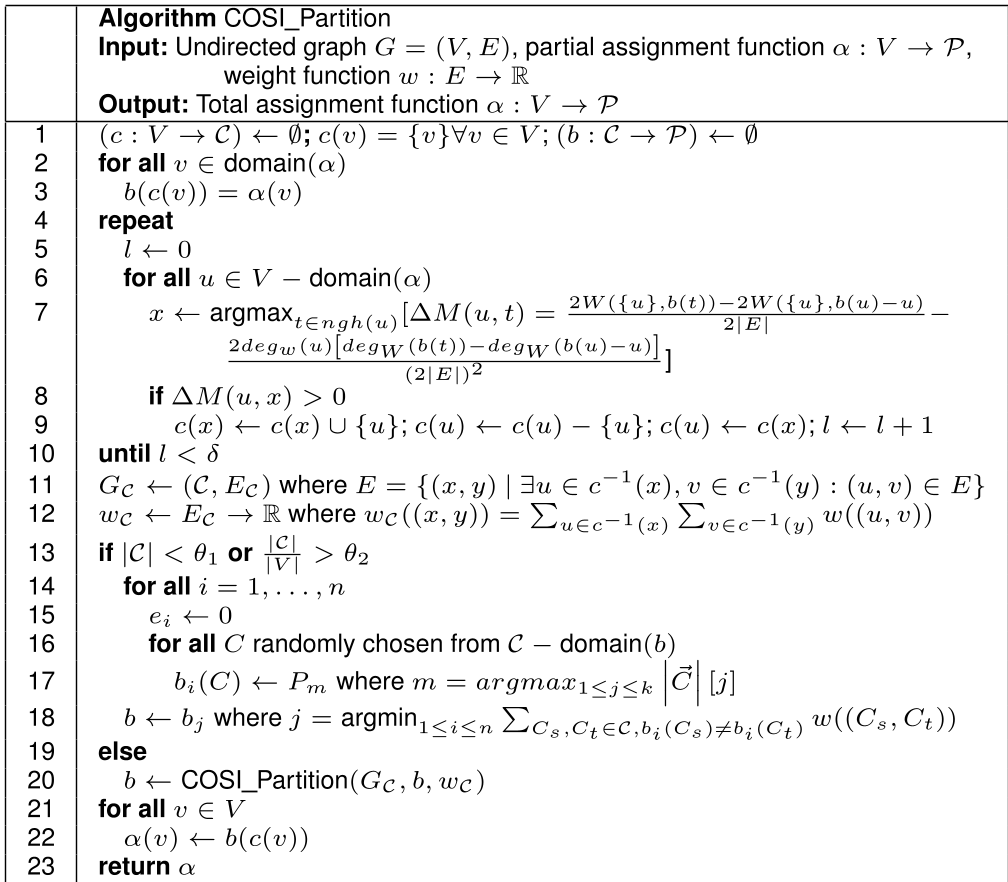
Since finding the perfect edge cut is NP-complete, the authors proposed a multi-level partitioning algorithm. It uses Graph Modularity to identify "communities" (clusters of vertices) and collapses them into higher-level nodes to simplify the partitioning task.
Execution: Locality vs. Parallelism
Even with perfect partitioning, the query engine must be smart. COSI offers two flavors:
- COSI basic: A standard asynchronous depth-first search.
- COSI heur: An optimized version using a cost function ().
The function is the secret sauce. it considers:
- Branching Factor: Preferring variables with fewer candidates.
- Locality: Favoring paths that stay on the current slave node.
- Workload Balance: Ensuring no single slave node becomes a "hotspot."
Experimental Results: 10,000x Speedup
The researchers tested COSI on a cluster of 15 storage nodes using a 778M edge dataset.
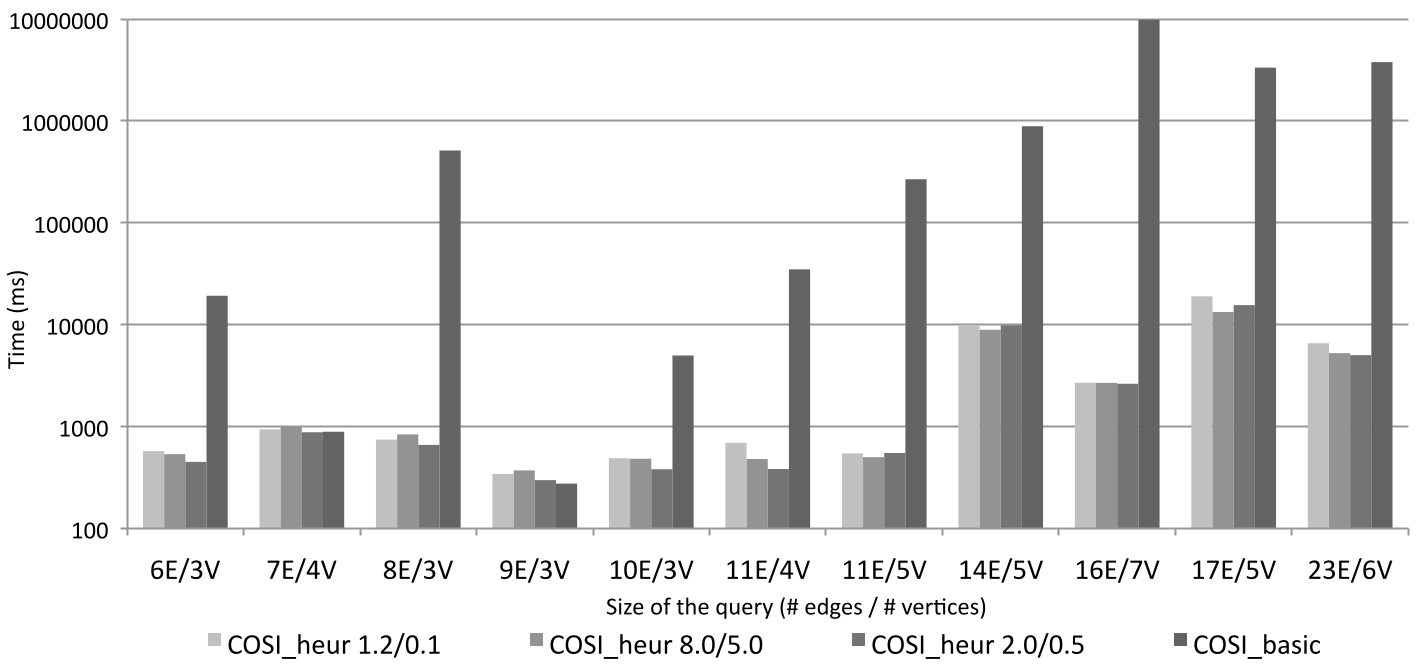
The results were staggering:
- COSI heur outperformed the basic version by up to 4 orders of magnitude ().
- Complex queries involving multiple variables and edges were consistently resolved in sub-second times.
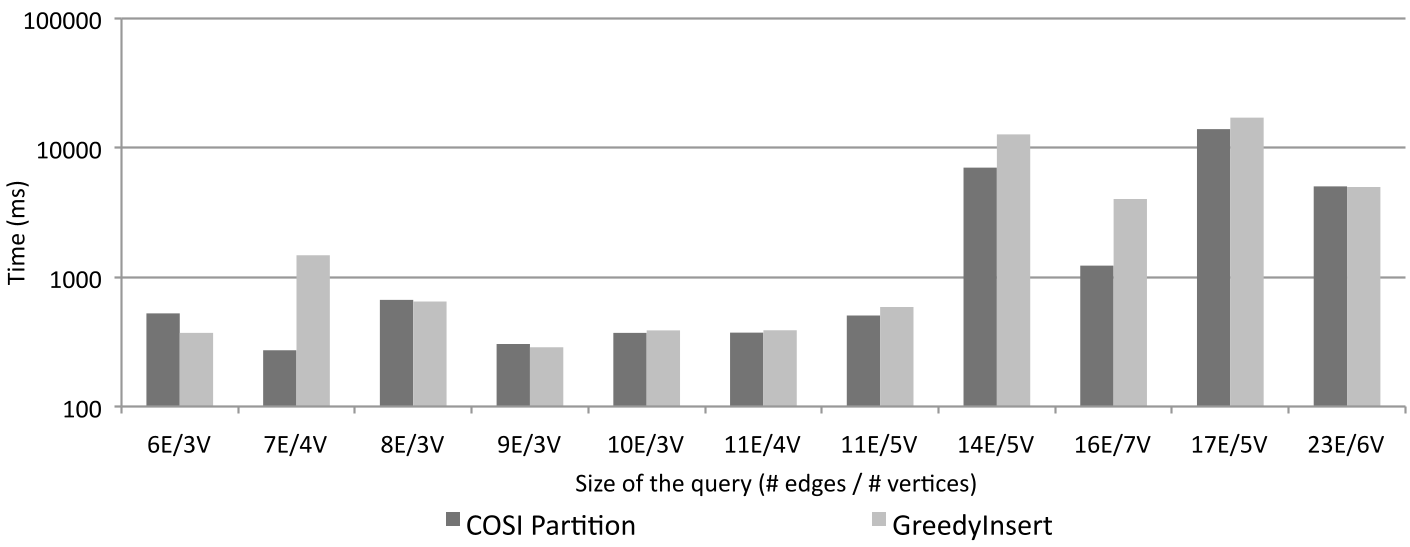
- Partition Impact: The specialized COSI partitioning (based on modularity) significantly reduced query latency compared to a simple Greedy approach, proving that "where you put the data" matters as much as "how you search it."
Critical Analysis & Conclusion
COSI demonstrates that cloud architecture is the only viable path for massive-scale subgraph matching. Its strength lies in its asynchronous execution (no central master bottleneck) and its query-aware partitioning.
Limitations: The system relies heavily on having a representative "query distribution" to calculate edge weights. In environments with highly unpredictable or rapidly shifting query patterns, the initial partitioning might lose its edge over time.
Future Outlook: As we move toward the era of real-time social analytics, the principles of COSI—minimizing cross-node communication through probabilistic affinity—will likely be integrated into the next generation of Graph Neural Network (GNN) infrastructures and distributed RDF stores.