
This paper utilizes discrete Morse theory and persistent homology to quantify the impact of massive neutrinos on the multiscale cosmic web, specifically focusing on filaments. By analyzing N-body simulations (MassiveNuS and QUIJOTE), the authors demonstrate that neutrinos leave mass-dependent imprints on skeleton connectivity, achieving a few-percent level detection sensitivity for masses as small as eV.
Executive Summary
TL;DR: Researchers from Sejong University have pioneered a method to "weigh" the elusive neutrino by looking at the very shape of the universe—its cosmic filaments and voids. Using Persistent Homology and Discrete Morse Theory, they found that massive neutrinos act as a cosmic "shaper," lengthening filaments and slowing down the emptying of voids, leaving a detectable topological fingerprint even at minuscule mass scales ( eV).
Background Position: This work moves beyond traditional two-point correlation functions (which only measure "how much" matter is where) into the realm of Topological Data Analysis (TDA). It is a sophisticated "SOTA-level" analysis that addresses the non-linear regime of structure formation, where standard linear theory fails.
Moving Beyond Power Spectra: The Topological Motivation
While we know neutrinos have mass (thanks to the 2015 Nobel Prize), measuring their absolute mass remains one of the "Holy Grails" of physics. Standard methods use the Matter Power Spectrum, but these are plagued by degeneracies—where different cosmic parameters can look identical.
The authors' key insight is that massive neutrinos possess high thermal velocities (free-streaming). This prevents them from clumping at small scales, which doesn't just "blur" the map; it fundamentally changes the connectivity and hierarchy of the Cosmic Web. By treating the universe as a mathematical manifold rather than just a density grid, we can isolate neutrino signatures that are hidden in plain sight.
Methodology: The Persistence of Topology
The core of the study relies on Discrete Morse Theory. Unlike standard calculus, which needs smooth functions, this method works directly on the discrete points (particles/galaxies) of the universe.
- Delaunay Tessellation: Space is partitioned into a web of triangles and tetrahedrons.
- Morse-Smale Complex: The algorithm identifies "Critical Points" (Maxima, Minima, and Saddles). Filaments are mathematically defined as "arcs" connecting these points.
- Filtration & Persistence: This is the "magic" step. By varying a density threshold, the algorithm tracks when a feature (like a void) is "born" and when it "dies."
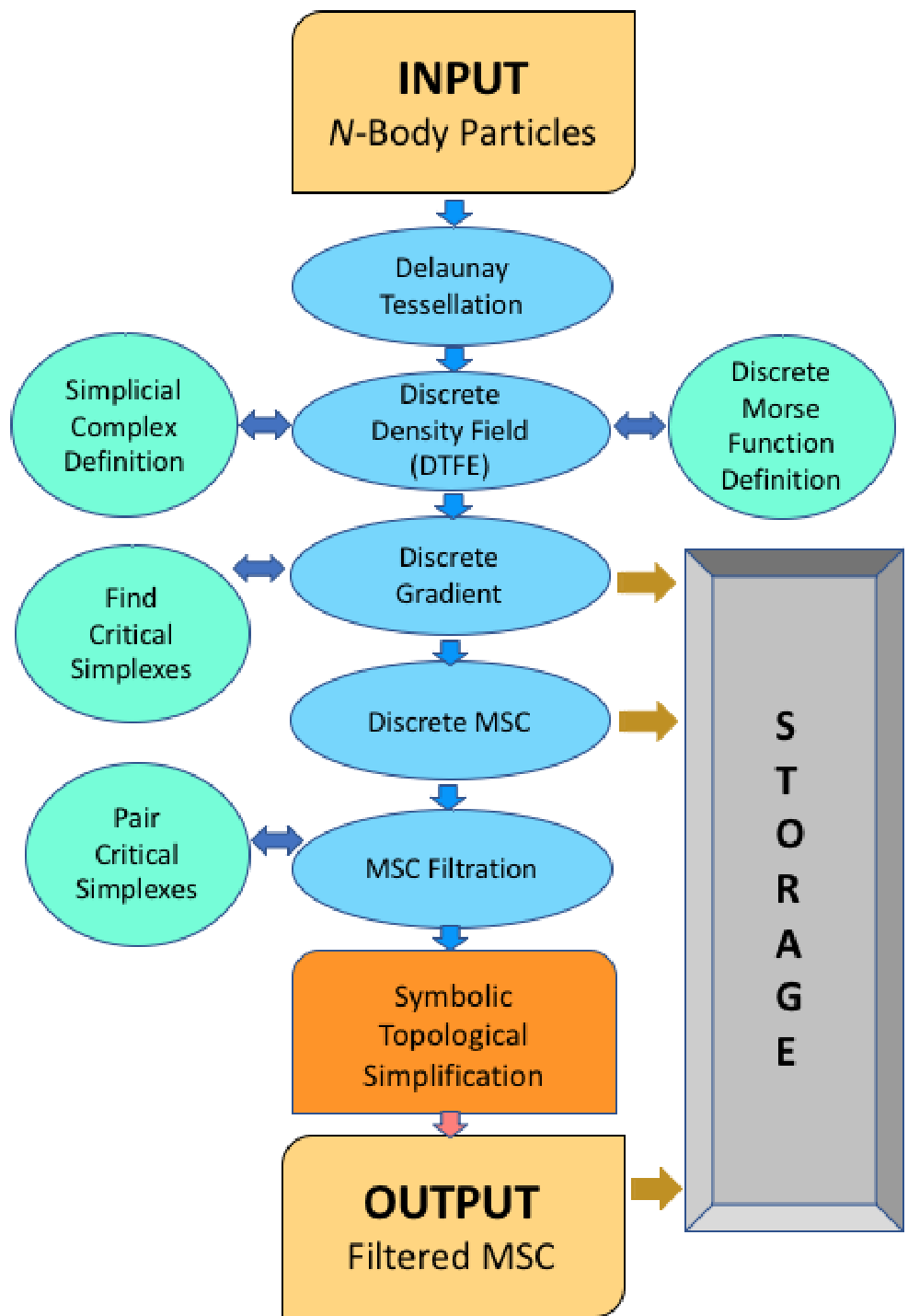 Figure 1: The analytical pipeline—from N-body simulation particles to the filtered Morse-Smale complex.
Key Experimental Insights
1. The Filament Length Distribution
The study utilized two major simulation suites: MassiveNuS and QUIJOTE. They found that the presence of massive neutrinos alters the length of cosmic filaments by up to 15% for larger masses.
- The "Spoon-like" Effect: Just as neutrinos suppress power at small scales, they lead to a deficit of short filaments and an excess of longer, more disconnected structures.
- Redshift Sensitivity: Interestingly, these effects are most visible at (when the universe was about 3 billion years old), making high-redshift galaxy surveys the perfect laboratory.
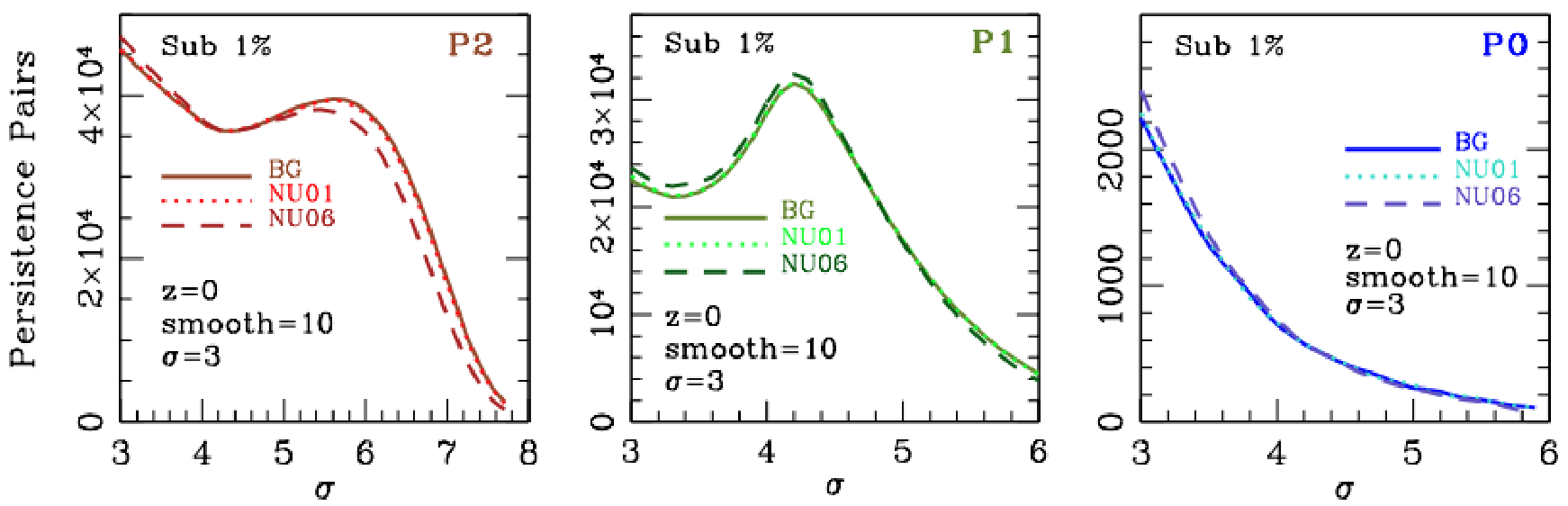 Figure 2: Evolution of filament lengths. Notice the mass-dependent departure from the baseline (black line) as neutrinos increase in weight.
2. Persistence Diagrams as a "Fingerprint"
The Persistence Diagram (a 2D plot of Birth vs. Death density) acts as a unique ID for a cosmology. The authors identified "Apex Points"—sharp clusters in these diagrams that shift systematically with neutrino mass.
- Delayed Voids: Neutrinos slow down the flow of matter out of voids. In the persistence diagram, this appears as a shift in "P0" pairs (minima-to-saddle) toward higher densities.
 Figure 3: Persistence diagrams for different neutrino masses. The shift in the 'Apex' density reflects the slowing of structure formation.
Critical Analysis & Future Outlook
The Takeaway: This research proves that the Cosmic Web's "skeleton" is highly sensitive to the most lightweight particles in the Standard Model. Filaments are not just bridges between galaxies; they are precision instruments for fundamental physics.
Limitations:
- Systematics: The results vary slightly depending on how neutrinos are simulated (linear response vs. particle-based).
- Baryonic Effects: Real-world gas and supernovae might "mess up" the clean topological signals found in these Dark Matter-only simulations.
Future Work: The authors plan to apply this to DESI and Euclid data. If the topological signal holds, we might finally pinpoint the neutrino mass and solve the hierarchy problem without needing to build a larger particle collider on Earth.
Academic Note: For a deep dive into the underlying math, see the A. Methodology section in the full paper regarding the heuristic definition of discrete Morse functions over simplicial complexes.