
Cosmos 3: The Omnimodal Breakthrough in Physical AI World Models
Cosmos 3: Omnimodal World Models for Physical AI
NVIDIA introduces Cosmos 3, a family of omnimodal world models (Edge, Nano, Super) that unify multimodal understanding and generation within a single Mixture-of-Transformers (MoT) architecture. It processes language, images, video, audio, and action sequences, establishing a new SOTA for Physical AI backbones that function as both vision-language models and world simulators.
TL;DR
NVIDIA's Cosmos 3 is a paradigm shift in embodied AI. By unifying language, vision, audio, and action into a single Mixture-of-Transformers (MoT) architecture, it eliminates the need for fragmented AI pipelines. It serves as a reasoner, a simulator, and a policy executor all at once, setting new benchmarks in Text-to-Image (T2I), Video Generation, and Robotic Control.
Problem & Motivation: The Fragmentation Bottleneck
In the current state of Physical AI, a robot cleaning a table acts like a patchwork of different "brains":
- A VLM to locate the dishes.
- A VLA or WAM to calculate arm movements.
- A World Model to simulate if the bowl will break if moved.
This fragmented architecture is computationally expensive and logically inconsistent. NVIDIA’s insight is that understanding requires reasoning about the future (generation), and generation relies on an internal model of object persistence and physics (understanding). Cosmos 3 unifies these two pillars, treating "Action" as just another modality to be modeled in a shared latent space.
Methodology: The Mixture-of-Transformers (MoT) Core
1. Dual-Tower Layer Architecture
Cosmos 3 doesn't just pile everything into one big heap. It uses a Mixture-of-Transformers approach. Within each transformer layer, there are two specialized pathways:
- The Reasoner Tower: Processes Autoregressive (AR) tokens (language and ViT-encoded vision) for understanding.
- The Generator Tower: Processes Diffusion (DM) tokens (VAE-encoded media, audio, action) for synthesis.
Crucially, these two speak to each other. The Generator tokens utilize bidirectional attention over the AR context, allowing the generated video or action to be perfectly grounded in the text prompt or reasoning trace.
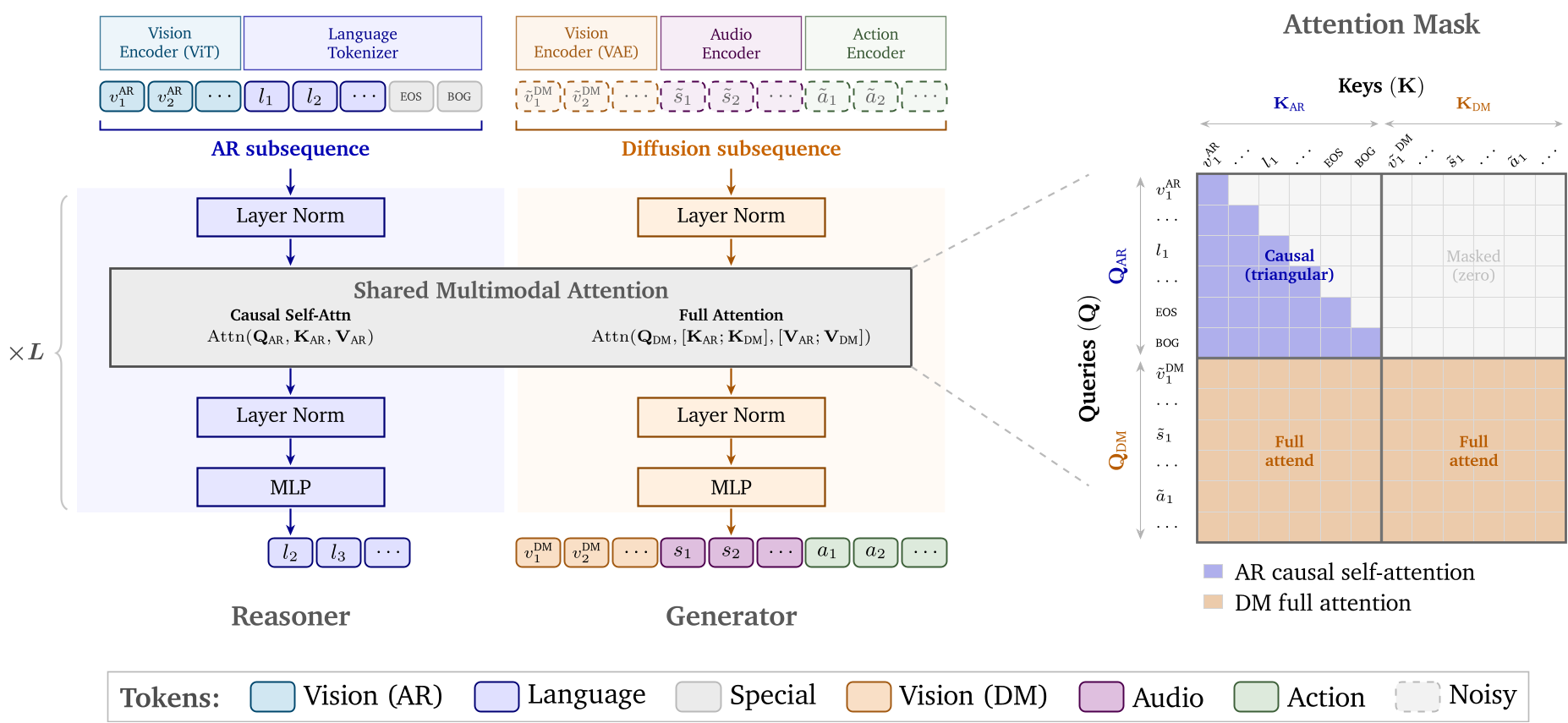 Figure: The MoT architecture preserves causal integrity for reasoning while allowing full bidirectional context for diffusion-based generation.
2. Physical Temporal Alignment (Absolute Temporal Modulation)
Handling different sensors is a nightmare because they operate at different speeds (e.g., 24 FPS video vs. 15 Hz robot actions). Cosmos 3 solves this with Absolute Temporal Modulation applied to 3D MRoPE (Multimodal Rotary Positional Embeddings). It assigns temporal coordinates based on real-world time rather than discrete token indices, ensuring that a "second" in video tokens precisely aligns with a "second" in audio and action tokens.
3. Unified Action Tokenization
Whether it's a drone's camera motion, a car's steering, or a robot's 7-DoF arm, Cosmos 3 maps them into a unified action interface. It uses relative transforms (SE(3) poses) and grasp states, allowing the model to learn a "Universal Prior" of movement across wildly different embodiments.
Experiments & Results: SOTA Across the Board
NVIDIA tested Cosmos 3 at three scales: Edge (4B), Nano (16B), and Super (64B).
Reasoning vs. Generation
As shown in the table below, Cosmos 3 is not just "good at everything"—it is often the best. It outperformed Gemini 3.1 Pro and Qwen3-VL in specialized driving and robotics reasoning while simultaneously leading the pack in image and video generation.
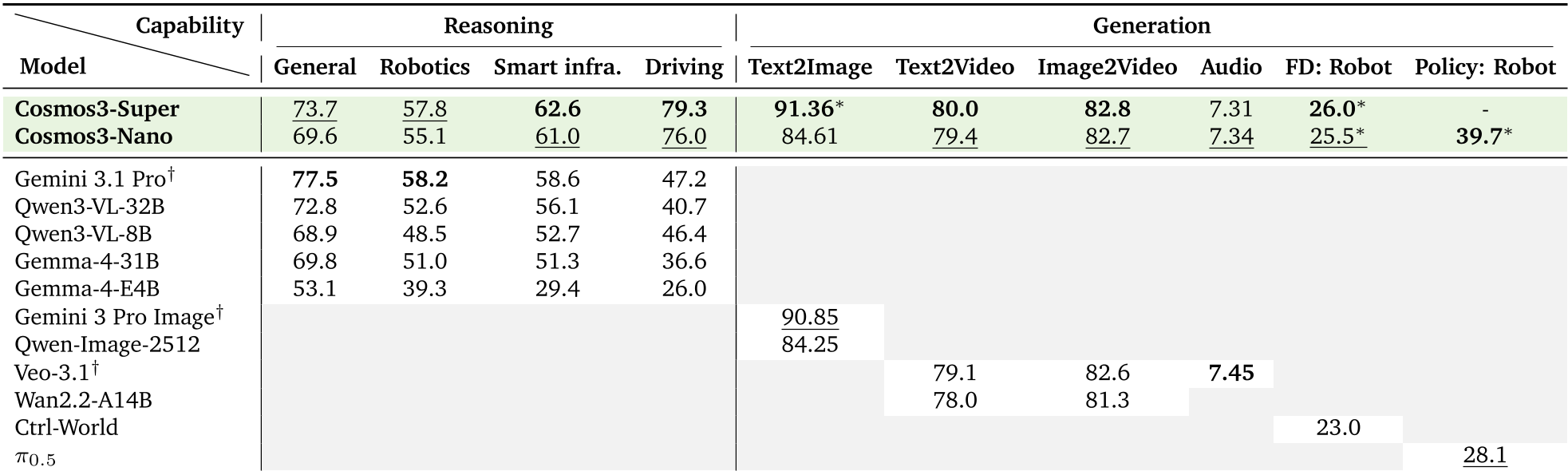 Figure: Performance of Cosmos 3 against top proprietary and open-source models.
Zero-Shot World Simulation
One of the most impressive feats is Action-Conditioned Generation. When given a robot command (e.g., "put the screwdriver on the shelf"), the model doesn't just guess the next frame; it generates a physically consistent video rollout that matches the executed action.
 Figure: Cosmos 3 executing complex multi-step instructions on the RoboArena real-world benchmark.
Critical Analysis & Conclusion
The Power of Synthetic Data (SDG)
A core component of Cosmos 3's success is NVIDIA's Open Synthetic Datasets (SDG-PhyxSim, SDG-DriveSim, etc.). While web-scale data is great for general visuals, it lacks the "long-tail" safety cases needed for Physical AI. By training on high-fidelity simulations of crashes, collisions, and warehouse fires, Cosmos 3 learns physical laws (gravity, momentum) that pure real-world data often misses.
Key Takeaways
- Unified representation is superior to task-specific pipelines for embodied agents.
- Action as a Modality: Treating control signals the same as pixels or words allows for massive cross-domain transfer.
- Efficiency: The MoT design allows for caching the Reasoner tower, dramatically speeding up the generation process.
Limitations & Future Work
The "Sim-to-Real" gap in human motion remains a challenge, as synthetic human data sometimes degrades the model's performance on real human metrics. Future work will likely focus on even tighter integration of proprioceptive feedback for closed-loop control at higher frequencies.
Cosmos 3 proves that world models are not just for generating cool videos—they are the foundational backbones for the next generation of intelligent, physical robots.