
COSNET: Harmonizing the Social Multiverse with Global Consistency
COSNET: Connecting Heterogeneous Social Networks with Local and Global Consistency
The paper introduces COSNET (COnnecting heterogeneous Social NETworks), an energy-based model designed to link user accounts across multiple social platforms. It integrates local profile features, network structure, and a triad-based global consistency mechanism to achieve state-of-the-art performance in cross-network identity linkage.
TL;DR
In our digital lives, we are fragmented across multiple platforms—Twitter for thoughts, LinkedIn for careers, and Instagram for visuals. COSNET is a sophisticated energy-based framework designed to "stitch" these identities together. By moving beyond simple pairwise matching and enforcing Global Consistency, it achieves a massive 10-30% improvement in accuracy over traditional methods.
The Problem: The Inconsistency of Pairwise Linkage
Imagine a scenario where an algorithm identifies @user_1 on Twitter as the same person as user_A on LinkedIn. It also links user_A to profile_X on Facebook. However, the algorithm fails to link @user_1 to profile_X. This logical breakage (inconsistency) is the primary failure mode of current SOTA methods that focus solely on local similarities.
The challenge is threefold:
- Imbalanced Profiles: Some accounts are rich in data; others are "ghost" profiles.
- Structural Divergence: A user's friend circle on a professional network looks nothing like their circle on a gaming platform.
- Transitivity: Ensuring that if A=B and B=C, then A=C across networks.
Methodology: The Energy-Based Approach
The authors propose COSNET, which defines the problem as finding a label configuration that minimizes a total energy function.
1. The Energy Triad
COSNET’s brain consists of three energy components:
- Local Matching (): Uses Jaro-Winkler distance for usernames and TF-IDF for profile content.
- Network Matching (): Implements "neighborhood-preserving matching." If two users are linked, their friends should likely be linked too.
- Global Consistency (): The "secret sauce." It penalizes configurations that violate the transitivity of identity by looking at triads (cycles of three account pairs).
2. Theoretical Elegance: Dual Decomposition
Optimizing this across millions of nodes is NP-hard. The authors use Lagrangian relaxation to break the complex graph into "easy-to-solve" subgraphs. This allows the model to scale efficiently using a subgradient method.
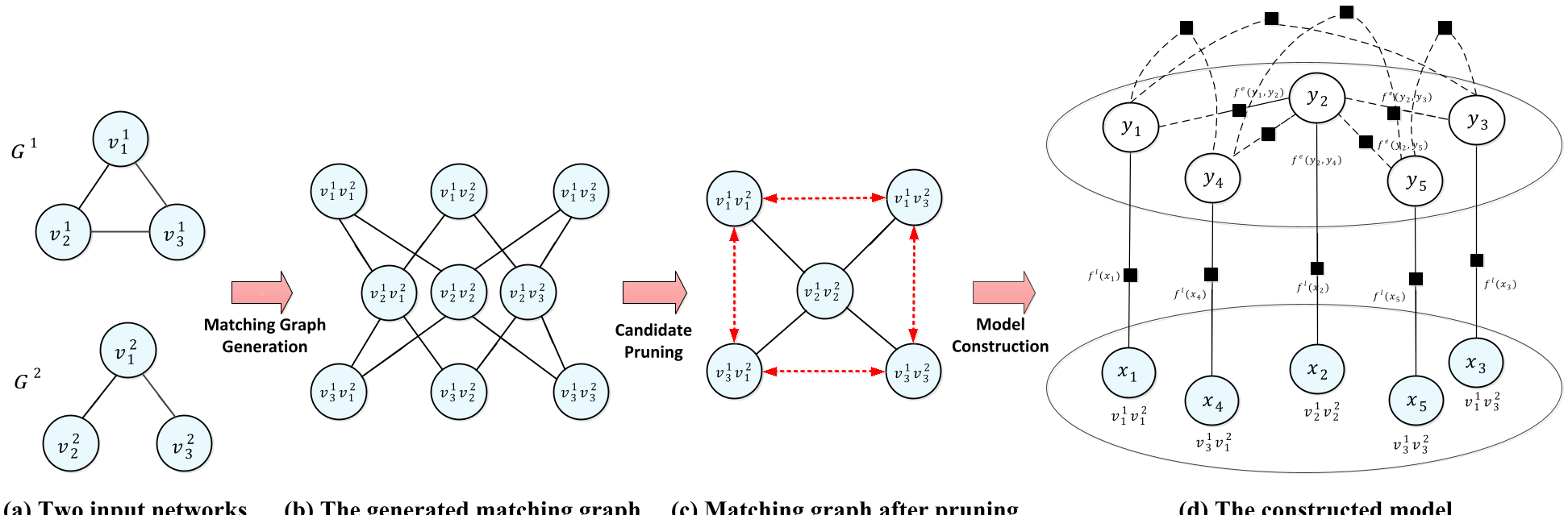 Figure: The generation of the Matching Graph and the transition from raw networks to an EBM.
Experiments: More Than Just Matching
The team tested COSNET on two massive datasets: SNS (featuring Twitter, Flickr, Last.fm) and Academia (LinkedIn, ArnetMiner).
Key Findings:
- Massive Gains: On the SNS dataset, COSNET achieved an F1-score of 76.04%, significantly higher than SVM (64.20%) or the previous SOTA, MNA (70.84%).
- Ablation Study: Removing the Global Consistency term (
COSNET-) caused a significant drop in precision, proving that transitivity logic is essential for clean data.
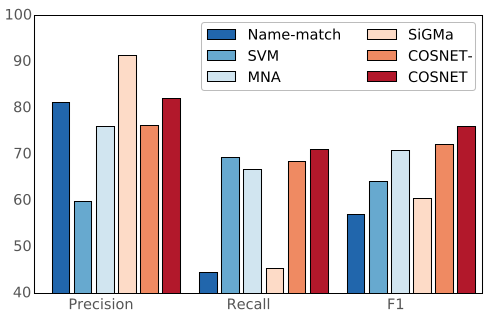 Figure: COSNET consistently outperforms baselines across various network pairs.
Real-World Impact: Expert Finding
The authors didn't just stop at matching. They applied the results to Expert Finding. By merging ArnetMiner (academic data) with LinkedIn (industry data), they built a richer graph. The result? A 5-10% boost in Precision@5 for finding the right expert for a specific topic. This proves that network integration is a "force multiplier" for downstream AI tasks.
Critical Insight & Conclusion
COSNET represents a shift from local feature engineering to global logical constraints. While many modern methods now use Deep Learning or GNNs, the core intuition of COSNET—that identity must be logically consistent across a closed system—remains a foundational principle for data integration.
Limitations: The model assumes a one-to-one constraint (one person, one account per network), which doesn't always hold true in the age of "finstas" and bot swarms. Future work scaling this to many-to-many relationships would be the next frontier.
Keywords: Identity Linkage, Social Network Integration, Energy-Based Models, Global Consistency, Dual Decomposition.