
CBTA: Achieving Cost-Efficiency and Fairness in Word-of-Mouth Crowdsourcing
Towards cost-effective and budget-balanced task allocation in crowdsourcing systems
This paper introduces the Cost-Effective and Budget-Balanced Task Allocation (CBTA) problem for word-of-mouth (WoM) crowdsourcing in social networks. It proposes two heuristic algorithms, CB-greedy and CB-local, to minimize total budget consumption while ensuring budget fairness across social groups by constructing an optimized spanning tree.
TL;DR
Crowdsourcing is shifting from direct recruitment to Word-of-Mouth (WoM) propagation. This paper tackles the CBTA (Cost-Effective and Budget-Balanced Task Allocation) problem—an NP-Complete challenge of finding a task spread path that minimizes costs without overburdening specific social groups. The authors propose two heuristics, CB-greedy and CB-local, which utilize graph spanning tree techniques to balance the "cost vs. fairness" trade-off.
Problem & Motivation: The Hidden Cost of Overlap
In modern crowdsourcing, we often rely on workers to recruit other workers (WoM mode). However, social groups often overlap. If multiple workers are paid to "spread" a task to the same group, the platform wastes its budget. Furthermore, if a single social group is forced to handle a disproportionate amount of task propagation, it creates a "budget hotspot" that threatens the long-term stability of the network.
The authors identify a critical gap: prior work focuses on facilitating dissemination (incentives) but ignores the structural optimization of the propagation path to ensure fairness and cost-efficiency simultaneously.
Methodology: Spanning Trees for Social Harmony
To solve this, the paper treats the social network as a directed graph and aims to extract a Spanning Tree . This ensures every group is reached exactly once through the most efficient path.
1. CB-greedy: The Rank-Based Approach
CB-greedy divides bids into ranks. It prioritizes edges in lower cost ranks while attempting to balance the degree of nodes within the same rank. While intuitive, its performance is highly sensitive to the parameter .
2. CB-local: Refinement via Local Search
The more sophisticated approach, CB-local, focuses on degree transformation. It starts with an arbitrary tree and iteratively performs an Adjust-Tree operation. By using Disjoint-Set data structures and Least Common Ancestor (LCA) calculations, it replaces high-cost edges with lower-cost alternatives without breaking the tree's connectivity.
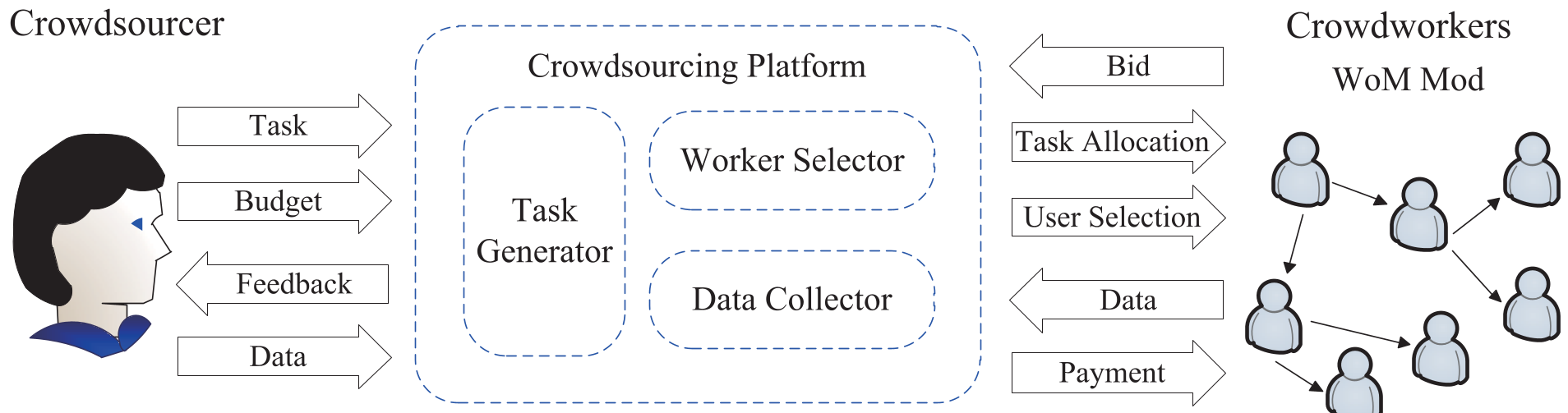 Figure: The WoM-based Crowdsourcing System Architecture.
Experiments & Results
The researchers evaluated the algorithms based on Average Consumption (cost-effectiveness) and Consumption Range (budget balance).
- Complexity: CB-local is theoretically faster, achieving , where is the inverse Ackerman function.
- Cost Effectiveness: CB-greedy performs slightly better in terms of average cost when the social network is dense, as shown in the "Average Consumption" comparison.
- Fairness (Balance): CB-local wins decisively. It keeps the "Maximum Consumption" significantly lower, preventing any single group from becoming a budget bottleneck.
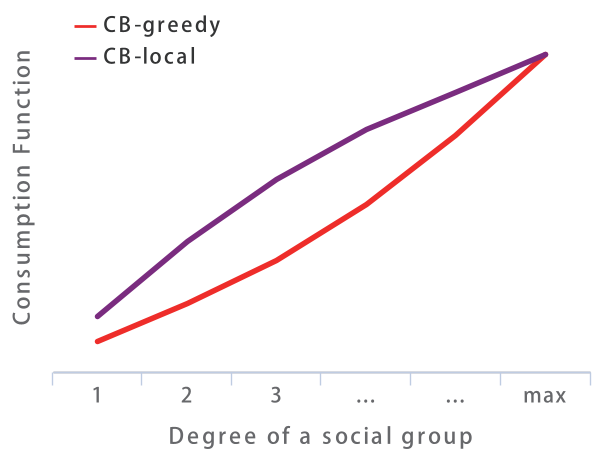 Figure: Analysis of Average Consumption and Consumption Range.
Critical Insight & Conclusion
The core takeaway is that budget balance is as important as cost minimization. While a greedy approach might save money in the short term, it creates structural imbalances.
Limitations: The model assumes a "globally visible" platform where all bids are known upfront. In many real-world scenarios, bids arrive dynamically.
Future Outlook: Integrating these structural optimization algorithms with dynamic incentive mechanisms (like Sybil-proof rewards) could lead to the first truly robust, self-sustaining social crowdsourcing ecosystem.