
ListReader: Turning Dusty Archives into Structured Knowledge with Minimum Effort
3739_Cost effective ontology population with data from lists in OCRed historical documents.
This paper introduces ListReader, a specialized information extraction system designed to populate ontologies from lists in OCRed historical documents. By employing an ensemble of Adaptive Regular Expressions (Regex) and Hidden Markov Models (HMM) with active learning, it achieves a 94% F-measure while reducing manual labeling efforts by approximately 70%.
TL;DR
Digitizing historical archives is often a choice between expensive manual entry or inaccurate automated OCR. ListReader breaks this deadlock. It is a specialized system that takes noisy OCRed lists (like family genealogies) and transforms them into rich, queryable ontologies using an ensemble of Regex and HMMs. The kicker? It learns to do this with almost zero human training—often needing just a single example to handle an entire list.
Background: The "Dark Data" Problem
Millions of historical pages reside in digital repositories like FamilySearch.org, yet they remain "dark data"—images of text that search engines can't truly understand. While OCR converts images to strings, it doesn't understand that "Samuel Holden Parsons, b. 1772" implies a Person, a BirthDate, and a Year. Standard tools fail here because:
- OCR Noise: "1772" might be read as "I772" or "1772.".
- Structural Inconsistency: Lists change format mid-page.
- The Cold Start Problem: You can't train a massive model for every single unique book format.
Methodology: The Core Engine
ListReader’s brilliance lies in its two-pronged attack on the data, combined with a human-in-the-loop "Active Learning" strategy.
1. Adaptive Regex Induction (The Precision Precision)
ListReader uses A Search* to evolve a regular expression. Starting from a single labeled record, it tries "mutations" (insertions, deletions, character class expansions) to find a regex that matches the next record with the minimum edit distance.
- Physical Intuition: Think of it as a key being filed down until it perfectly fits a new lock, using the shortest path of modifications possible.
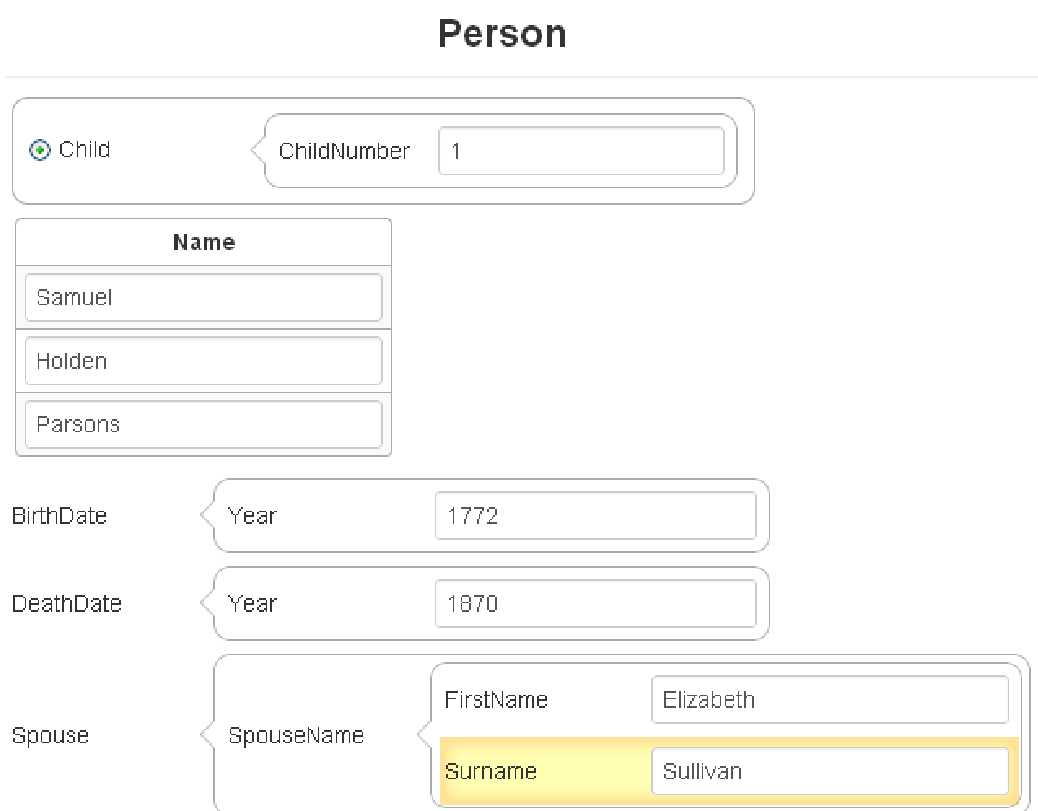 Figure: The user-facing form that defines the target ontology.
2. Adaptive HMM Induction (The Robust Workhorse)
While Regex is precise, it's brittle. If the OCR is too messy, the HMM takes over. It models the list as a sequence of hidden states (e.g., Name -> BirthDate). ListReader uses Dirichlet priors and parameter tying to ensure the model doesn't overfit to the first record it sees.
3. Active Learning: Identifying the "Unknown"
When the system encounters a piece of text it can't explain—like an extra death date that wasn't in the first record—it doesn't guess. It flags it as "Unknown" and asks the user: "What is this?" Once the user labels it, the system updates its ontology and learned grammar instantly.
Experiments: Performance vs. Effort
The researchers tested ListReader against the industry-standard Conditional Random Field (CRF).
| Method | F1-Measure | Label Efficiency |
|---|---|---|
| ListReader Ensemble | 94% | 82 |
| CRF (Best Case) | 92% | 67 |
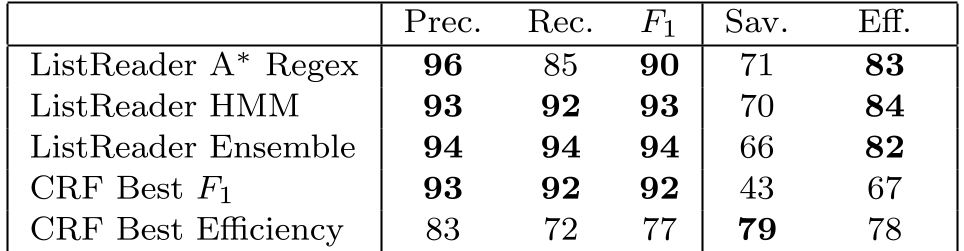 Table: Comparison of ListReader vs. CRF. Note the massive gap in efficiency.
The results were clear: while a CRF can eventually reach high accuracy, it requires significantly more human-labeled data. ListReader achieves better results with 70% less manual work.
Critical Analysis & Conclusion
Takeaway
The study proves that for highly structured yet noisy domains (like lists), inductive bias (the assumption that the data is a repeating cycle of fields) is more powerful than raw statistical power. By establishing a direct mapping between a UI form, an ontology, and a grammar, ListReader creates a seamless pipeline from human intuition to machine data.
Limitations & Future Work
The current version struggles with "factored out" data (e.g., a surname listed once at the top for all children). The authors suggest future work will involve self-supervised learning, where the system uses its knowledge from one book to automatically "guess" the structure of a completely new, similar book without any human clicks at all.
In the era of LLMs, the ListReader approach remains relevant for its interpretability and low compute cost—it's a scalpel where a Transformer might be a sledgehammer.