
CBCR: Balancing the Load in Spatial Crowdsourcing Coverage
Cost-Efficient Heterogeneous Worker Recruitment under Coverage Requirement in Spatial Crowdsourcing
This paper introduces the Coverage and Balanced Crowdsourcing Recruiting (CBCR) problem in spatial crowdsourcing, aiming to ensure full coverage of task locations while minimizing the maximum workload cost. The authors propose a mix of Dynamic Programming and PTAS for 1-D scenarios and Randomized Rounding for 2-D scenarios, achieving state-of-the-art performance in balancing heterogeneous worker costs.
TL;DR
Spatial crowdsourcing is the backbone of modern apps like Waze and Uber, but most algorithms focus on "how many tasks can we finish" rather than "how do we ensure every spot is covered without burning out the resources." This paper introduces the Coverage and Balanced Crowdsourcing Recruiting (CBCR) problem. It moves the needle from simple cost-minimization to Min-Max workload balancing, ensuring total geographic coverage while preventing any single location from becoming a bottleneck.
The "Missing Data" and "Resource Burnout" Problem
Traditional crowdsourcing models often assume that as long as the total cost is low, the system is efficient. However, the authors identify two critical flaws in this logic:
- The Coverage Gap: In traffic monitoring or climate forecasting, a "sparse" sample isn't enough. Missing data from a single critical intersection can lead to failed route optimization.
- Workload Imbalance: In many scenarios, data collection costs energy (battery) or money. If a specific "hotspot" location is visited and taxed by too many recruited workers, the local sensing infrastructure might die early, or the platform might overspend on redundant data.
The challenge lies in the heterogeneity: every worker has a unique trajectory and a unique cost for different locations.
Methodology: From 1-D Simplicity to 2-D Complexity
1. The 1-D Scenario (Highways & Linear Corridors)
In 1-D, the problem is more manageable because worker trajectories overlap in a predictable, contiguous way.
- Directional Coverage: The authors propose covering locations from one side to the other. This prevents "cost accumulation" where a location is accidentally covered by a dozen workers because they all happen to pass through it.
- Dynamic Programming (DP): By proving a sub-optimal structure exists, they developed a DP approach that finds the mathematically optimal set of workers to minimize the maximum cost.
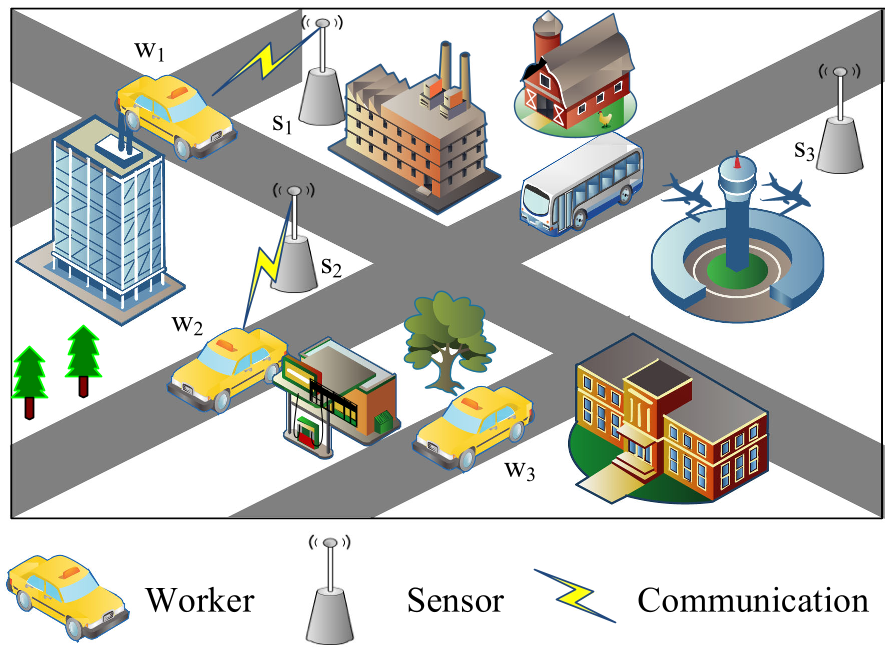
2. The 2-D Scenario (Urban Grids)
In a city grid, the contiguous overlap property disappears. Trajectories can intersect and diverge in complex patterns, making the problem NP-hard.
- Sub-modular Property: The authors prove that the objective function is sub-modular, which allows them to define performance bounds for even simple greedy algorithms.
- Randomized Rounding: To tackle the complexity, they relax the integer problem into a Linear Program (LP). After solving the LP for "fractional worker assignments," they use a randomized rounding strategy to pick the actual workers. This ensures that every location is covered with a high probability while keeping the maximum cost within an bound.
Experimental Validation
The researchers tested their algorithms against three real-world datasets: EPFL (San Francisco Taxis), Seattle Buses, and Rome Taxis.
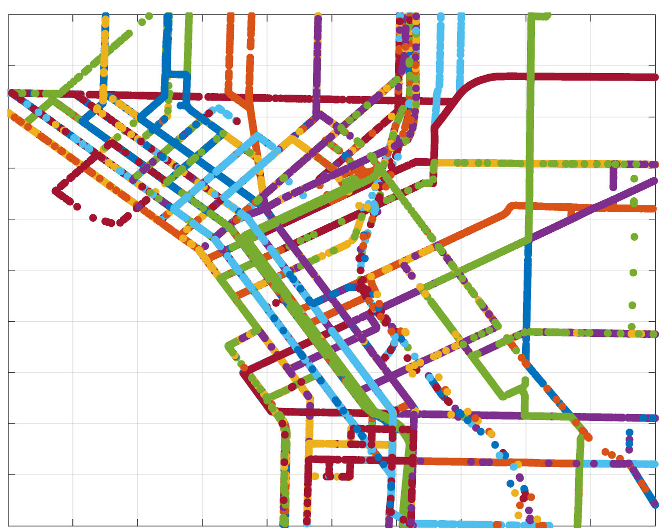
Key Findings:
- DP and PTAS (1-D): The DP algorithm consistently outperformed the standard Min-Max Greedy (MG) approach, especially as the number of locations increased.
- Randomized Rounding (2-D): In complex urban environments, the RD algorithm provided a much smoother workload distribution, reducing the "peak" cost at locations by up to 30% compared to greedy benchmarks.
- Cost Distribution: The algorithms proved resilient even when worker costs followed an exponential distribution (where high-cost "luxury" workers are outliers).
Critical Insight & Future Outlook
The genius of this paper is the shift from "Global Utility" to "Local Resilience." By focusing on the maximum cost at any location, the authors ensure the longevity of spatial sensing systems.
Limitations: Currently, the model assumes trajectories are fixed. In the real world, workers can detour. Future Work: The authors suggest moving toward a "detour-aware" model (like UberPool), where workers might deviate slightly from their path for a higher reward, further complicating the balancing act.
Overall, this work provides a rigorous mathematical foundation for the next generation of balanced, reliable Smart City infrastructure.