
ROI-Driven Influence: Beyond Fixed Budgets and Single-Product Echo Chambers
Cost-Efficient Influence Maximization in Online Social Networks
The paper introduces SmoothGreedyURM, a cost-efficient influence maximization framework for Online Social Networks (OSNs) focusing on maximizing the profit/cost ratio. It is the first to incorporate the impacts of coexisting products and user interaction frequency into a non-monotone submodular maximization problem.
TL;DR
Most viral marketing research asks: "How many people can we reach with $X budget?" This paper flips the script by asking: "How do we maximize the bang-for-buck (Profit/Cost ratio) while accounting for the products users already use?" By introducing an interaction-based influence model and a smooth greedy algorithm, the authors provide a pathway to cost-efficient marketing in crowded digital ecosystems.
The "Budget Paradox" and The Coexistence Reality
In classic Influence Maximization (IM), we assume a budget is known. However, in the real world, determining without prior market knowledge is a shot in the dark. Furthermore, users aren't blank slates; their willingness to adopt a new fitness app is heavily influenced by whether they already use a competitor's app (negative impact) or own a smartwatch (positive impact).
Existing SOTA methods often fail here because:
- Static Topology: They look at "friendship" links rather than "interaction" frequency.
- Monotonicity Bias: They assume adding more seeds always increases value, whereas in a ratio-based approach, a high-cost seed can actually tank your ROI.
Methodology: The Interaction-Aware Ratio
The authors propose a general influence measurement that combines social intimacy with product affinity:

- Part 1: Captures the normalized interaction weight (how often talks to ).
- Part 2: Sums the "willingness" parameters of existing products owned by user .
The SmoothGreedyURM Algorithm
Since the objective function (Profit/Cost) is non-monotone (adding a seed can decrease the ratio), standard hill-climbing fails. The authors utilize a Smooth Greedy approach:
- Initialize a seed set and a full set .
- Iteratively narrow the gap between and by adding or removing nodes based on a probability calculated from the marginal gain.
- This "smoothness" prevents the algorithm from getting stuck in local optima that deterministic greedy approaches might hit in fractional objective spaces.
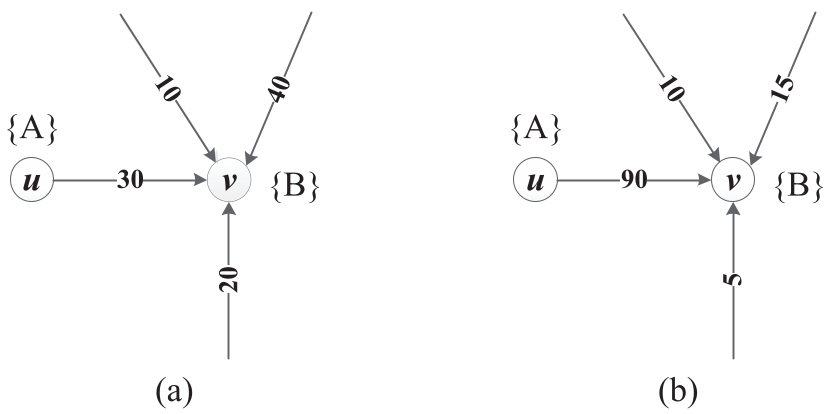 Figure 1: Comparison of influence when existing products have positive (a) vs. negative (b) effects on the new product A.
Experimental Insights: Why Context Matters
The experiments on Facebook and Weibo datasets revealed a "threshold effect." As the number of related products in the network increases, the potential for high-ratio seeding grows—but only up to a point. Once about 20% of the network is "primed" with related products, the ratio gains stabilize.
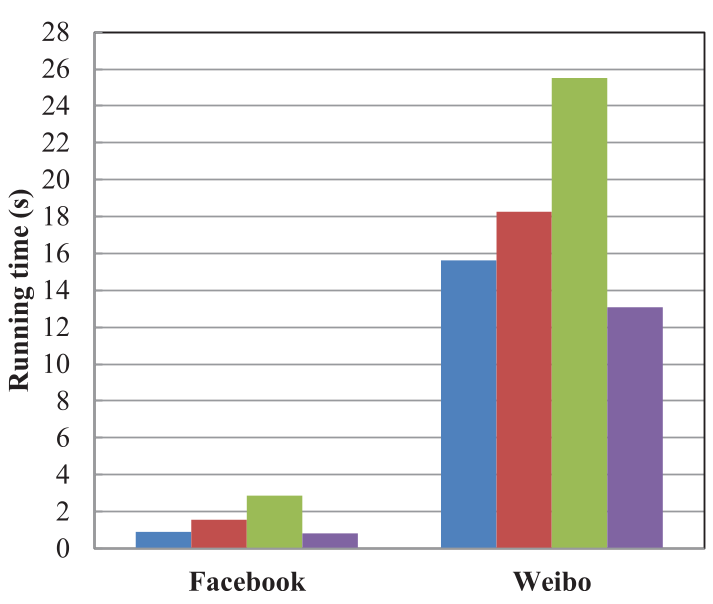 Figure 2: Ratio performance. Notice how IMM (a SOTA for reach) underperforms in ROI because it ignores the high cost of high-influence seeds.
Key Results:
- ROI Superiority: SmoothGreedyURM outperformed PMIA and CELF in maintaining a stable, high profit/cost ratio.
- Cost Sensitivity: Unlike IMM, which chases "celebrity" nodes at any cost, the proposed method finds "high-value" niche influencers whose cost-to-influence ratio is optimal.
- Efficiency: The total time complexity is , making it feasible for large-scale OSNs.
Critical Perspective & Takeaways
The brilliance of this work lies in its pragmatism. Moving from "Influence Maximization" to "Influence Efficiency" aligns AI research with actual business objectives.
Limitations: The model assumes we know the interactions () and existing products (). In privacy-conscious environments, this data is harder to aggregate. Future Work: Integrating this ratio-maximization with Reinforcement Learning could allow for dynamic seed selection where we "learn" the product affinity on the fly.
In conclusion, the era of "burning cash for reach" is ending. Algorithms like SmoothGreedyURM prove that context-aware, ratio-driven targeting is the future of viral markets.