
Balancing the Cost of Truth: Optimized Hybrid Strategies for Rumor Control in MSNs
Cost-Efficient Strategies for Restraining Rumor Spreading in Mobile Social Networks
This paper proposes a heterogeneous-network-based epidemic model to restrain rumor spreading in Mobile Social Networks (MSNs) by jointly optimized "immunization" (blocking rumors at influential users) and "cure" (spreading truth). The authors develop two novel strategies: Real-Time Optimization (RTO) for continuous control and Pulse Spreading Truth and Continuous Blocking (PSCB) for periodic intervention, aiming to achieve rumor extinction with minimal social and network costs.
TL;DR
In the era of rapid disinformation, simply "blocking" users or "spreading truth" is either too expensive or too slow. This paper introduces a sophisticated mathematical framework to combine these two methods. By treating rumor spreading as a heterogeneous epidemic, the authors provide two strategies: RTO (for immediate, cost-optimized continuous suppression) and PSCB (for resource-efficient periodic intervention).
The Core Motivation: Why "Full-Scale Warfare" on Rumors Fails
Most rumor-control models assume an infinite budget and zero social friction. In reality:
- Blocking (Immunization) can violate human rights and requires tedious persuasion or document support.
- Spreading Truth (Cure) consumes valuable network channels and media cooperation.
The authors argue that prior work ignores these costs. They suggest that the real challenge isn't just stopping the rumor, but stopping it cheaply and within a specific timeframe.
Methodology: The SIDR Model and Control Theory
The researchers divided users into groups based on their social "degree" (connectivity), acknowledging that a user with 1,000 followers spreads rumors differently than one with 10.
1. The Real-Time Optimization (RTO) Strategy
For scenarios where resources are sufficient but time is of the essence, the authors use Pontryagin’s Maximum Principle. This allows them to calculate the "Hamiltonian" of the system—essentially a roadmap for the optimal intensity of intervention at any given second .
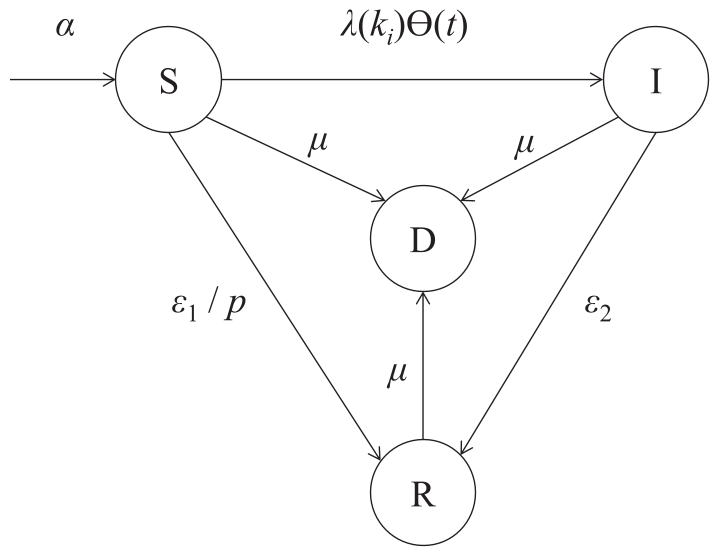 Fig 1: The transition flow between Susceptible (S), Infected (I), Recovered (R), and Dead (D) states.
2. The Pulse Strategy (PSCB)
What if you can't run clarify campaigns 24/7? The PSCB strategy uses "Pulse" spread. It calculates the Maximum Immunization Period (). As long as you broadcast the truth at intervals shorter than , the rumor is mathematically guaranteed to die out eventually.
Experimental Insights from Digg2009
Using real-world data from Digg, the authors proved that their threshold accurately predicts whether a rumor will explode or fade.
Key Finding: The Switch Over
One of the most profound insights from the RTO experiments is the timing of intervention. Early on, spreading truth should be the dominant force. As the deadline approaches, the strategy shifts toward intensive blocking to mop up the remaining infected nodes.
 Fig 2: Convergence of the system toward the zero-equilibrium (rumor extinction) under the optimized strategy.
Cost Efficiency
Compared to a "heuristic" strategy (reacting only to current infection levels), the RTO and PSCB strategies achieved the same reduction in rumors at a fraction of the cost. This is because the proposed models anticipate the network's natural decay and connectivity patterns.
Critical Analysis & Conclusion
This work moves rumor control from "theoretical modeling" to "operational logistics." It recognizes that intervention is an economic problem as much as a social one.
Limitations: The model assumes a static network topology during the spreading period. In many MSNs, "influencers" change rapidly, and news cycles may move faster than the Interest Decaying Rate () can account for.
Future Outlook: Integrating these cost-efficient strategies into automated social media moderation tools could help platforms contain "fake news" spikes without resorting to broad, expensive, and controversial censorship.