
CWRP: Optimizing the Quality-Cost Frontier in Spatial Crowdsourcing
Cost-Efficient Worker Trajectory Planning Optimization in Spatial Crowdsourcing Platforms
The paper introduces the Cost-Efficient Worker Recruitment Problem (CWRP) in spatial crowdsourcing, aiming to maximize the ratio of total collected data quality to worker trajectory costs under full task coverage constraints. The authors propose Dynamic Programming (DP) for 1-D topologies and a novel Minimum Spanning Tree (MST) based approximation algorithm for 2-D scenarios, achieving superior performance on real-world Uber mobility traces.
TL;DR
Spatial crowdsourcing platforms (like Uber or TaskRabbit) face a constant struggle: how to recruit workers to cover all tasks while keeping costs low and data quality high. This paper defines the Cost-Efficient Worker Recruitment Problem (CWRP), providing optimal Dynamic Programming solutions for 1-D paths and a Minimum Spanning Tree (MST) approximation for complex 2-D urban environments.
The Core Conflict: Quality vs. Cost
Most existing platforms use a "Nearest Assignment" (NA) logic—assigning a task to the closest available worker. While intuitive, this fails for two reasons:
- Heterogeneity: Not all workers are equal. Worker A might provide high-resolution data (high quality) but be slightly further away than Worker B (low quality).
- Trajectory Overlap: Multiple tasks might be efficiently covered by one worker in a single "tour" rather than multiple workers traveling shorter but redundant distances.
The authors argue that we should maximize the Overall Quality-Cost Ratio:
Methodology: From 1-D Lines to 2-D Manifolds
1. The 1-D Optimal Solution (DP)
In a linear environment (like a highway), the problem can be solved optimally. The authors propose a DP state representing the highest efficiency ratio for the first workers covering the first tasks. This captures the recursive nature of whether to recruit a new worker or extend an existing worker's route.
2. The 2-D Challenge (NP-Hardness)
In 2-D, the problem becomes a variation of the Traveling Salesman Problem (TSP). The authors prove that the standard "Nearest Assignment" can be as bad as of the optimal solution—meaning it doesn't scale as the number of workers () increases.
3. The MST-Based Breakthrough
To solve this, they construct a specialized graph:
- Dummy Node: Connects to all worker starting positions with weight 0.
- Minimum Spanning Forest: By running an MST and removing the dummy node, they naturally cluster tasks around the most "cost-effective" workers.
- Tour Construction: They then transform these trees into actual worker trajectories.
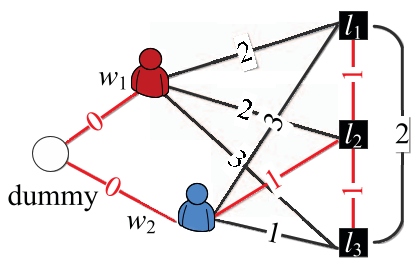 Figure: Comparison between Nearest Assignment (a) and the proposed MST/Optimal approach (b).
Experimental Proof: NYC Uber Traces
Using 4.5 million Uber pick-up records from New York City (Manhattan and Broadway), the authors validated their algorithms against real-world mobility patterns.
Key Findings:
- Scale Matters: When the number of tasks is large, the DP and MST methods significantly outperform greedy heuristics.
- Quality Wins: As the variance in worker quality increases, the "Maximum Quality" (MQ) and "Nearest" (NA) approaches fall behind because they lack the "global view" provided by the MST forest.
- Efficiency Gains: In 2-D scenarios, the MST-based ratio was often 3x higher than the baseline.
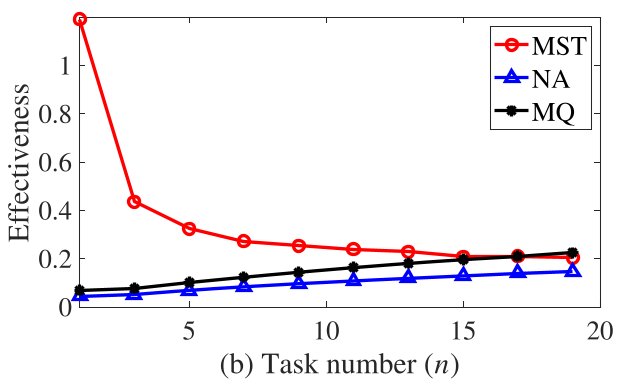 Figure: Performance in 1-D topology showing the dominance of DP as task density increases.
Critical Insight & Future Outlook
The brilliance of this work lies in the Dummy Node MST construction. It elegantly bridges the gap between pure clustering (Voronoi) and pure pathfinding (TSP).
However, two limitations remain for future work:
- Dynamic Re-planning: The current model is "offline." In a real Uber scenario, new tasks appear every second.
- Incentives: This paper assumes workers will follow the planned trajectory. Future models must incorporate Game Theory to ensure workers are incentivized to take these "optimal" paths.
In conclusion, the CWRP framework provides a mathematically grounded path for crowdsourcing platforms to transition from simple "proximity-based" matching to "value-optimized" logistics.