
Cost-Sensitive Learning: Solving the Imbalance in Cultural Behavior Modeling
Employing cost-sensitive learning in cultural modeling
This paper explores the application of cost-sensitive learning to Cultural Modeling, a field aimed at analyzing group behavior through computational methods. By evaluating four cost-sensitive techniques across six standard classifiers using MAROB datasets, the authors demonstrate significant reductions in misclassification costs under conditions of high class imbalance.
TL;DR
Cultural modeling often suffers from a "needle in a haystack" problem: the behaviors we care most about (e.g., specific group actions or conflicts) are rare, making standard machine learning models biased toward the majority. This paper demonstrates that by shifting the focus from accuracy to misclassification cost, we can reduce modeling errors by as much as 50%. Through a rigorous benchmark, the authors find that Oversampling combined with Naive Bayes or MLP provides the most reliable performance for these sparse, high-stakes datasets.
Problem & Motivation: The Failure of Accuracy
In the realm of social computing and cultural modeling, we use data (methods like CARA or CONVEX) to predict group decisions. However, these models often fall into a trap: they are "accurate" but useless.
If a group commits an act of violence only 5% of the time, a model that predicts "No Action" 100% of the time is 95% accurate. In cultural modeling, the Cost of a False Negative (failing to predict an action) is significantly higher than a False Positive. Standard classifiers suffer because:
- Class Imbalance: Positive instances are extremely rare.
- Uniform Cost Bias: They treat all errors as equal, which is factually incorrect in social risk assessment.
Methodology: Four Paths to Cost-Sensitivity
The authors analyze four primary ways to "force" a model to care more about the minority class:
- Oversampling: Replicating minority samples to balance the ratio.
- Undersampling: Removing majority samples (enhanced here with stacked generalization to prevent information loss).
- MetaCost: A "wrapper" method that relabels training data based on a cost-minimizing probability estimate.
- Threshold-moving: Adjusting the decision boundary post-hoc so the model requires less "certainty" to predict the expensive class.
(Note: Above figure represents the pairing of 4 methods with 6 classifiers: NB, SVM, ANN, kNN, DT, and RF)
Key Insights from the Experiments
The study utilized 15 datasets from the MAROB (Minorities at Risk Organizational Behavior) project, featuring organizations in the Middle East with positive class ratios as low as 7.7%.
1. Oversampling Wins the Information War
Contrary to some general ML literature, Oversampling outperformed Undersampling in this domain. Why? Because cultural datasets are already small (often <100 instances). Undersampling throws away precious data, whereas Oversampling preserves the limited environmental context available.
2. The Resilience of Naive Bayes (NB)
While Artificial Neural Networks (MLP) performed best on average, Naive Bayes was the champion for "Highly Imbalanced" data. In sparse environments, complex models like kNN struggle to form reliable neighborhoods, and SVMs (without probability calibration) fail at cost-sensitivity. The simplicity of NB acts as a powerful regularizer against the "rarity" problem.
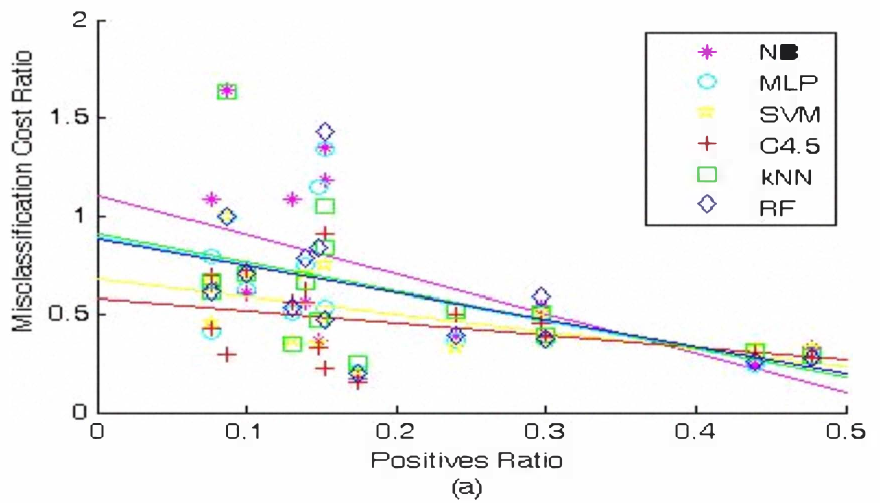 Figure: Average misclassification costs across all datasets, showing the clear advantage of cost-sensitive augmentation.
Critical Analysis & Conclusion
This work highlights a critical truth in social computing: Context is sparse, and errors are unequal.
Takeaways for Practitioners:
- Metric Shift: Move away from Accuracy/AUC and toward Expected Misclassification Cost.
- Method Selection: If your dataset is small and imbalanced, start with Oversampling + Naive Bayes.
- Limitations: The study notes that as imbalance becomes extreme, even cost-sensitive learning hits a wall—the "rarity" simply provides too little signal for the "cost" to overcome.
Future work in this area will likely move toward Synthetic Minority Over-sampling (SMOTE) or specialized deep generative models to create more nuanced cultural samples rather than simple replication.
Conclusion
By integrating cost factors directly into the learning process, we move cultural modeling from a theoretical exercise into a functional tool for social risk analysis, ensuring that the most critical "black swan" events are not ignored by the algorithms meant to find them.