
Neutralizing Sybils: The First Defense Against Active Attacks in Social Graphs
Counteracting Active Attacks in Social Network Graphs
This paper introduces the first anonymization method specifically designed to counteract active attacks in social network graphs. Leveraging the (k, δ)-anonymity framework, the authors propose a graph transformation technique called "v-transformation" that uses edge additions to eliminate 1-resolvable vertices, effectively preventing sybil-based re-identification.
TL;DR
While most researchers focus on masking social data against passive observers, an "Active Attacker" can break privacy by planting fake users (sybil nodes) to flag victims. This paper introduces the v-transformation, a theoretically sound method to "immunize" social graphs by strategic edge addition, making it impossible for attackers to uniquely identify targets via structural fingerprints.
Background: The Power of Active Attacks
In the world of social network privacy, not all adversaries are equal.
- Passive Attackers look at the released graph and try to match nodes with external knowledge (like degree or neighborhood structures).
- Active Attackers are more insidious. They insert their own nodes before the data is released, connecting them to victims to create a unique "metric representation" (a vector of distances).
Previous work showed that real-life social graphs are often (1,1)-anonymous, the lowest possible privacy level. This means a single sybil node is often enough to uniquely identify a user.
The Problem: The 1-Resolvable Vertex
The authors identify a core weakness: the existence of 1-resolvable vertices. If a node has a unique distance to another node , then can be identified by anyone knowing that distance. The authors demonstrate that these unique identifiers are usually located on the "eccentricity paths" of a graph (the longest shortest paths).
Methodology: The v-Transformation
To destroy these unique fingerprints, the paper proposes a specific graph transformation. The intuition is beautiful: cycles of odd order naturally create symmetry in distances.
The Core Mechanism
If a vertex is 1-resolvable by , the algorithm adds a single edge to form a cycle. This edge is chosen such that the paths to become redundant, making indistinguishable from at least one other node.
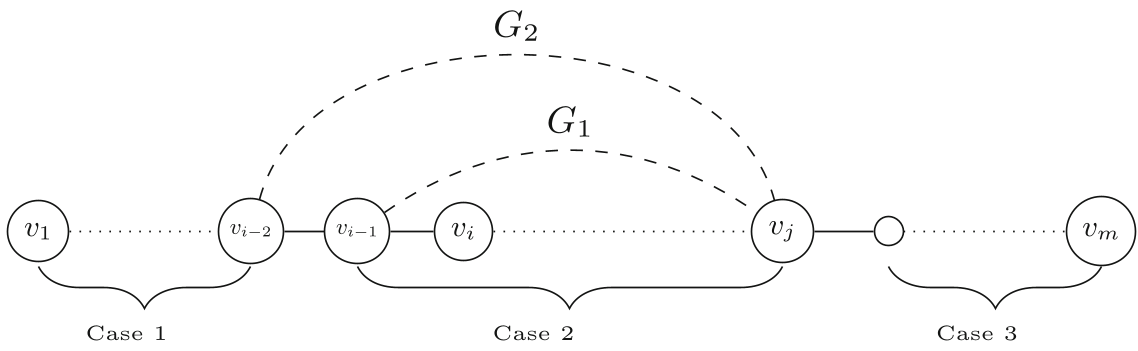 Figure: The v-transformation logic, showing how adding an edge creates cycles that mask previously unique metric representations.
Convergence and Utility
The authors prove a strict upper bound on how many edges are needed (linked to the graph's eccentricity). The process is iterative:
- Find a 1-resolvable vertex.
- Apply a v-transformation.
- Repeat until no 1-resolvable vertices remain.
Experiments & Results
The researchers tested their method against the Walk-Based Attack, a state-of-the-art re-identification strategy.
- Privacy Gains: Against an attacker with 1 sybil node, the v-transformation reduced the attack success probability to 0.
- Comparison: Compared to a "Random Approach" (adding edges randomly), the v-transformation achieved much higher privacy for the same cost in graph utility (number of edges added).
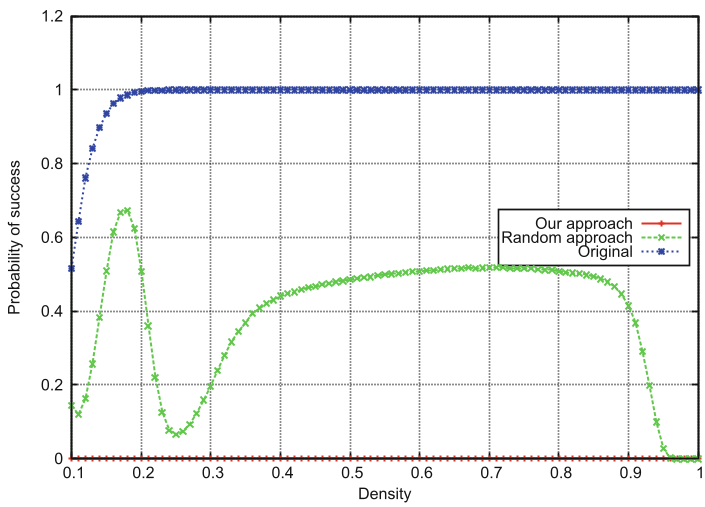 Figure: Average success probability of active attacks. The blue line (proposed method) consistently drops faster than the original or random baselines.
Academic Insight: Why This Matters
This paper is a significant milestone because it moves beyond the "passive" defense mindset. By identifying that (1,1)-anonymity is a structural property that can be "broken" with minimal graph perturbation, the authors provide a practical toolkit for data publishers.
Limitations: The algorithm's complexity of might be challenging for massive-scale networks (like the full Facebook graph), suggesting a need for localized or approximate v-transformations in future work.
Conclusion (Takeaway)
The battle for privacy in social graphs is an arms race. As attackers become more proactive, our sanitization methods must become more structural. The v-transformation provides a mathematically rigorous way to ensure that even if an attacker "plants" a sybil node, the graph's own geometry will hide the victim in the crowd.