
P2P Resilience in the Dark: Surviving Country-Scale Internet Partitions
Impact of country-scale Internet disconnection on structured and social P2P overlays
This paper investigates the resilience of P2P overlay networks (Chord, SPROUT, and a novel Social-aware overlay) against country-scale Internet disconnections. It demonstrates how leveraging social network topologies can maintain localized connectivity when a small fraction of the global network (approx. 1%) is partitioned.
TL;DR
When a government cuts the cord to the global Internet, traditional P2P systems like Chord fail instantly because their routing logic depends on global connectivity. This paper proposes a Social-aware unstructured overlay that leverages local social friendships and geographical routing to ensure that even if the world is cut off, you can still reach your local social circle.
Background: The "Kill Switch" Problem
Internet outages are no longer just accidental (natural disasters); they are increasingly political. The 2011 Egyptian shutdown proved that a country representing ~1% of global users can be effectively isolated. For decentralized systems, this is a "black swan" event. Most P2P systems are designed for churn (individual nodes leaving) but they crumble under correlated failures where a specific geographical subset of the graph vanishes.
Why Structured Overlays (Chord) Fail
Structured overlays like Chord use a Ring topology based on random IDs. To reach a node, you jump through "fingers" that skip across the ID space.
- Physical disconnect: In a 1% partition, 99% of your routing table points to "dead" nodes outside your country.
- Self-Healing Failure: Because the bootstrap nodes and the majority of the successor pointers are gone, the ring cannot close, and routability drops to near zero.
Methodology: The Social-Aware Alternative
The authors argue that we should build overlays based on Social Graphs rather than random IDs.
- Topology: Instead of a ring, they use a Social-aware overlay (an extension of SocialVPN). Links are established only between friends.
- Routing: Instead of DHT-based jumps, they use Geographical Routing. A message for Bob is passed to the friend who is physically closest to Bob’s last known coordinates.
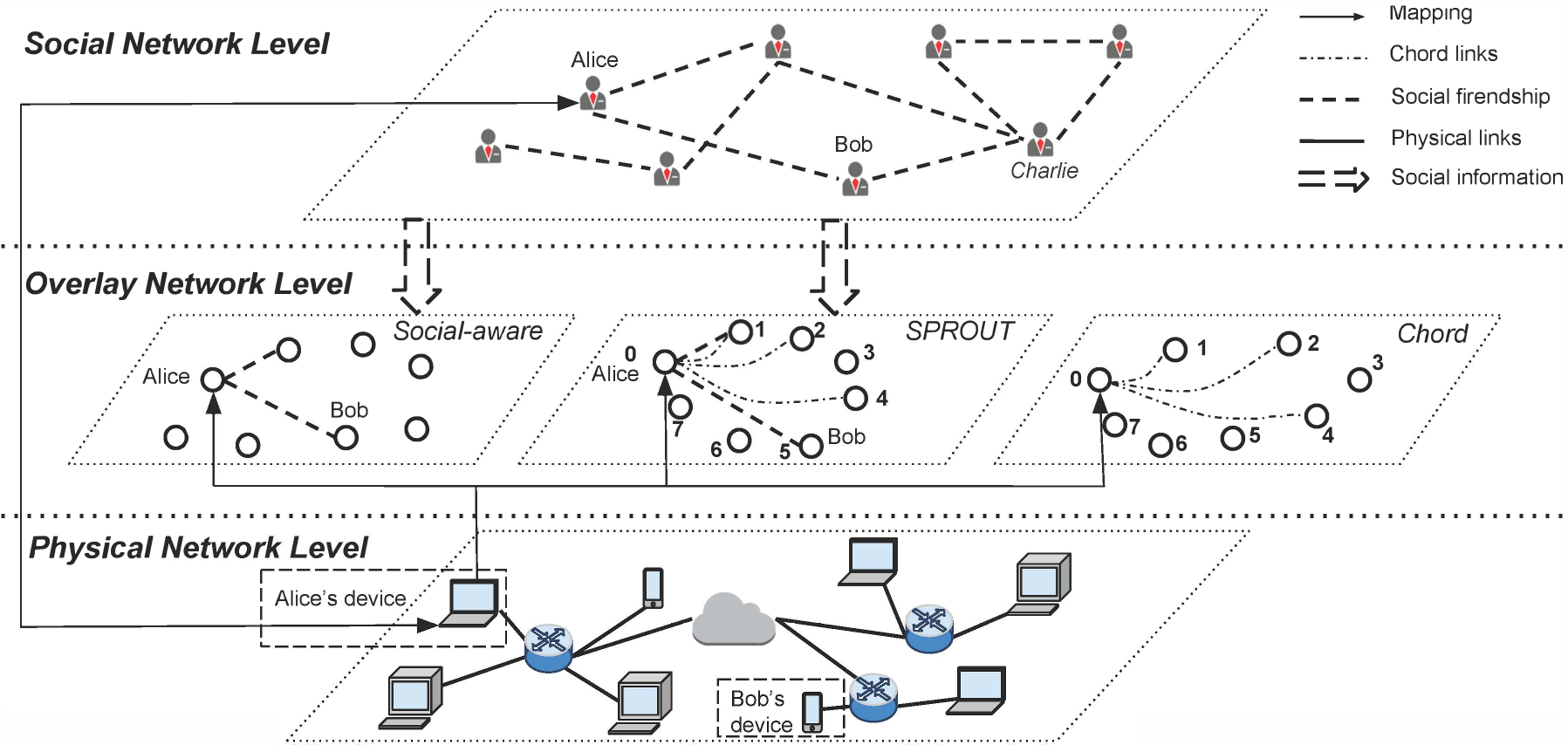 Fig 1: The mapping between Physical, Social, and Overlay layers.
The Comparison: Chord vs. SPROUT vs. Social-Aware
- Chord: Purely structured.
- SPROUT: Hybrid. Uses Chord rings but prioritizes social links for trust.
- Social-Aware: Purely unstructured social links.
Experimental Insights
Using a Foursquare dataset and synthetic models, the research measures two critical metrics:
- AP-TFP (Topological Probability): "Is there a path at all?"
- AP-RFP (Routing Probability): "Can the algorithm actually find that path?"
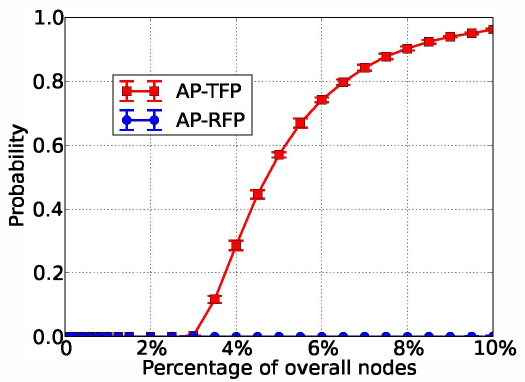 Fig 2: Chord connectivity (AP-TFP vs AP-RFP) plummeting to zero when the partition is small.
The results reveal a fascinating paradox: SPROUT has better topological connectivity (more links), but Social-aware has better routability.
Why? SPROUT still tries to be "Chordly-efficient." It attempts to route to nodes that would be the next logical hop in a global ring. Since those nodes are missing, the routing fails. The Social-aware model, by using geographical proximity, relies on the fact that friends of friends are often physically nearby, making the path much more likely to stay within the partitioned country.
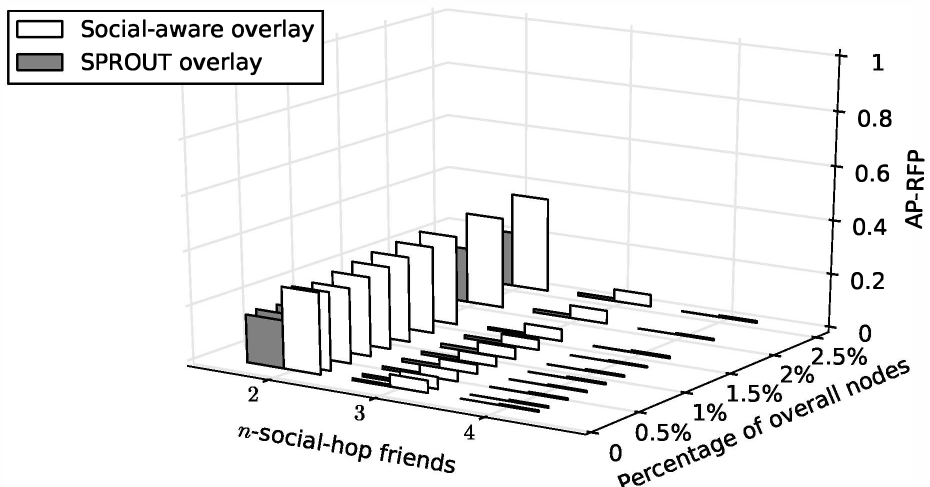 Fig 3: Social-aware routing outperforms SPROUT in partitioned scenarios.
Critical Analysis & Takeaways
The core insight is that structural "elegance" is the enemy of localized resilience.
- Resilience through Proximity: By aligning the overlay topology with the physical reality of human relationships (which are geographically clustered), the network becomes naturally "partition-tolerant."
- Limitations: The Social-aware model currently assumes users have one device and known locations. In a real-world scenario with high mobility and NAT/Firewall constraints, bootstrapping would still be a significant hurdle.
- Future Value: This work provides a blueprint for "Emergency Mode" in social applications. When the global backbone goes down, apps could automatically switch from DHT/Server-based modes to a localized social-mesh mode to keep communities connected.
Conclusion
This paper serves as a critical reminder for P2P architects: don't just optimize for the 99% of uptime; design for the 1% of total isolation. Social graphs aren't just for features; they are the ultimate redundancy for network survival.