
The Ripple Effect: How Coupled Social Networks Amplify Public Opinion
Study On Coupled Social Network Public Opinion Communication Based On Improved SEIR
This paper introduces an improved SEI2R epidemic model to simulate the cross-platform dissemination of public opinion between Weibo and WeChat within a double-layer coupled scale-free network. By establishing specific coupling rates and state transition rules, the study identifies how inter-layer transmission dynamics drive the scale and speed of public opinion fermentation.
TL;DR
In the era of ubiquitous social media, public opinion rarely stays confined to one platform. This paper proposes the SEI2R model, a sophisticated evolution of the classic epidemic model, to study how information jumps between Weibo (as a directed scale-free network) and WeChat (as an undirected BA network). The research reveals that the "coupling rate"—the density of users holding accounts on both platforms—is the primary driver of how fast and how far a rumor can spread.
Problem & Motivation: The Multi-Account Reality
Most traditional models treat public opinion as a single-stream process. However, modern netizens are often "multi-platform" creatures. A rumor might start on the open, directed environment of Weibo and then leak into the private, trust-based circles of WeChat.
The authors identified two major gaps in prior research:
- Platform Heterogeneity: Weibo rewards "followers" (one-way), while WeChat relies on "friends" (two-way).
- User Apathy: Not everyone who sees a post spreads it; many are "directly immune."
Methodology: The SEI2R Architecture
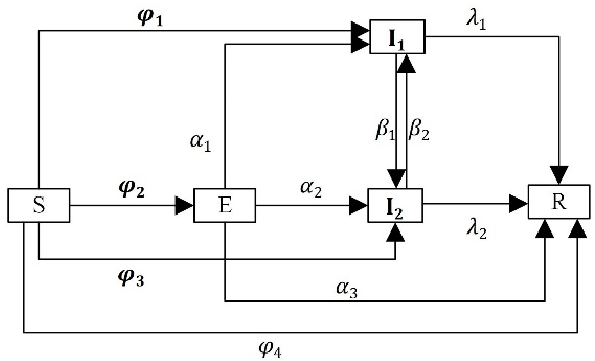
The core of this research is the transition from a simple SIR model to a SEI2R (Susceptible-Exposed-Infected1-Infected2-Removed) framework.
1. The Dual-Layer Network
The researchers built a complex carrier:
- Weibo Layer: A directed scale-free network where "V" users (opinion leaders) exert massive influence.
- WeChat Layer: An undirected BA (Barabási–Albert) network representing high-trust friend circles.
- Bridge Nodes: The glue connecting the layers, representing users with accounts on both.
2. The State Transitions
Unlike basic models, SEI2R accounts for the Exposed (E) state, where users "wait and see" before forwarding. It also distinguishes between propagating on WeChat (I1) and Weibo (I2).
Experiments & Results: The Power of Coupling
The researchers used MATLAB to simulate the spread across 10,000 nodes. Key findings include:
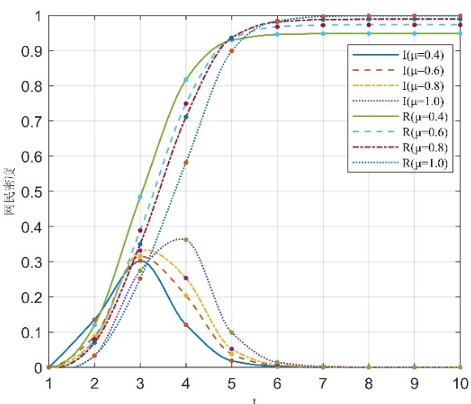
- Coupling Accelerates Fermentation: As shown in the simulation results, a higher coupling rate (more dual-account users) leads to a much faster decline in "Susceptible" nodes. Essentially, the cross-platform bridge acts as a shortcut that bypasses natural network bottlenecks.
- WeChat vs. Weibo: Interestingly, public opinion peaks faster in WeChat due to its undirected nature (easier bi-directional flow), but Weibo's "super communicators" (stars/media) can drive massive sudden spikes.
- The "Kill Switch": The "Direct Removed" rate (netizens who ignore the news) has a significant negative correlation with the peak of public opinion.
Critical Analysis & Conclusion
Takeaway
This paper provides a mathematical foundation for why "siloed" public opinion management fails. If a government or organization only monitors Weibo, they miss the "bridge effect" that carries information into private WeChat circles, where it might be harder to debunk.
Limitations & Future Work
The study assumes a static network, which doesn't account for users joining or leaving during a crisis. It also simplifies the "weight" of friendship—in reality, a message from a close friend on WeChat is much more influential than a post from a stranger on Weibo. Future research should look into dynamic weighting based on tie-strength.
Conclusion
By quantifying the "inter-layer transmission probability," the authors suggest that the best way to handle viral misinformation is not just to target the source, but to increase the difficulty of cross-platform "forwarding," effectively breaking the bridge that links these social digital continents.