
Weaponizing the Infodemic: A Deep Dive into COVID-19 Facebook Ads
Analyzing the Use of COVID-19 Ads on Facebook
This study presents a systematic analysis of COVID-19 related Facebook ads using a custom web crawler to bypass official API limitations. Focusing on the Brazilian landscape during the 2020 pandemic, the researchers characterized over 236k ads globally, revealing how sponsored content was weaponized for political agendas and the spread of medical misinformation.
TL;DR
As COVID-19 forced the world into isolation, digital platforms became the primary battleground for information. This research uncovers how Facebook ads were used not just for public health, but as a tool for political warfare and medical misinformation. By analyzing over 236k ads, the study highlights a disturbing trend: the "infodemic" is a paid endeavor, largely driven by political actors exploiting a lack of platform transparency.
Context: The Transparency Gap
The researchers argue that Facebook’s current transparency tools are insufficient. The FbAdLibrary only archives political ads for long-term study. If an advertiser promotes misinformation (like unverified cures) without labeling it as "political" or "social," the ad vanishes from the library once it becomes inactive. This "stealth" mechanism allows harmful content to go unaudited by the scientific community.
Methodology: Beyond the API
Because the official Facebook API is riddled with restrictions, the authors built a custom Web Crawler to perform daily keyword searches (e.g., "Coronavirus," "Chloroquine," "Pandemia").
The Global vs. Local Dataset
- CovidAdsWorld: 236k ads from 75 countries.
- CovidAdsBrasil: 858 specific ads that served as the primary case study for sentiment and political analysis.
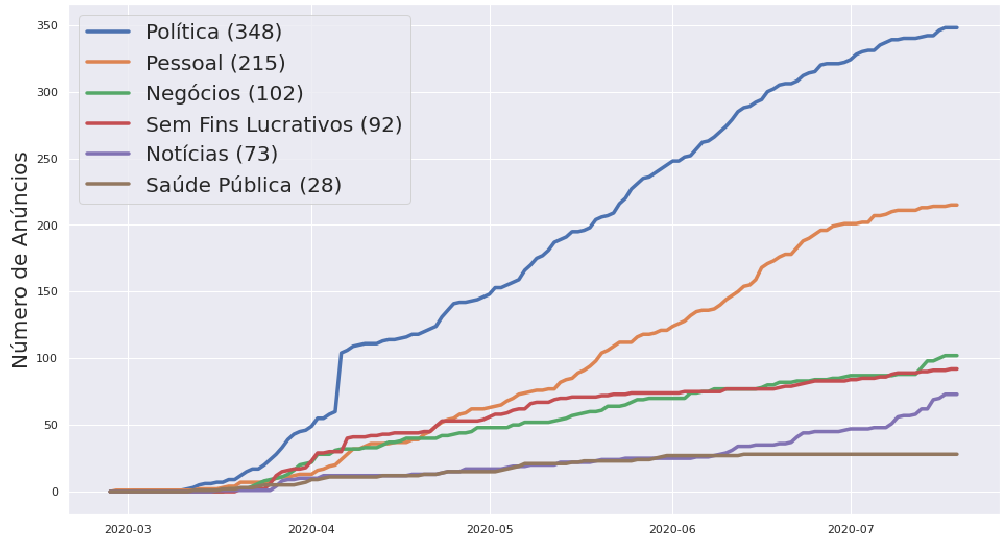 Figure 1: The growth of ads shows a massive spike in political content coinciding with government aid announcements.
Key Insights: Politics and Misinformation
1. The Political Dominance
In Brazil, 40.4% of all COVID-related ads came from political sources. Rather than focusing on hygiene or social distancing, these ads were often used to:
- Promote candidates for upcoming municipal elections.
- Criticize government responses using aggressive rhetoric.
- Claim credit for economic aid packages.
2. Emotional Manipulation
Using DepecheMood++, the authors categorized the emotional "flavor" of the ads.
- Fear: Heavily utilized by news outlets reporting death tolls.
- Inspiration: Used by non-profits for donation drives, but also by political actors to build a "we are in this together" brand image.
 Figure 2: Distribution of emotions across different advertiser categories.
3. Medical Misinformation as a Sponsored Product
The study documented several alarming instances of paid misinformation:
- Doctors prescribing Vitamin D or Hydroxychloroquine as a "shield" against the virus.
- Anti-lockdown groups sponsoring content to mobilize the public against health measures.
Experimental Results: Who Paid and Who Saw?
The financial data revealed that political parties like the PSDB and non-profits like Ação da Cidadania were top spenders. Interestingly, women were the primary recipients of ad reach in Brazil. The efficiency of these ads was remarkable; some political campaigns achieved 1,000 views (CPM) for as little as R$ 0.70, demonstrating how cheaply a narrative can be scaled.
 (a) An example of a political ad categorized during the study.
Critical Analysis & Conclusion
This paper serves as a wake-up call for independent auditing of social media platforms. The authors prove that the "infodemic" isn't just organic viral news—it is a subsidized phenomenon.
Takeaway: The reliance on self-declaration for political ads is a systemic flaw. Platforms must be held accountable for high-reach ads that promote medical pseudoscience, especially during global emergencies. Future research should look into the long-term shifts in public opinion caused by these specific 2020 ad waves.