
COVID-19 Ads as Political Weapon: How the Infodemic Was Monetized
COVID-19 ads as political weapon
This study investigates the weaponization of Facebook advertisements during the COVID-19 pandemic, focusing on a dataset of 391K ads across 90 countries. By concentrating on 5,033 Brazilian ads, the researchers identify how political actors leveraged a public health crisis to spread misinformation, launch attacks, and promote polarized agendas.
TL;DR
While the world grappled with a biological virus, digital platforms faced a parallel "infodemic." This research reveals that in Brazil, the COVID-19 pandemic was less a public health conversation and more a paid political battlefield. Using a dataset of over 391,000 global ads, researchers found that political actors spent exponentially more than health organizations to spread polarized narratives, medical "miracles" like Vitamin D treatments, and vitriolic attacks on opponents.
The Transparency Gap: Why This Research Matters
The core motivation for this study stems from a flaw in Facebook’s transparency architecture. While ads labeled as "political" are archived for seven years, regular ads—including those spreading medical misinformation—often vanish from the Facebook Ad Library (FbAdLibrary) the moment they become inactive. This "stealth" capability allows advertisers to inject misinformation into the public consciousness and disappear before auditors can flag them.
The researchers argue that this lack of independent auditing tools makes social media a "breeding ground" for digital scams and conspiracy theories under the guise of sponsored content.
Methodology: Auditing the Invisible
To overcome the limitations of the official Facebook API, the authors built a custom Web Crawler to scrape data across 90 countries. They focused their deep-dive on Brazil, a country characterized by extreme political polarization during the pandemic.
The Categorization Framework
The team mapped 274 disparate Facebook page categories into 6 logical sectors:
- Political (57.2% of the ads)
- Personal (18.4%)
- News (10.5%)
- Non-profit (5.7%)
- Business (5.1%)
- Public Health (Only 2.7%)
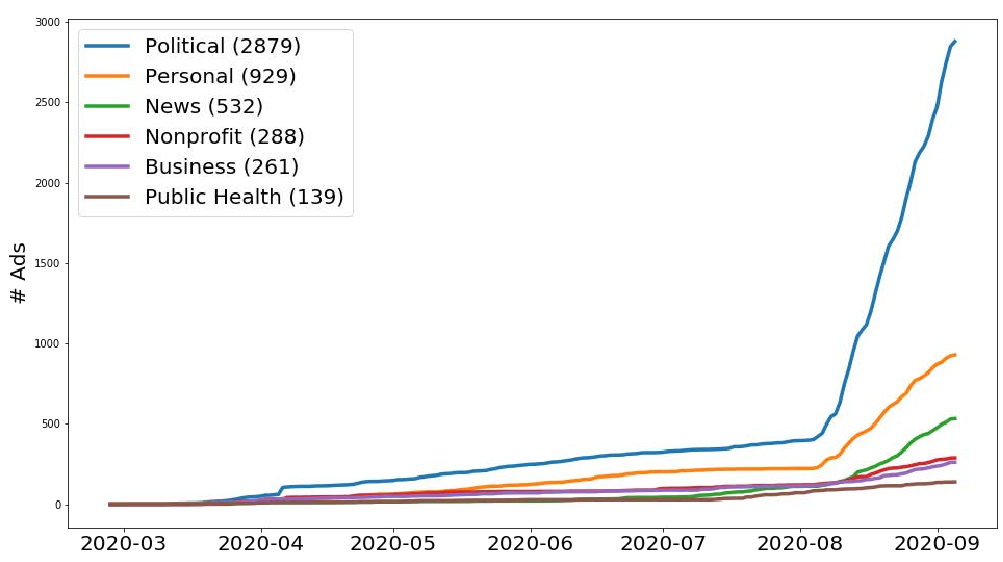 Figure 1: The surge in daily ads corresponds with political milestones, such as the distribution of emergency aid and the approach of local elections.
Key Insights: Politics Trumps Public Health
The disparity between political spending and public health outreach is staggering.
- Spending Power: Political entities spent roughly 41 times more (R 3.2k).
- Reach: Political ads garnered over 10 million impressions, dwarfing the 261k reach of actual health advice.
- Sentiment & Discourse: Using the DepecheMood++ lexicon, the study found that "Inspiration" (often in the form of religious or nationalistic appeals) and "Fear" were the dominant emotional hooks.
 Figure 2: Wordcloud analysis showing how different sectors framed the pandemic—Business focused on "Digital," while News and Politics focused on "Government" and "Bolsonaro."
The Toxicity of Sponsored Content
Perhaps the most alarming finding is the level of toxicity identified via the Perspective API. Unlike organic posts, which are subject to community moderation, these were paid messages.
| Category | Threat | Identity Attack | Insult |
|---|---|---|---|
| Political | 13.4% | 13.0% | 2.0% |
| Pub. Health | 0.3% | <0.1% | <0.1% |
Table: Percentage of ads with a toxicity score > 0.5.
Political ads weren't just about the virus; they were about "Identity Attacks" against black people, communists, or fascists, and "Threats" aimed at local mayors or the President. The pandemic was simply the backdrop for these pre-existing ideological wars.
Critical Analysis & Conclusion
This paper provides empirical evidence that the "Ad Library" is a faulty shield. The fact that medical misinformation (like Vitamin D or Hydroxychloroquine "cures") can be promoted through "Personal" or "Business" categories and then disappear from the archive reveals a massive regulatory loophole.
Takeaway: As we move toward future global crises, the "vaccine" for the infodemic is not just better fact-checking, but mandatory, permanent transparency for all sponsored content, regardless of whether it is self-labeled as "political."
Limitations: The study relies on automated translation (Google Cloud Translate) which may miss local Brazilian nuances or slang, though the high-level toxicity and frequency data remains robust.