
COVID-19 as a Catalyst: Redefining the Digital Nomad Lifecycle and High-Tech Work
COVID-19 as Opportunity to Test Digital Nomad Lifestyle
This study investigates the impact of the COVID-19 pandemic on the lifestyles and work practices of Digital Nomads (DNs). By synthesizing existing fragmented literature and analyzing Reddit community data, the authors propose a three-layered holistic conceptual framework and identify the pandemic as a catalyst for new "DN candidates" to test nomadic work models.
Executive Summary
TL;DR: This paper explores how the global pandemic acted as a "stress test" and an opportunity for the Digital Nomad (DN) lifestyle. By analyzing thousands of interactions on Reddit and synthesizing a new three-layered conceptual framework, the researchers identify that COVID-19 didn't just disrupt travel—it catalyzed a new wave of professionals moving toward location-independent careers while exposing the structural flaws of current gig economies.
Positioning: This work serves as an empirical bridge between classical CSCW (Computer-Supported Cooperative Work) nomadic theories and the post-pandemic "Future of Work" reality.
The Problem: A Fragmented Understanding of the Nomad
Before this study, "Digital Nomadism" was often treated as a lifestyle curiosity rather than a rigorous academic subject. Research was scattered: some focused on the technological infrastructure (how they connect), others on location-centered mobility, and some on the work-life balance.
The authors argue that we lack a "unified theory" of nomadism. Why does it matter? Because without a holistic view, we cannot design better tools for a workforce that is increasingly "gray-market," resistant to local taxation, and reliant on complex digital ecosystems.
Methodology: Building a Holistic Framework
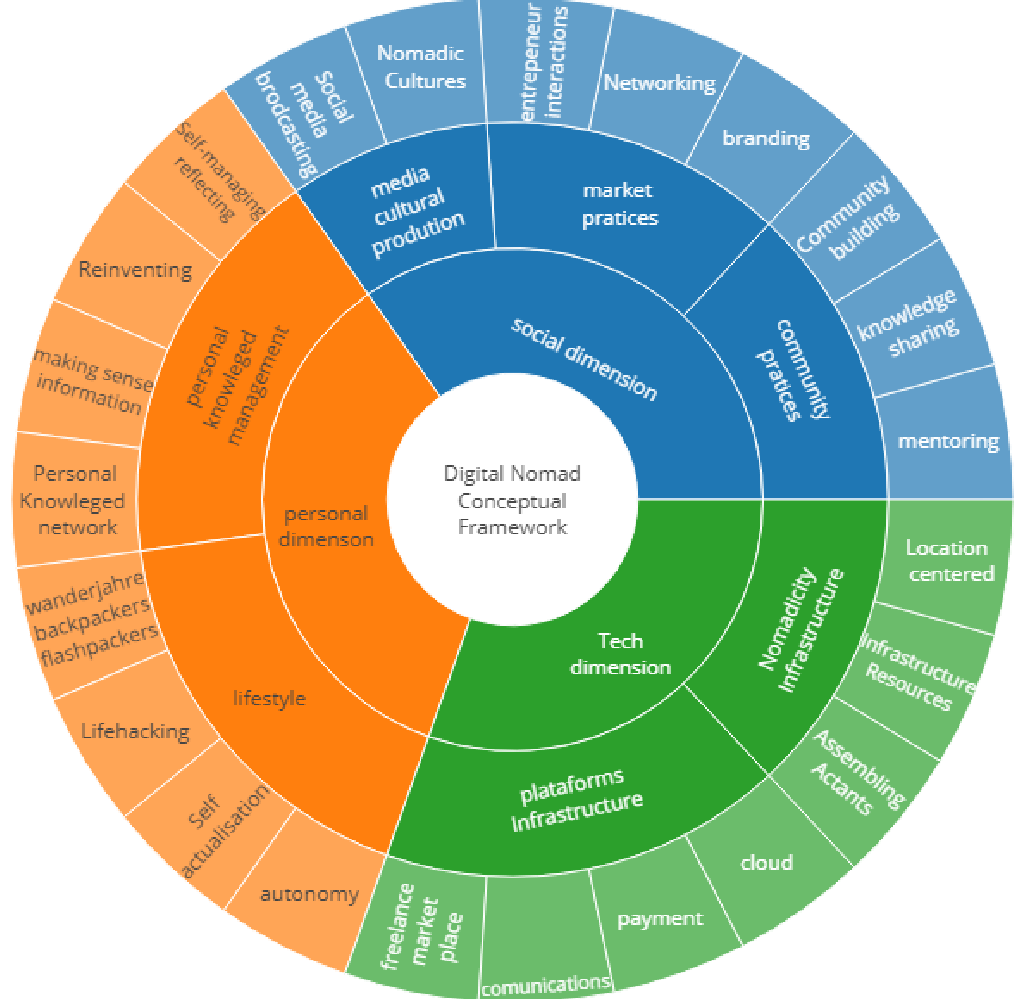
The researchers developed a Three-Layered Conceptual Framework to unify the field, using the Gioia methodology to maintain qualitative rigor.
The Three Dimensions:
- Personal: Focuses on self-actualization, autonomy, and the "lifestyle" of traveler tribes.
- Social: Explores market relations, digital content production, and socioeconomic resistance.
- Technological: Covers the IT platforms (Fiverr, Slack, etc.), payment systems, and physical infrastructures like coworking spaces.
Empirical Findings: The Pandemic as an "Opportunity"
Analyzing data from the r/digitalnomad subreddit (840,000+ members), the study identified five key 1st-order concepts that emerged during the pandemic:
- The "Road-Testers": Traditional office workers utilized "guaranteed remote" status to test nomadic setups (e.g., working during the day and hiking in the afternoon).
- Skill Investors: A surge in individuals using quarantine time to learn "nomad-friendly" skills like SEO or web development.
- Digital Exhaustion: A significant finding was the "overhead on online channels." Nomads, already tethered to screens for work, reported profound fatigue with video-conferencing as a social substitute, leading to social isolation.
- The "Service Arbitrage" Model: To survive in saturated markets, nomads are turning into "mini-agencies"—finding clients and subcontracting the work to other freelancers on platforms like Fiverr or Upwork.
Experiments & Results: The Crisis of Gig Platforms
The study highlights a growing tension in the Gig Economy.
| Issue | Insight from the Study |
|---|---|
| Entry Barriers | Platforms prioritize freelancers with "proven track records," making it nearly impossible for talented new entrants to break in. |
| Platform Isolation | Platforms try to lock users into their "walled gardens," while nomads prefer an open ecosystem (Slack + PayPal + Dropbox). |
| Middle-Man Paradox | While "Middle-men" (arbitrage) are criticized, they provide essential services in finding and closing deals, highlighting a gap in platform design. |
Critical Insight & Conclusion
The core contribution of this paper is the realization that nomadism is no longer a fringe subculture; it is a preview of the broader digital transformation.
Takeaway for Designers: Current remote work platforms are too restrictive. The future lies in transparent, fair business models and "Decentralized Autonomous Organizations" (DAOs) that use smart contracts to regulate work without the predatory "platform tax" or algorithmic bias of today's SOTA gig sites.
Limitations: The study relies heavily on Reddit data, which may skew toward a specific demographic. Future research involving broader surveys and direct interviews is necessary to validate these findings across more diverse populations.