
CP2: Reclaiming Privacy in Social Networks via Broadcast Encryption
CP2: Cryptographic privacy protection framework for online social networks q
The paper proposes CP2, a user-centric cryptographic framework for Online Social Networks (OSNs) that utilizes a modified Public-Key Broadcast Encryption (BE) scheme to ensure data confidentiality and relational privacy. It allows users to manage sharing with dynamic subsets of friends without trusting the OSN provider, achieving SOTA performance in communication and storage efficiency.
TL;DR
Current Online Social Networks (OSNs) like Facebook are essentially "digital panopticons" where providers own your data and your relationships. CP2 (Cryptographic Privacy Protection) is a breakthrough framework that uses advanced Broadcast Encryption (BE) to give users total control. It makes data invisible to the provider, hides who your friends are through pseudonyms, and performs remarkably faster than previous cryptographic attempts—reducing data access time from minutes to milliseconds.
The Motivation: The "Provider-Centric" Trap
Why is privacy so hard on social media? Because the system is rigged. OSN providers require you to surrender ownership of your content in exchange for service. Even when "Privacy Settings" exist, they are:
- Static: Hard to change memberships quickly.
- Transparent to the Provider: The company knows exactly who is in your "Family" or "Colleagues" list.
- Binary: Often failing to support complex logic (e.g., share with "All Friends" EXCEPT "Bob").
The authors of CP2 argue for a User-Centric shift. In their view, the OSN should be nothing more than a "dumb" encrypted storage bucket.
Methodology: The Core of CP2
The technical heart of CP2 is a modified Public-Key Broadcast Encryption (BE) system based on the work of Malek and Miri.
1. Personalized Domain
In CP2, every user is the "Root Authority" of their own cryptographic domain. Unlike previous systems that required a trusted setup, CP2 allows you to generate your own Master Public/Private keys locally.
2. Pseudonym-Based Relational Privacy
This is a standout feature. Most encrypted OSNs protect the content but leak the context (who you talk to). CP2 uses:
- Unique Indices: Friends are identified by random numbers, not names.
- Group Pseudonyms: Instead of a group named "Cancer Support Group," the OSN only sees "Group_X."
3. Dynamic Membership (The Versioning Trick)
Handling a "un-friending" event is traditionally expensive. CP2 uses a Version parameter. When someone is removed, the Version increments, and a new Group Key is generated. This ensures Forward Secrecy (the ex-friend can't see new posts) and Backward Secrecy (new friends can't see the embarrassing past).
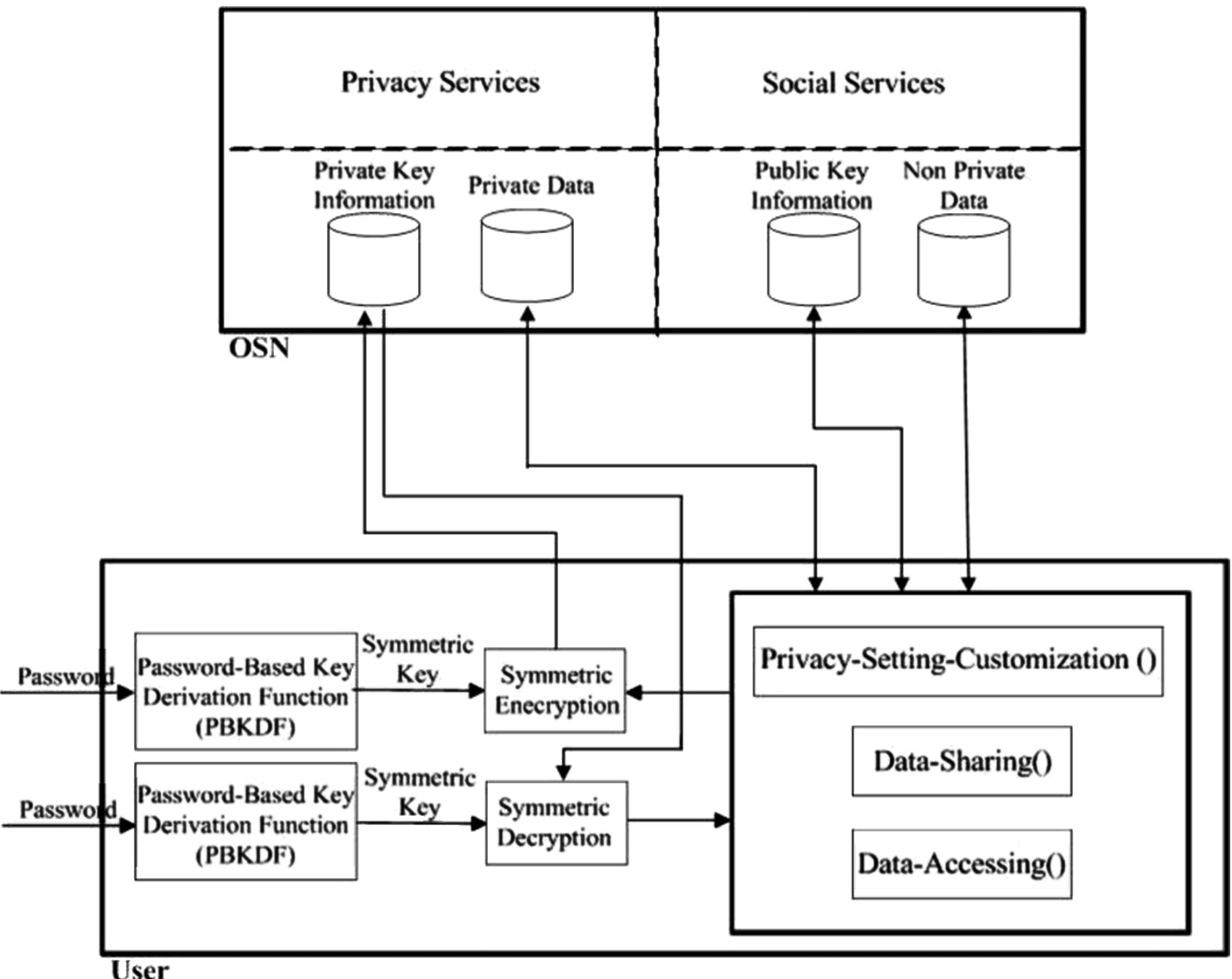 Figure 1: High-level overview of user interaction with the OSN provider and storage.
Experimental Results: Performance That Matters
Cryptography often comes with a "speed tax." CP2 proves this tax doesn't have to be high.
Communication Efficiency
While Attribute-Based Encryption (like EASiER) requires sending dozens of group elements for a single post, CP2 keeps the header size constant at just 2 group elements.
Speed Comparison
The most dramatic results are in Data Accessing. In the IBBE-based models that preceded CP2, decrypting a friend's post could take nearly 4 hours (14,096s) due to the complexity of bilinear pairings. CP2 achieves the same result in 0.8 seconds.
 Table 1: CP2 vs. EASiER and IBBE in terms of communication complexity.
Critical Analysis & Conclusion
The Takeaway: CP2 is a masterclass in applying heavy-duty cryptography (Bilinear Maps and BDHE assumptions) to a practical problem without breaking the user experience. By making the user the administrator of their own BE domain, it removes the "trusted middleman" entirely.
Limitations:
- Key Management: Users must manage their own passwords to "un-blind" their master keys. If the password is lost, the data is gone forever.
- Traffic Analysis: While the content and relations are hidden, the timing and size of encrypted packets could still potentially reveal user behavior to a sophisticated adversary.
Future Outlook: As we move toward Web3 and decentralized social platforms, the CP2 framework offers a verified mathematical path to ensure that "Social" doesn't have to mean "Public."