
CRATS: Deciphering the Hidden Logic of Geosocial Interactions
CRATS: An LDA-Based Model for Jointly Mining Latent Communities, Regions, Activities, Topics, and Sentiments from Geosocial Network Data
This paper introduces CRATS, a comprehensive LDA-based generative probabilistic model designed to jointly mine five interdependent latent variables—Communities, Regions, Activities, Topics, and Sentiments—from geosocial network data. By capturing the complex dependencies between social links, geographical mobility, and textual opinions, it achieves state-of-the-art performance in sentiment classification and venue recommendation.
TL;DR
Researchers have developed CRATS, the first LDA-based unified model that jointly mines Communities, Regions, Activities, Topics, and Sentiments. By treating these five facets as a deeply interconnected ecosystem rather than isolated data points, the model achieves a significant leap in sentiment analysis and venue recommendation accuracy across massive Yelp and Foursquare datasets.
The Problem: The Silo Effect in Geosocial Modeling
Most existing models for geosocial networks (like Yelp or Foursquare) suffer from "tunnel vision." Some focus on Social Topics (who you know affects what you say), while others focus on Geographical Topics (where you are affects what you talk about).
However, human behavior is fluid and integrated:
- Social Dependency: You visit venues recommended by your community.
- Activity Dependency: A venue's category (e.g., "Gym") dictates the activity ("Fitness"), which dictates the Topic ("Weights," "Trainers").
- Sentiment Nuance: The word "high" is positive for "Quality" but negative for "Price."
Previous SOTA methods failed to capture this full chain of causality, leading to "noisy" clusters and generic recommendations.
Methodology: The CRATS Unified Framework
The core innovation of CRATS is its probabilistic generative process. Instead of assuming these five variables are independent, the authors built a hierarchy of conditional probabilities.
1. The Five-Layer Dependency
- Communities (): Discovered via social links AND check-in patterns.
- Regions (): Modeled using Gaussian Distributions (Mean , Covariance ) to handle continuous GPS coordinates, ensuring spatial coherence.
- Activities (): Latent variables mapped from discrete venue categories.
- Topics (): Conditioned on the user’s community and current activity.
- Sentiments (): Conditioned specifically on the topic to capture aspect-based nuances.
2. Model Architecture
The model uses Collapsed Gibbs Sampling for posterior inference. While the math is complex, the physical intuition is simple: the model iteratively adjusts its "guess" for each latent variable until the global configuration most likely explains the observed data (the check-ins, social links, and review text).
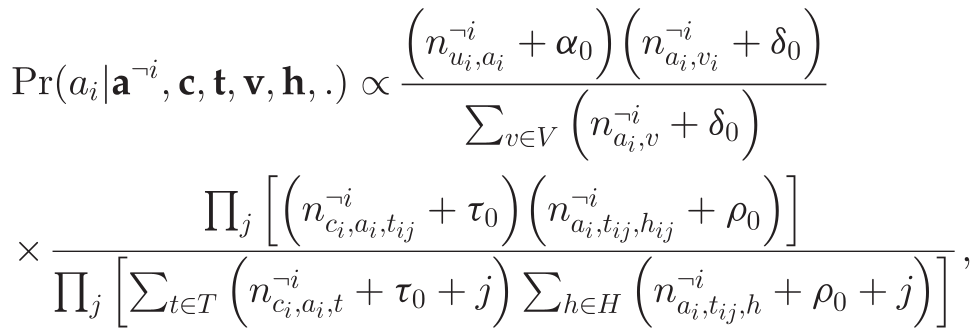 Fig 1: The mathematical formulation of the sampling probability for latent activities, showing the dependency on user preference, venue correlation, and topical relevance.
Experiments & Results: Proving the Joint Insight
The authors tested CRATS against 8 state-of-the-art competitors (including LDA, LCTA, and JST).
Key Metrics:
- Perplexity: CRATS achieved significantly lower perplexity (e.g., ~358 on Yelp vs. ~806 for baseline LDA), indicating a much better fit for the text data.
- Sentiment Precision: By knowing the activity and community, CRATS could more accurately classify "Neutral" and "Negative" reviews which typically trip up generic models.
- Venue Recommendation: By focusing on "Positive" sentiment clusters within a user's specific mobility region, CRATS hit higher Precision@K scores than models that ignored social or sentimental context.
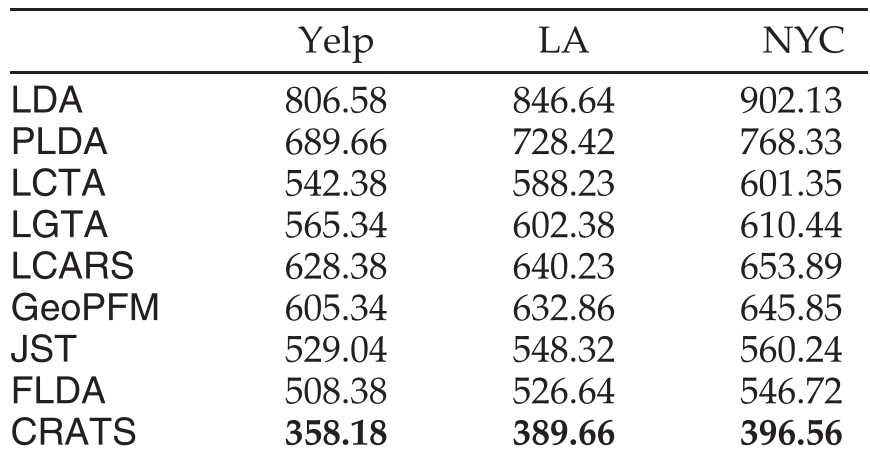 Table 1: Perplexity comparison highlights the superior predictive power of the joint modeling approach.
Deep Insights: Beyond the Numbers
One of the most revealing parts of the study is the Ablation-style analysis of community density. The authors found that CRATS discovered communities with higher Average Node Degree (AND) and Average Edge Weight (AEW) than previous models. This means CRATS isn't just grouping strangers who happen to like pizza; it's identifying real-world social "tribes" who interact and influence each other's geographical and categorical preferences.
Conclusion & Future Outlook
CRATS represents a milestone in "context-aware" AI. It proves that sentiment isn't just a text problem—it's a spatial and social problem.
Future Directions:
- Temporal Dynamics: Adding "Time" (e.g., morning vs. night check-ins) could further refine the "Activity" layer.
- Scalability: While linear in complexity, moving from Gibbs Sampling to Variational Inference could allow CRATS to run in real-time on streaming social data.
For developers and data scientists, the takeaway is clear: when modeling human behavior, the connections between features are often more informative than the features themselves.