
CRATS: Decoding the Multidimensional Pulse of Geosocial Networks
CRATS: An LDA-Based Model for Jointly Mining Latent Communities, Regions, Activities, Topics, and Sentiments from Geosocial Network Data
This paper introduces CRATS, an LDA-based generative probabilistic model designed to jointly mine five interdependent latent variables—Communities, Regions, Activities, Topics, and Sentiments—from geosocial network data. By capturing the rich interplay between social links, geographical coordinates, and textual comments, it achieves state-of-the-art performance in sentiment classification and venue recommendation.
TL;DR
Geosocial networks like Yelp and Foursquare are more than just check-ins; they are a complex tapestry of social ties, spatial movement, and personal opinions. CRATS (Communities, Regions, Activities, Topics, and Sentiments) is the first LDA-based model to weave these five threads into a single generative framework. By recognizing that who you know affects where you go and what you say, CRATS achieves a massive leap in recommendation accuracy and sentiment understanding.
The "Silo" Problem in Geosocial Modeling
Until now, researchers viewed your social life and your travel habits through separate lenses. Social-topic models looked at your friends; geographical-topic models looked at your GPS coordinates. But in reality, these are not independent. You likely visit a specific restaurant (Region) because your friend group (Community) loves brunch (Activity). When you complain that the "price is high" (Sentiment/Topic), that "high" means something very different than when you say the "quality is high."
Previous SOTA models failed because they couldn't see these cross-variable dependencies. They suffered from high perplexity (inability to predict new data) and struggled with the "cold start" problem for new venues.
Methodology: The Five-Way Joint Discovery
CRATS solves this by modeling the decision-making process as a unified hierarchy. Instead of discrete points, it utilizes:
- Community Dependency: Linking users not just by "follows" but by shared venue interests.
- Region Dependency: Using Gaussian distributions over latitudes and longitudes to represent geographic centers of gravity for users.
- Activity/Topic Coupling: Recognizing that "Topics" (what people talk about) are strictly driven by "Activities" (what people are doing).
- Contextual Sentiment: Mapping sentiments to specific topics to catch nuances in language.
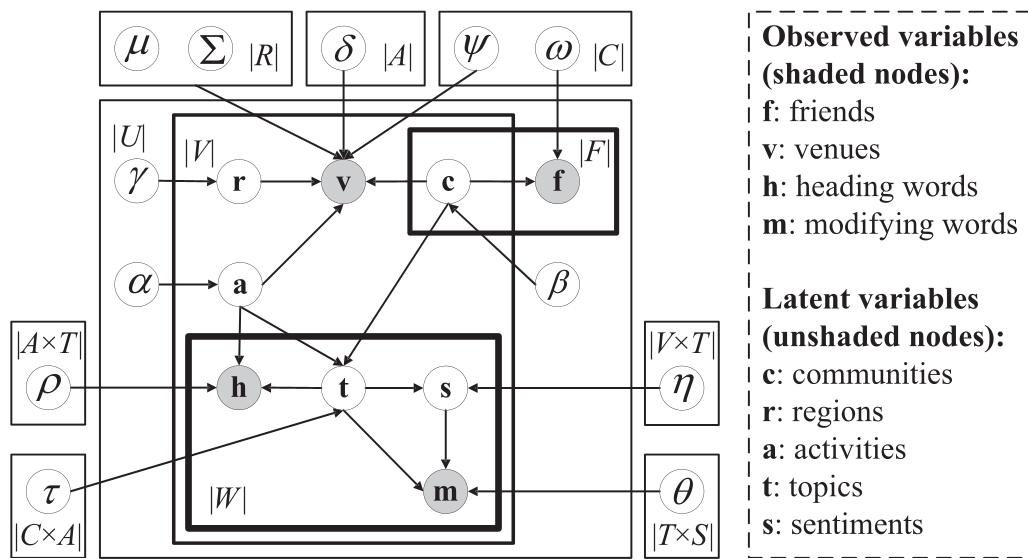 Figure 1: The Graphical Representation of CRATS, illustrating the dependencies between observed data (shaded) and latent variables.
The Math Behind the Magic
The authors utilize Collapsed Gibbs Sampling to estimate parameters. While the model is complex, the time complexity remains linear with respect to the size of social links and check-ins, making it scalable for city-scale datasets like NYC or LA.
Experimental Evidence: SOTA Performance
The model was put to the test against heavyweights like JST (Joint Sentiment Topic) and LCTA (Latent Community Topic Analysis).
- Generalization: CRATS achieved a Perplexity of 358.18 on Yelp data—a nearly 30% improvement over the nearest competitor, FLDA (508.38).
- Recommendation Precision: By understanding that users in the same community share common interests, CRATS significantly outperformed models that only looked at geography.
- Sentiment Accuracy: Because CRATS knows that "fresh" is a sentiment specific to "Fruit" and "cheap" is specific to "Price," its classification of user reviews is much more precise.
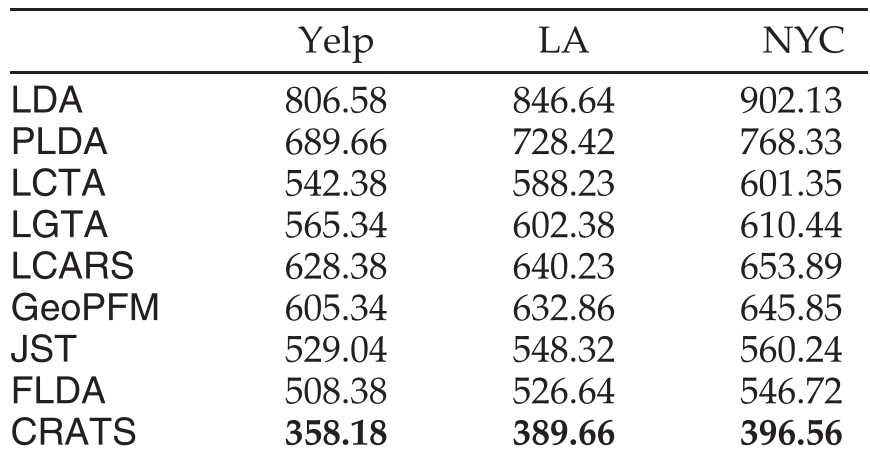 Table 1: Perplexity comparison across Yelp, LA, and NYC datasets.
Deep Insights: Beyond the Numbers
One of the most fascinating findings (shown in Figure 6 of the paper) is the Community Density. CRATS revealed that users assigned to the same latent community are actually linked in the social graph at a much higher rate (AND: 1.181) than previous models like LCTA (AND: 0.640). This proves that the latent variables found by CRATS aren't just mathematical abstractions—they reflect real-world social structures.
Additionally, the model's ability to map region centers in cities like Pittsburgh perfectly aligned with existing "Cultural Districts" and "University Areas," proving its spatial reasoning is sound.
Critical Analysis & Future Outlook
Limitations: While CRATS is a breakthrough, it is currently "time-blind." Human behavior changes from weekdays to weekends and across seasons. A user's "Activity" at 2 PM on a Tuesday is vastly different from 10 PM on a Saturday.
The Takeaway: CRATS demonstrates that in the world of Big Data, context is king. By jointly modeling the social, spatial, and textual dimensions, we move closer to AI that truly understands the "why" behind human mobility and opinion. The next frontier? Adding the temporal dimension to make these insights real-time.
Summary for Researchers: This work bridges the gap between spatial data mining and NLP sentiment analysis, offering a scalable Bayesian framework that handles the inherent sparsity of geosocial data.