
Navigating the Social Labyrinth: Efficiency and Bias in OSN Crawling
Crawling Online Social Graphs
This paper presents a systematic empirical study of crawling algorithms for Online Social Networks (OSNs) using large-scale real-world datasets from Flickr, LiveJournal, Orkut, and YouTube. It evaluates the impact of seed selection, node selection algorithms (BFS, Greedy, Lottery), and user privacy settings on crawling efficiency and graph metric bias.
TL;DR
Collecting data from Online Social Networks (OSNs) is a foundational step for social computing, yet the crawling process itself is a "black box" that can contaminate research results. This paper performs an in-depth autopsy of crawling factors—seeds, algorithms, and privacy—revealing that while discovering nodes is surprisingly fast due to small-world properties, obtaining an accurate statistical "snapshot" of the network is notoriously difficult.
The Motivation: Why Your Partial Dataset is Probably Biased
Most OSN research relies on partial datasets. However, obtaining these slices involves overcoming rate limits, AJAX-heavy pages, and "black hole" users who hide their profiles. The fundamental research question is: If we only see 10% of the network, how much is the mirror distorted?
Previous sampling literature often assumes we can pick a random node from a hat. In a live crawl, you can only see what is connected to your current frontier. This creates an inductive bias where high-degree nodes (hubs) are disproportionately discovered early, potentially skewing everything from average connectivity to community structure.
Methodology: The Anatomy of a Crawler
The authors compare four distinct node selection strategies across four diverse ecosystems (Flickr, LiveJournal, Orkut, YouTube):
- BFS (Breadth-First Search): The standard baseline; robust and simple.
- Greedy: Always picks the node in the "seen" queue that appears to have the highest degree.
- Lottery: A weighted random approach to balance exploration (new nodes) and exploitation (high-degree nodes).
- Hypothetical Greedy: A "god-mode" baseline where the crawler knows the true degree of a node before crawling it.
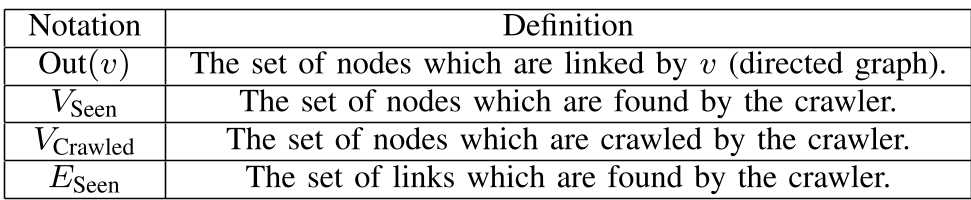 Above: The basic formalization of seen vs. crawled nodes/edges used in the study.
Key Insights from the Simulation
1. The Power of Small Hop Counts
The "Small World" effect is the crawler's best friend. In LiveJournal, crawling just 10% of nodes allowed the discovery of over 55% of the total population. This suggests that the "visible" horizon of an OSN is remarkably wide, even if the "accessible" content is restricted.
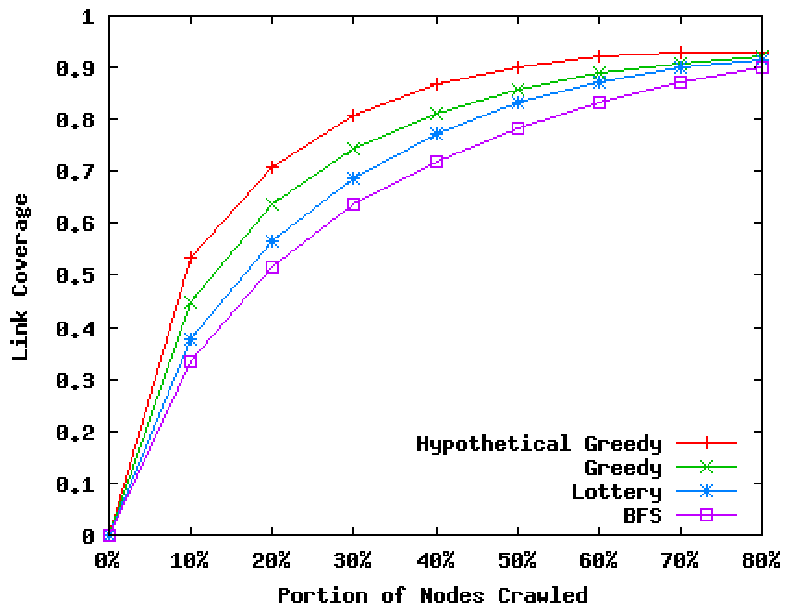 Fig 1: Discovery efficiency. Note how Link Coverage (LC) lags behind Node Coverage (NC), especially in sparse graphs.
2. High Resilience to Privacy Settings
One of the most surprising findings is the sensitivity to protected users. Even when 18% of YouTube users hid their profiles, the impact on overall node discovery was less than 7%. Social graphs are so densely interconnected that the crawler simply "routes around" private nodes to find the same information through different neighbors.
3. The Dangerous Bias of Graph Metrics
This is where the warning bells ring.
- Mean Degree: Estimates fluctuate wildly. In Orkut, a BFS crawl initially overestimates the mean degree because it finds "popular" nodes first, only stabilizing after a massive portion of the graph is indexed.
- Clustering Coefficient: Consistently underestimated. Because crawlers favor hubs, they often miss the "local" triangles of connections between low-degree nodes, leading to a distorted view of how tight-knit communities actually are.
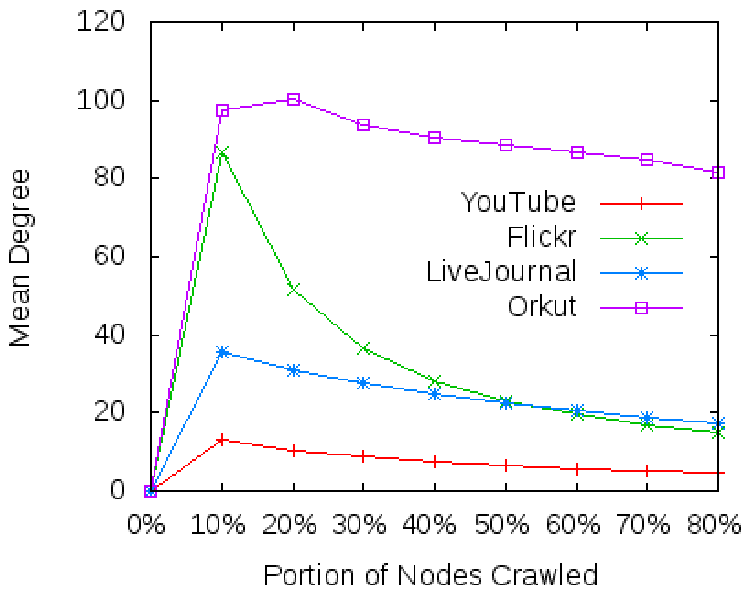 Fig 6: The volatile nature of Mean Degree estimation across different OSN topologies.
Critical Analysis & Conclusion
This paper serves as a vital reality check for social network scientists.
Strengths: The use of four distinct, large-scale real-world graphs provides a level of empirical "ground truth" that synthetic models (like Barabási-Albert) cannot replicate.
Limitations: The study focuses on topological properties. It does not account for temporal dynamics—how the crawl changes if the graph is growing while being crawled—nor does it explore the "cost" of crawling in terms of API overhead.
Takeaway: If you are conducting a parallel crawl, coordinate. Without it, you could waste 50% of your bandwidth re-visiting nodes. More importantly, if your research depends on "clustering" or "local density," be aware that your crawler is likely showing you a world that is less connected than it truly is.